
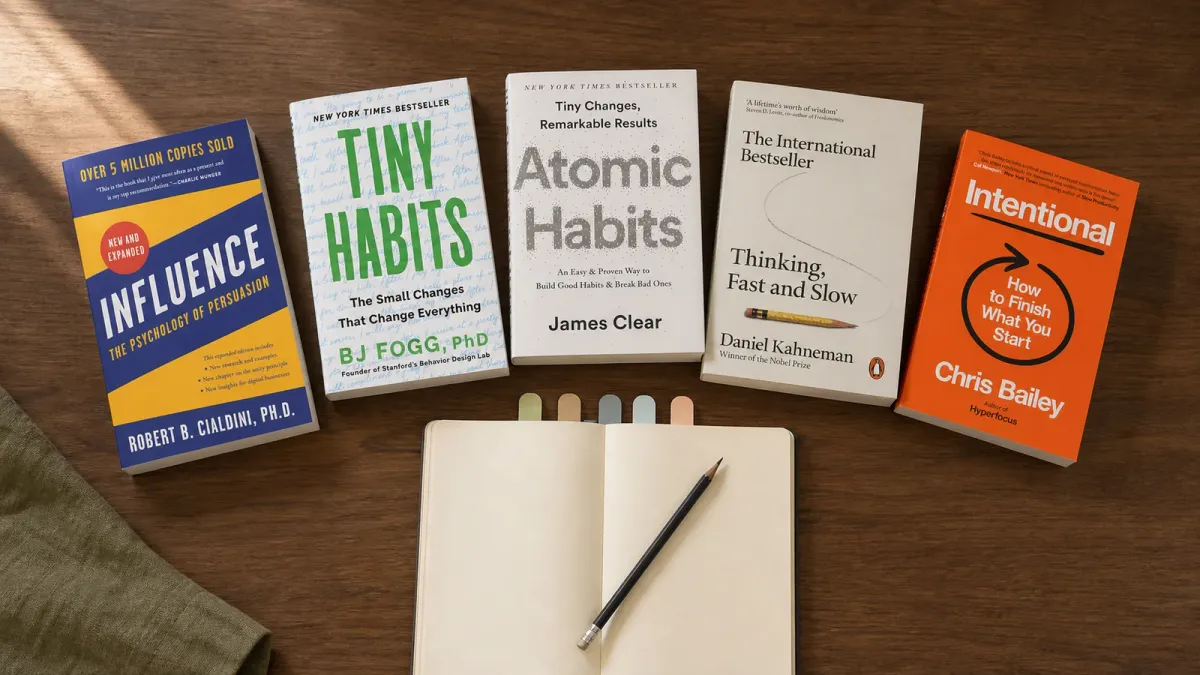
Most self-improvement books ask readers to want change more. The best ones explain the machinery underneath it: the social cues that shape a yes, the friction that kills a new routine, the shortcuts that bend a judgment and the gap between an intention and an action.
This five-book sequence is a compact education in that machinery. It begins with persuasion, moves through two complementary systems for building habits, examines the biases behind decisions and ends with a new 2026 guide to protecting attention. The selections are not an objective ranking; each earns its place by answering a different practical question.
The short take: Start with Influence if you negotiate or sell, Tiny Habits if starting feels hard, Atomic Habits if your environment keeps defeating you, Thinking, Fast and Slow if judgment is the problem, or Intentional if you are busy but not moving toward what matters.
1. Influence, New and Expanded — Robert Cialdini
Best for: Understanding why people say yes—and recognizing when someone is trying to steer you. Cialdini organizes persuasion around principles including reciprocity, social proof, authority, scarcity, consistency, liking and unity. The expanded edition adds newer research and emphasizes ethical use.
Why it matters: The ideas apply to sales pages, meetings, pricing, fundraising and everyday requests. Its most valuable lesson may be defensive: once you can name an influence tactic, you are less likely to mistake it for a neutral fact.
2. Tiny Habits — BJ Fogg
Best for: Anyone whose ambitious routine repeatedly collapses. Fogg’s method makes a desired behavior extremely small, attaches it to an existing anchor and uses immediate positive emotion to help it take root. His official book page describes the method as behavior design rather than a test of willpower.
Tradeoff: Readers looking for a dramatic overhaul may find the scale almost comically small. That is the point. Fogg is strongest on lowering the difficulty of the first repeatable action.
3. Atomic Habits — James Clear
Best for: Turning small behaviors into a durable system. Clear’s four-part framework asks readers to make good habits obvious, attractive, easy and satisfying, while reversing those conditions for unwanted habits.
Why it pairs with Fogg: Tiny Habits is especially sharp on starting and celebration; Atomic Habits adds memorable tools for identity, environment and tracking. Read both, but apply one method at a time so the frameworks do not become another form of procrastination.
4. Thinking, Fast and Slow — Daniel Kahneman
Best for: Seeing how intuition, framing, anchoring, loss aversion and overconfidence affect judgment. Kahneman’s tour of fast and slow thinking is denser than the habit books, but it supplies the vocabulary behind many modern discussions of behavioral economics.
Tradeoff: This is not a quick-fix manual, and knowing a bias does not make anyone immune to it. Read slowly, test the concepts against real decisions and resist using them only to diagnose other people.
5. Intentional — Chris Bailey
Best for: Converting values into action when attention is fragmented. Published on Jan. 6, 2026, Bailey’s newest book focuses on aligning daily behavior with what matters, without treating more effort or more productivity as the automatic answer.
Why it completes the list: Cialdini explains social influence, Fogg and Clear explain behavior design, and Kahneman explains judgment. Bailey brings those lessons back to the question readers eventually face: what deserves a place in the day?
How to choose your first book
Choose by bottleneck, not popularity. If other people’s requests and marketing shape too many decisions, begin with Cialdini. If you know what to do but cannot begin, choose Fogg. If you can begin but cannot sustain, choose Clear. If you make consequential decisions under uncertainty, choose Kahneman. If your calendar is full and your priorities are not, choose Bailey.
Then turn reading into an experiment: select one idea, define one behavior you can observe for seven days and record what changes. These books are most useful when they leave the shelf and enter a real decision.


