
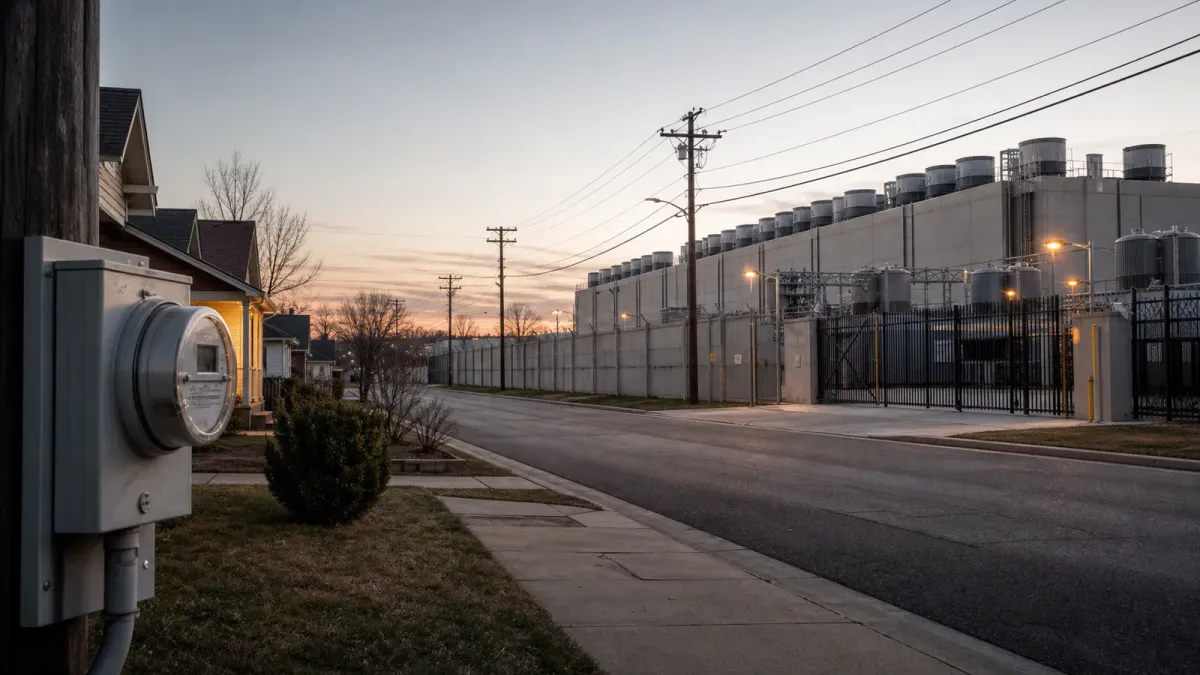
AI data centers are no longer just a story about servers, chips and cloud contracts. They are becoming a local bill fight, because the same buildings that make AI services possible can also reshape power planning, water use, zoning debates and election-year promises.
The newest signal is not that Americans have turned against technology itself. It is that many do not want the infrastructure placed near them without clearer answers on cost, noise, water and who pays for grid upgrades. Gallup found in a March 2026 survey that 71% of Americans opposed constructing an AI data center in their local area. A Fox News poll published July 27 put voter opposition at 70% versus 30% in favor.
Those numbers help explain why recent national coverage from CNN and Fox has treated data centers as a political and household-cost issue, not only as a Silicon Valley growth story. The practical question for residents is simple: before a local government approves a project, what exactly is the community being asked to absorb?
The short answer
Data centers are useful infrastructure, but the fight is shifting to local terms. Residents should look past the headline investment number and ask who pays for new substations, transmission upgrades, backup power, water systems, road work and long-term electricity demand if the project is delayed, downsized or cancelled.
The cost question matters because power demand is rising quickly. The U.S. Department of Energy said a Lawrence Berkeley National Laboratory report found data centers used about 4.4% of total U.S. electricity in 2023 and could reach about 6.7% to 12% by 2028. A June 2026 LBNL update estimated data centers could account for 9.5% to 15.3% of total U.S. electricity by 2030, depending on the scenario.
International Energy Agency analysis also points to the same pressure. Its base case projects global data-center electricity use nearly doubling by 2030, with the United States and China accounting for most of the growth. The IEA also notes that data centers are concentrated in specific places, which can make local grid integration harder than the national percentage suggests.
Why the politics changed
For years, a proposed data center could be sold as quiet industrial development: high investment, some jobs, more local tax revenue and little visible consumer friction. The AI boom changed the scale of the ask. Larger campuses can require major power capacity, cooling systems, backup generators, fiber routes and land-use approvals that put the project directly in front of residents.
That is why the debate now crosses party lines. In Gallup's survey, majorities of Democrats, Republicans and independents opposed nearby AI data-center construction. Fox's poll found a similar broad resistance, with many voters preferring a slower approach that addresses local concerns rather than rapid construction for global AI competition.
Supporters still have a real argument. Data centers can broaden a tax base, reuse industrial land, support construction work and keep digital services running. In some cases, a large customer can pay for dedicated infrastructure instead of spreading costs across households. The problem is that residents often do not see those commitments clearly enough before approval.
What communities should check first
The first check is the utility agreement. If new power lines, transformers or substations are needed, residents should ask whether the data-center operator, the utility, taxpayers or ordinary ratepayers carry the upfront cost and the risk if demand forecasts miss.
The second check is the water and cooling plan. Some facilities use little water once designed around closed-loop or air-cooled systems, while others can require meaningful water access during normal operation or emergency conditions. The project should say which system it will use, not rely on generic assurances.
The third check is the local benefit package. Jobs, tax revenue and community payments should be specific enough to compare with the public cost: how many permanent jobs, what wage range, what tax-abatement period, what infrastructure commitments and what happens if the developer changes plans.
The fourth check is enforceability. Promises in a press release are weaker than conditions in a permit, utility tariff, development agreement or state regulatory order. A serious project should leave a public paper trail residents can read before the vote, not after construction begins.
The caveat
Opposition alone is not a plan. AI tools, cloud storage, streaming, cybersecurity and ordinary business software all depend on data centers. Blocking every project can move infrastructure to places with weaker public oversight or dirtier power. The better test is whether a project proves it can pay its own way, limit local harm and make its tradeoffs visible before approval.
That is the shift readers should watch. The next data-center fight will not be decided only by whether AI is popular. It will be decided by whether local officials can show households, in plain numbers, that they are not being asked to subsidize someone else's compute boom.


