
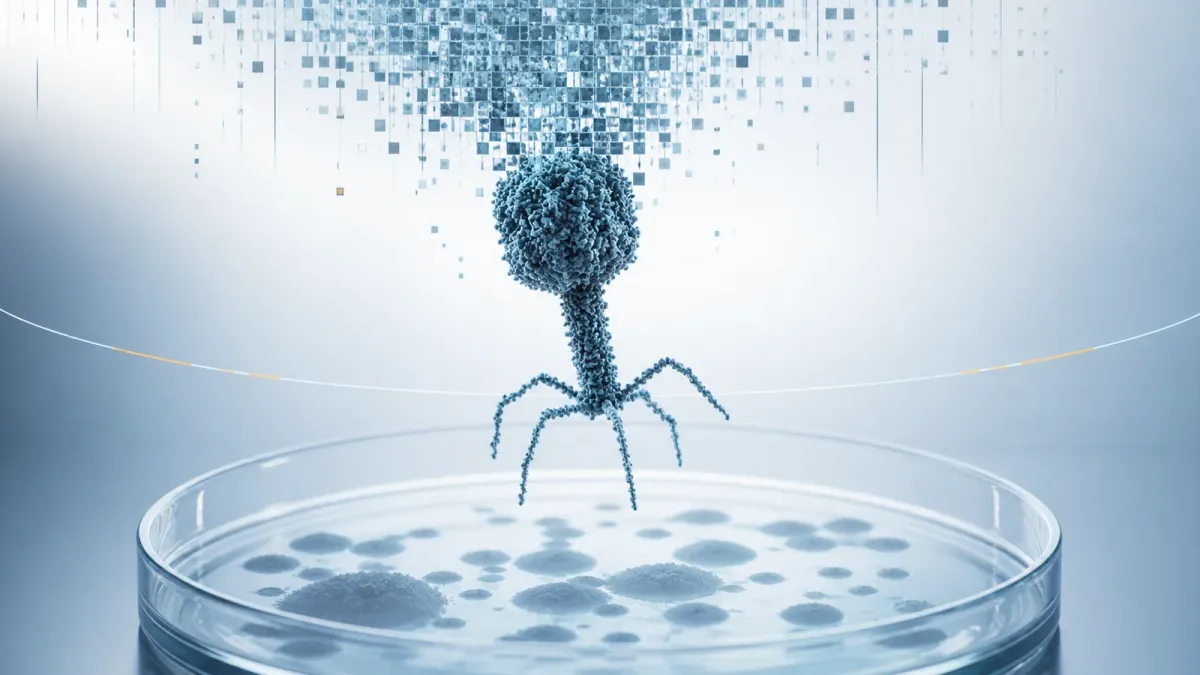
Researchers at Stanford University and the Arc Institute have reported a scientific first: artificial intelligence systems helped design complete viral genomes that produced 16 working bacteriophages in lab tests.
The safety line is important. These were phages, viruses that infect bacteria, not human-infecting viruses. The result, published in Science on August 6, 2026, points toward possible future tools against antibiotic-resistant bacteria while raising harder questions about who should control AI systems that can write biological code.
What the researchers built
The team used genome language models, including Evo 1 and Evo 2, to generate candidate bacteriophage genomes using the well-studied phage Phi X174 as a design template. According to the Science paper and Arc Institute research summary, the models generated designs with target host tropism, meaning they were aimed at a specific bacterial host.
After laboratory screening, 16 generated phages were viable. The paper reports that some had diverse fitness profiles, one used an evolutionarily distant DNA-packaging protein, and a cocktail of generated phages overcame resistance in three E. coli strains that resisted Phi X174 alone.
That screening result is also a reminder of the limits. The achievement was not a push-button cure or a demonstration that any dangerous virus can be summoned on demand. It was a controlled experiment in which most computational designs failed, and the surviving designs were evaluated against bacteria in a lab setting.
Why it matters
The medical promise is straightforward: bacteria evolve around antibiotics, and phage therapy is one possible way to target resistant infections. A model that can propose useful phages could eventually shorten the search for treatments, though this work is still laboratory research and not a patient-ready therapy.
The risk is also real. If AI tools can design working biological systems, safety cannot depend only on good intentions inside one lab. Researchers and outside biosecurity experts have pointed to layered controls, including model safeguards, DNA-synthesis screening, lab oversight and clear rules for high-risk biological design.
For readers, the practical question is not whether to panic about this particular set of phages. It is whether regulators, research funders, model developers and DNA suppliers can keep oversight close enough to the tools as biology design becomes easier to automate.
What readers should not assume
This study does not mean AI created a new human pandemic virus. The reported phages were designed to infect bacteria, and the article’s public summaries emphasize that distinction. It also does not prove that AI can safely or reliably design any organism on demand; most candidate designs did not become working phages.
The better takeaway is narrower and more consequential: AI has crossed from predicting pieces of biology toward composing complete viral genomes that can function in a controlled lab. That makes the research worth watching for its medical upside and for the governance gap it exposes.


