
The promise of workplace AI is usually framed as time saved. The more awkward question is what happens to that time after it is saved.
Atlassian’s Teamwork Lab reported on July 6, 2026 that 92% of 1,000 surveyed U.S. knowledge workers said their responsibilities had expanded beyond their original job description in the previous year. The heaviest AI users were nearly twice as likely to report taking on work from other teams and specialized tasks without bringing in an expert.
The joke
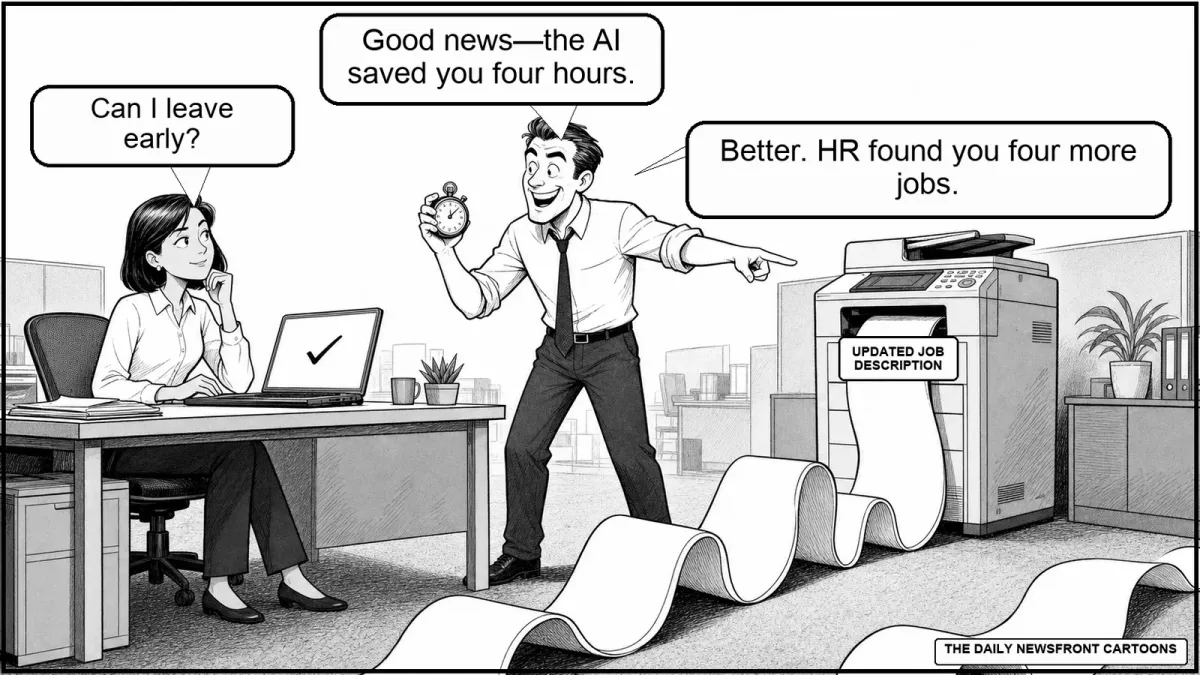
In the cartoon, a manager celebrates that AI saved an employee four hours. She asks whether that means she can leave early. He points to a printer unspooling an absurdly long updated job description and says, “Better. HR found you four more jobs.”
The office, the people, and every line of dialogue are fictional composites. The four extra jobs are satirical exaggeration, not a claim about a real employer.
Why it lands
Microsoft’s 2026 Work Trend Index, based on a survey of 20,000 knowledge workers who use AI, found that organizational conditions were the strongest measured correlate of workers reporting useful AI outcomes. Microsoft cautioned that those relationships were associations, not proof of cause.
That distinction matters. A faster tool can create capacity, but it cannot decide whether the gain becomes focus time, better work, training, compensation, or simply a longer list of duties. That choice still belongs to the organization—and it remains fertile territory for the office printer.


