
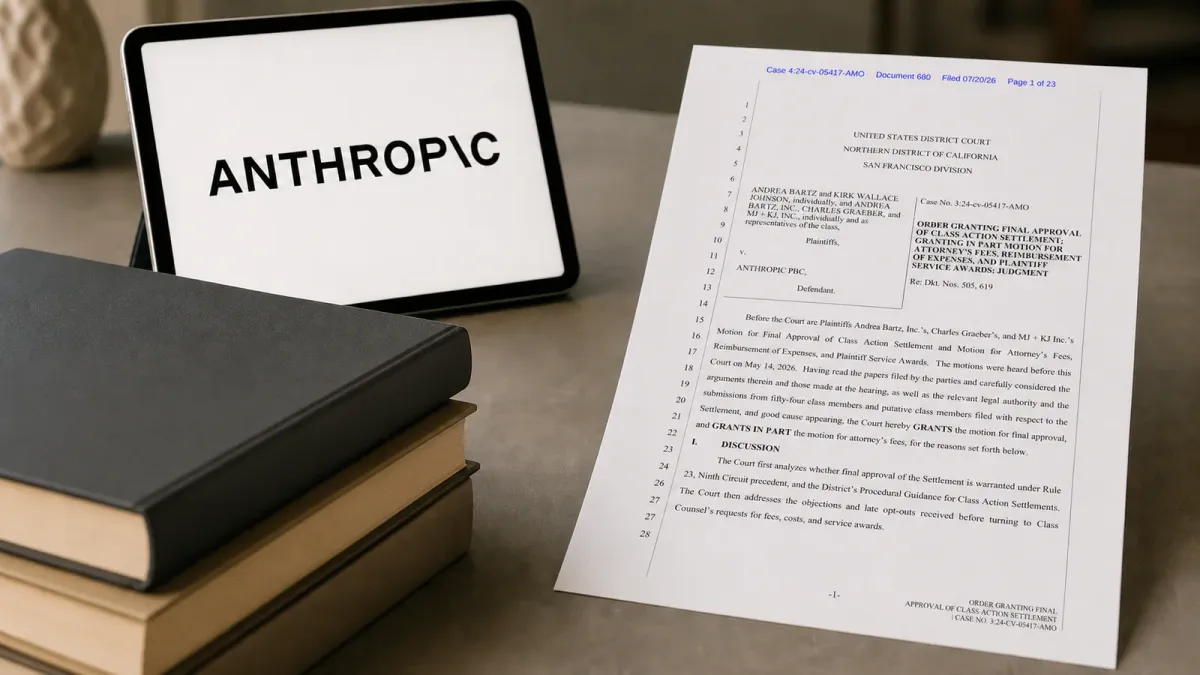
A federal judge in San Francisco has given final approval to Anthropic's $1.5 billion class-action settlement with authors and publishers, turning one of the biggest AI copyright cases into an immediate payout question for rightsholders.
The July 20 order in Bartz v. Anthropic grants final approval of the settlement and approves much of the fee and distribution plan. The case centered on claims that Anthropic used pirated copies of books while building material for Claude, its AI chatbot.
What changed
Associated Press reported Tuesday that the deal is expected to pay affected authors and publishers about $3,000 per book, with claims already filed for roughly 91% of the covered works. TechCrunch separately noted that the final approval settles this case but does not settle the industry's larger argument over copyrighted material and AI training.
That distinction matters. A prior ruling in the case treated some AI training uses of lawfully obtained books differently from the alleged downloading and retention of pirated copies. In plain English: the court fight did not produce a simple rule that all book training is illegal, or that all AI training is protected. It put the sharpest liability on how the books were acquired and stored.
Why authors care
For writers and publishers, the order converts years of litigation into a distribution process. The most practical next step is not another public debate about AI. It is checking claim notices, confirming covered works, and watching appeal or effective-date deadlines before assuming money is on the way.
The settlement also creates a benchmark other plaintiffs can point to. A large cash recovery does not automatically decide lawsuits against other AI companies, but it changes the negotiating backdrop for creators, publishers, model developers and investors trying to price training-data risk.
Why AI companies care
For AI developers, the message is narrower but costly: provenance matters. Courts may continue to debate whether training itself is transformative fair use, but a model company that cannot document where its training corpus came from is carrying a legal and reputational risk that can survive even a favorable fair-use ruling.
That is why the Anthropic settlement is more than a creator-compensation story. It is a compliance story. Legal data pipelines, audit trails, licensing records, deletion commitments and publisher negotiations are becoming part of AI infrastructure, not just public-relations cleanup after a lawsuit.
What to watch next
The next signals are whether any objectors appeal, when payments become effective, and how other courts handle pending AI copyright cases. Readers should also watch whether major model companies start describing training-data controls with the same precision they use for safety benchmarks and product performance.
For now, one high-profile case has a court-approved settlement. The bigger question, whether the AI economy can scale without a clearer market for copyrighted training material, is still open.


