
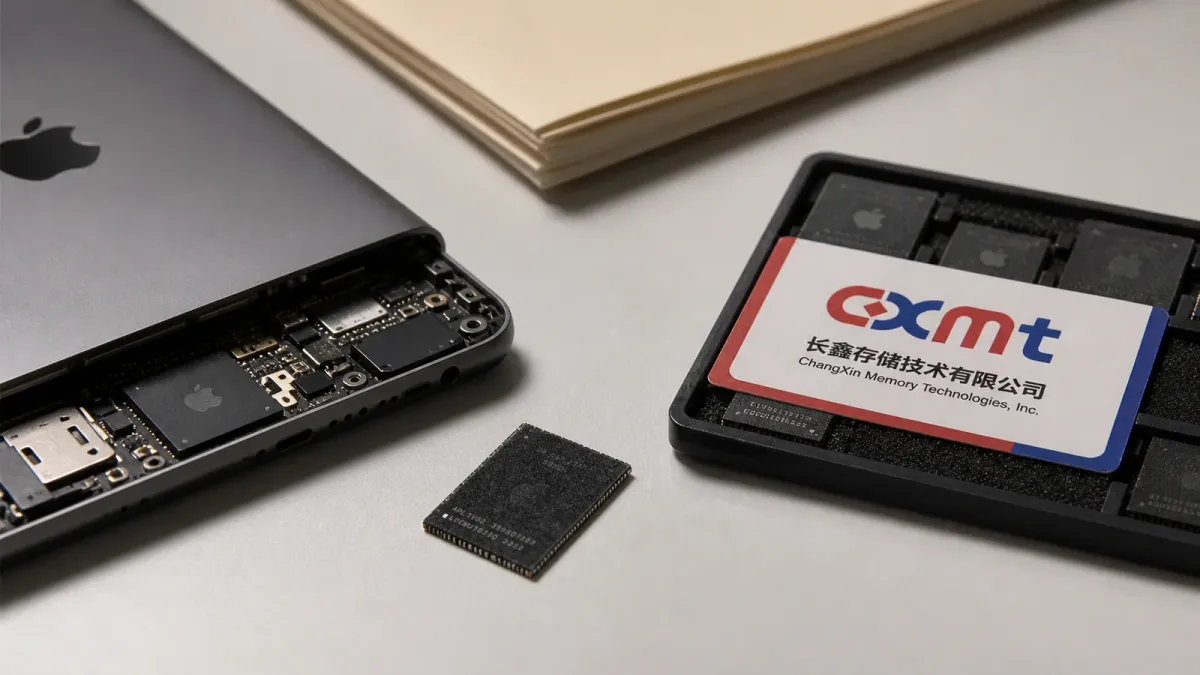
Apple is reportedly testing memory chips from China's ChangXin Memory Technologies for iPhones and MacBooks, a sign that the AI infrastructure boom is starting to squeeze consumer-device supply chains in ways shoppers may eventually notice.
Fox Business, citing The Wall Street Journal, reported Monday that Apple has held early talks with CXMT about supplying components for devices sold in China. The report said Apple is seeking a White House sign-off before going further because U.S. rules limit how American companies can work with the Chinese chipmaker.
The short version: this is not just a supplier swap. It is a test of whether Apple can add a fourth memory source without handing over sensitive technical detail, redesigning parts of China-market products, or stepping into a Washington fight over Chinese semiconductor ties.
What changed
Apple has been hit by rising memory-chip costs as AI data centers absorb more DRAM and high-bandwidth memory capacity. The company has already raised prices on some devices this year, and a new supplier could give it more room to manage availability and margins.
CXMT is China's fastest-growing DRAM supplier and has become large enough that global electronics companies are watching it as a possible pressure valve. But the company is also listed in a June Federal Register notice tied to the Pentagon's Section 1260H Chinese military companies process. That notice identifies ChangXin Memory Technologies and says it is directly affiliated with China's Ministry of Industry and Information Technology and indirectly affiliated with state-asset authorities.
Why Apple cannot treat this like a normal parts deal
The reported talks focus on devices sold in China, where using a Chinese supplier could reduce some supply-chain friction. But U.S. rules complicate the engineering. Fox Business reported that Apple could buy off-the-shelf CXMT parts, but could not order custom chips built to Apple's own specifications if that would require restricted technology transfer.
That distinction matters because Apple often tunes hardware around its own chips, thermal design, battery targets, and performance requirements. Standard DRAM may be easier to buy but harder to fit cleanly into the tightly engineered iPhone and MacBook lineup.
What to watch next
The key signal is whether Apple receives U.S. political or regulatory comfort to proceed. Without it, testing may remain a hedge rather than a supply-chain shift. Another signal is capacity: CXMT has reportedly prioritized domestic Chinese customers, so Apple may not gain much relief if the company has little room left for new international demand.
Investors will also be watching Micron, Samsung and SK Hynix, the dominant memory suppliers that benefit when capacity is tight. A credible fourth supplier could eventually change pricing power, but only if it can meet Apple-scale quality, volume and regulatory requirements.
For consumers, the immediate takeaway is narrower. This does not mean the next iPhone will suddenly use CXMT chips, and it does not prove U.S. models are affected. It does show that the AI spending boom is no longer just a cloud-computing story. The same memory market powering data centers is now pressing into the price, supply, and design choices behind everyday devices.


