
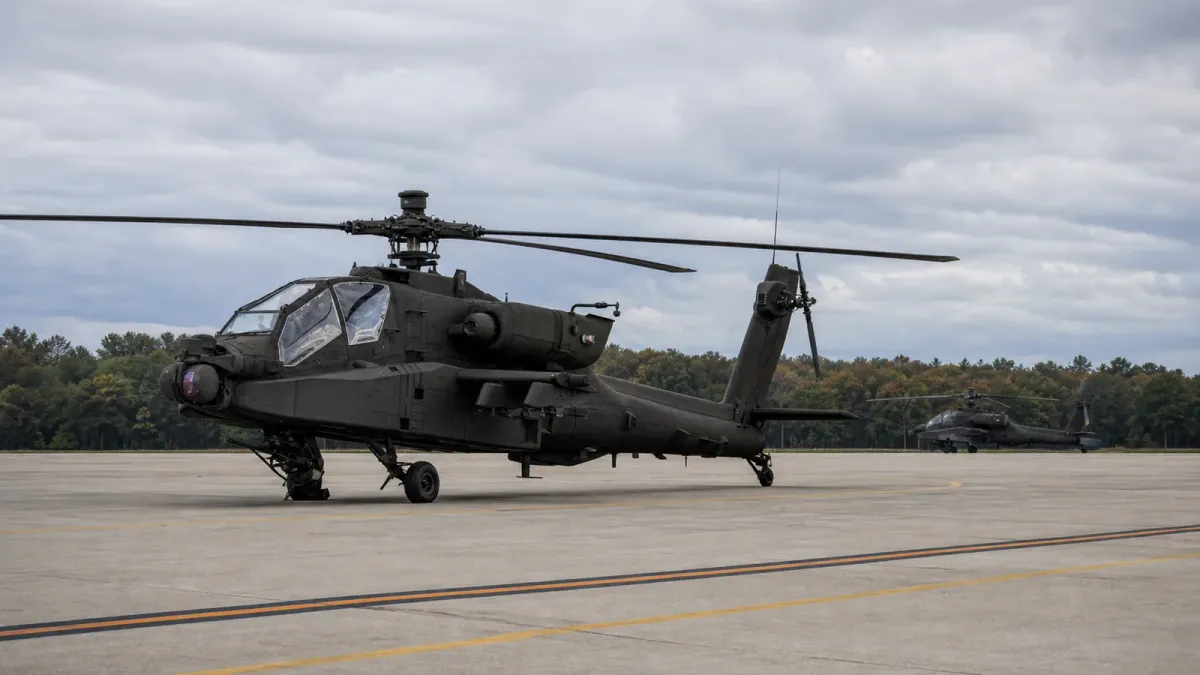
The U.S. Army temporarily halted AH-64 Apache training flight operations on Friday, August 14, after a maintenance-test crash near Salado, Texas, killed two Fort Hood pilots two days earlier. The pause is expected to remain in place while investigators work to understand the accident's root cause.
The order is narrower than a complete operational grounding: it applies to training flights. The Army has not announced that Apache combat missions are suspended, and it has not set a date for training to resume.
What changed
Army leaders directed the temporary stand-down after an AH-64E assigned to Fort Hood crashed at about 1:40 p.m. on August 12 during a maintenance test flight, according to the Fort Hood Media Center. The crash occurred near Salado, roughly 30 miles south of the installation.
Chief Warrant Officer 2 Deontre T. Huey, 34, of Killeen, Texas, and Warrant Officer Seth L. Olmstead, 25, of Belton, Texas, were killed. Both were assigned to Bravo Company, 1st Battalion, 227th Aviation Regiment, 1st Air Cavalry Brigade, 1st Cavalry Division.
Huey entered the Army in 2014 and had served with the unit since February 2022. Olmstead entered in 2023 and joined the unit in October 2025. Fort Hood said chaplains and other support resources were made available to affected families and soldiers.
What remains unknown
The Army has not released a cause. A safety investigation team from the U.S. Army Combat Readiness Center at Fort Rucker, Alabama, arrived on August 13 and is leading the safety investigation. That process is intended to determine what happened and identify measures that could reduce the risk of another mishap.
The stand-down itself does not prove that investigators have identified a defect in the Apache fleet, a maintenance failure or crew error. It is a precaution while the Army gathers evidence. The Associated Press separately confirmed the training-flight halt and reported that no cause had been released.
Why the distinction matters
A training stand-down can interrupt unit schedules, maintenance checks and aircrew proficiency work without removing the aircraft from every military task. The Army has not said how many helicopters or units are affected, what conditions must be met before training resumes, or whether the investigation has identified a common risk across the AH-64 fleet.
For now, the clearest boundary is the one in the order: Apache training flights are paused while the Army seeks a better understanding of the crash. Any conclusion about a fleet-wide technical problem would go beyond the evidence currently public.
What happens next
Investigators will examine the aircraft, maintenance history, flight data, operating conditions and other evidence before the Army decides whether training can resume or additional safeguards are required. Fort Hood said it will release more information when permitted by law and the investigative process.


