
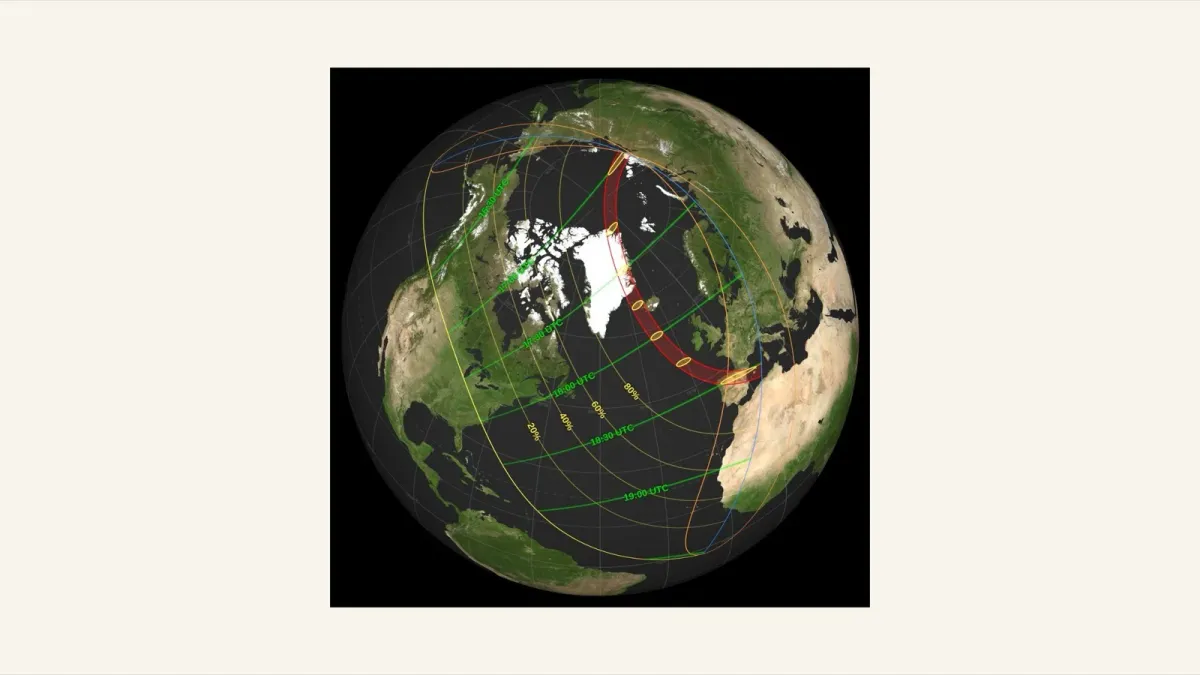
The total solar eclipse on Wednesday, August 12, 2026, is a Europe-centered sky event with a narrow path of totality across Greenland, Iceland, northern Russia, the Atlantic Ocean, Spain and a small corner of Portugal, according to NASA.
For U.S. readers, the practical answer is narrower: NASA says parts of the northern United States, Canada, Europe and northwestern Africa can see a partial eclipse, but the full blackout belongs to places inside the red path of totality.
What changed today
The eclipse is happening now, not just sitting on an astronomy calendar. NASA scheduled a live stream starting at 1:15 p.m. EDT on August 12, and the agency says the Moon's shadow will sweep from the Arctic region toward Greenland, Iceland and Spain before sunset in parts of western Europe and Africa.
NASA's map shows the red totality band crossing Greenland, Iceland and Spain, while yellow curves mark where a partial eclipse is visible. The agency says most people in the totality path will get less than two minutes of full coverage, with locations near the center of the path in Greenland, Russia or the North Atlantic getting slightly longer, but still less than two and a half minutes.
Why it matters
A total solar eclipse happens when the Moon blocks the Sun's bright face for viewers inside the inner shadow. That brief alignment gives scientists and skywatchers a rare look at the Sun's outer atmosphere, and it turns ordinary travel logistics into a public event for cities and viewing sites along the path.
The National Solar Observatory also lists the August 12 path across the Arctic Ocean, Greenland, Iceland, the Atlantic Ocean, Portugal and northern Spain, reinforcing NASA's map-based account of where totality is possible.
The Associated Press reported that excitement was especially visible in Spain, where residents and tourists prepared in cities including A Coruna, Bilbao and Santiago de Compostela. Business Insider reported that NASA planned to chase the eclipse with a WB-57 high-altitude research aircraft from Iceland to extend and improve the view for solar observations.
What to check before looking up
NASA's safety guidance is blunt: outside the short moments of totality, people should not look directly at the Sun without safe solar viewing glasses or a handheld solar viewer. Regular sunglasses are not eclipse glasses, and NASA says cameras, telescopes and binoculars need proper front-mounted solar filters because concentrated sunlight can cause serious eye injury.
If you are outside the path of totality, there is no safe naked-eye phase. NASA says a partial eclipse is never safe to view directly without proper eye protection. If you do not have eclipse glasses, an indirect method such as a pinhole projector lets you watch the projected shape of the Sun without staring at it.
What happens next
The next step for most readers is simple: use NASA's live coverage or a verified local astronomy source, then treat social clips as highlights rather than instructions. Exact local visibility depends on location, timing and horizon, so the safest useful check is NASA's eclipse map or a reputable observatory map before stepping outside.


