
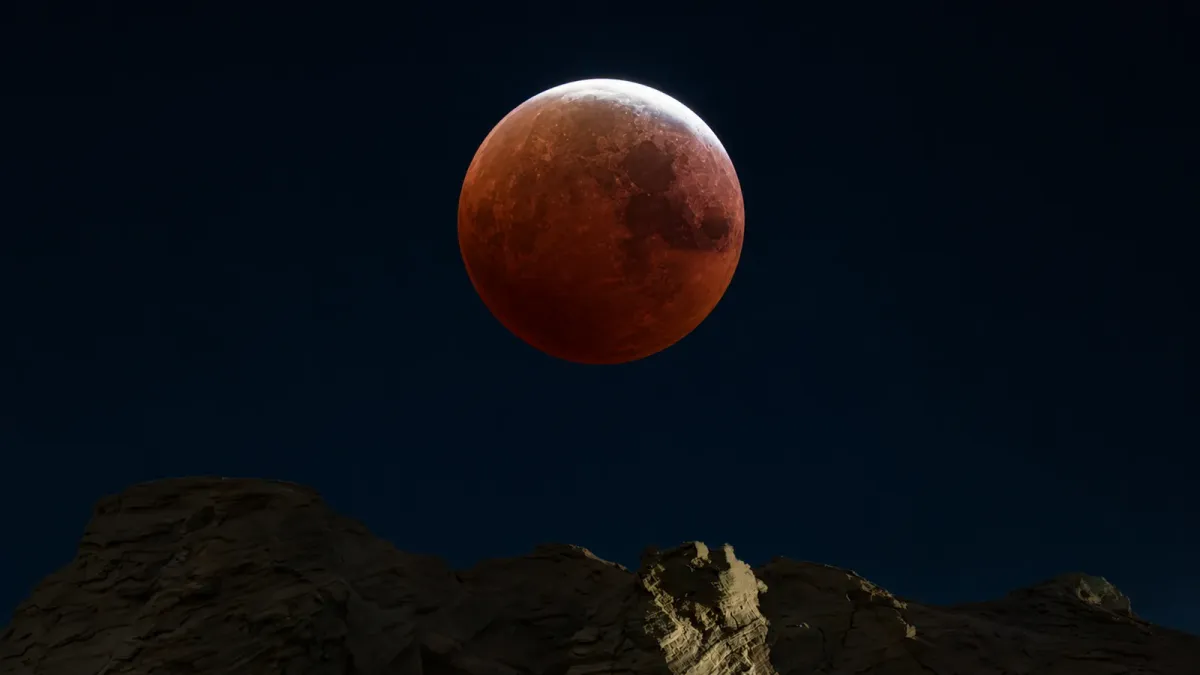
A deep partial lunar eclipse will unfold overnight on Thursday, August 27, into Friday, August 28, 2026. At maximum, 96.2% of the Moon's visible area will sit inside Earth's dark central shadow, according to Timeanddate. The event is partial, not total, because a narrow bright rim will remain outside the umbra.
NASA says the eclipse will be visible across the Americas and parts of Europe and Africa, with broader visibility reaching the eastern Pacific and portions of Western Asia. The partial phase lasts 3 hours and 18 minutes. Unlike a solar eclipse, it is safe to watch a lunar eclipse with unaided eyes; eclipse glasses and solar filters are not needed.
The simplest plan is to check your local time, find an open view of the Moon, and look during the partial phase rather than waiting through the faint opening penumbral stage.
The four times that matter
Timeanddate's worldwide timeline puts the first subtle penumbral shading at 01:23:58 UTC on August 28. The visible partial phase begins at 02:33:54 UTC, reaches maximum at 04:12:53 UTC, and ends at 05:51:59 UTC. The final penumbral shading fades by 07:01:47 UTC.
NASA's eclipse catalog independently classifies the event as partial, gives an umbral magnitude of 0.930, and lists a 3-hour, 18-minute partial phase. Umbral magnitude measures the fraction of the Moon's diameter immersed in Earth's darkest shadow. The separate 96.2% figure describes the Moon's area covered at maximum, which is why the two percentages are not interchangeable.
North America gets an evening-to-after-midnight show
In Eastern Daylight Time, the faint penumbral phase begins at 9:23 p.m. on August 27. The darker partial phase starts at 10:33 p.m., maximum arrives at 12:12 a.m. on August 28, and the partial phase ends at 1:51 a.m. The penumbral phase finishes at 3:01 a.m.
Move each time one hour earlier for Central Daylight Time, two hours earlier for Mountain Daylight Time, and three hours earlier for Pacific Daylight Time. That puts maximum eclipse at 9:12 p.m. on the West Coast, a more convenient window than the after-midnight peak in the East.
Europe and Africa need a horizon check
In London, the Royal Observatory Greenwich says the partial phase begins at 3:33 a.m. British Summer Time and peaks at 5:12 a.m. The Moon will be sinking toward the southwest and sets around 6:15 a.m., so buildings, trees and hills can matter as much as the clock.
Farther east in Europe and across parts of Africa, the Moon may be lower or may set before every phase is complete. NASA's regional map establishes where at least part of the eclipse is visible, but it does not replace a city-level moonrise and moonset check. Use a location-specific eclipse table before committing to a viewing spot.
Why the Moon can look coppery without totality
A lunar eclipse happens when Earth moves between the Sun and the full Moon. During this event, most of the Moon will enter the umbra, the darkest part of Earth's shadow, while a small portion remains directly lit.
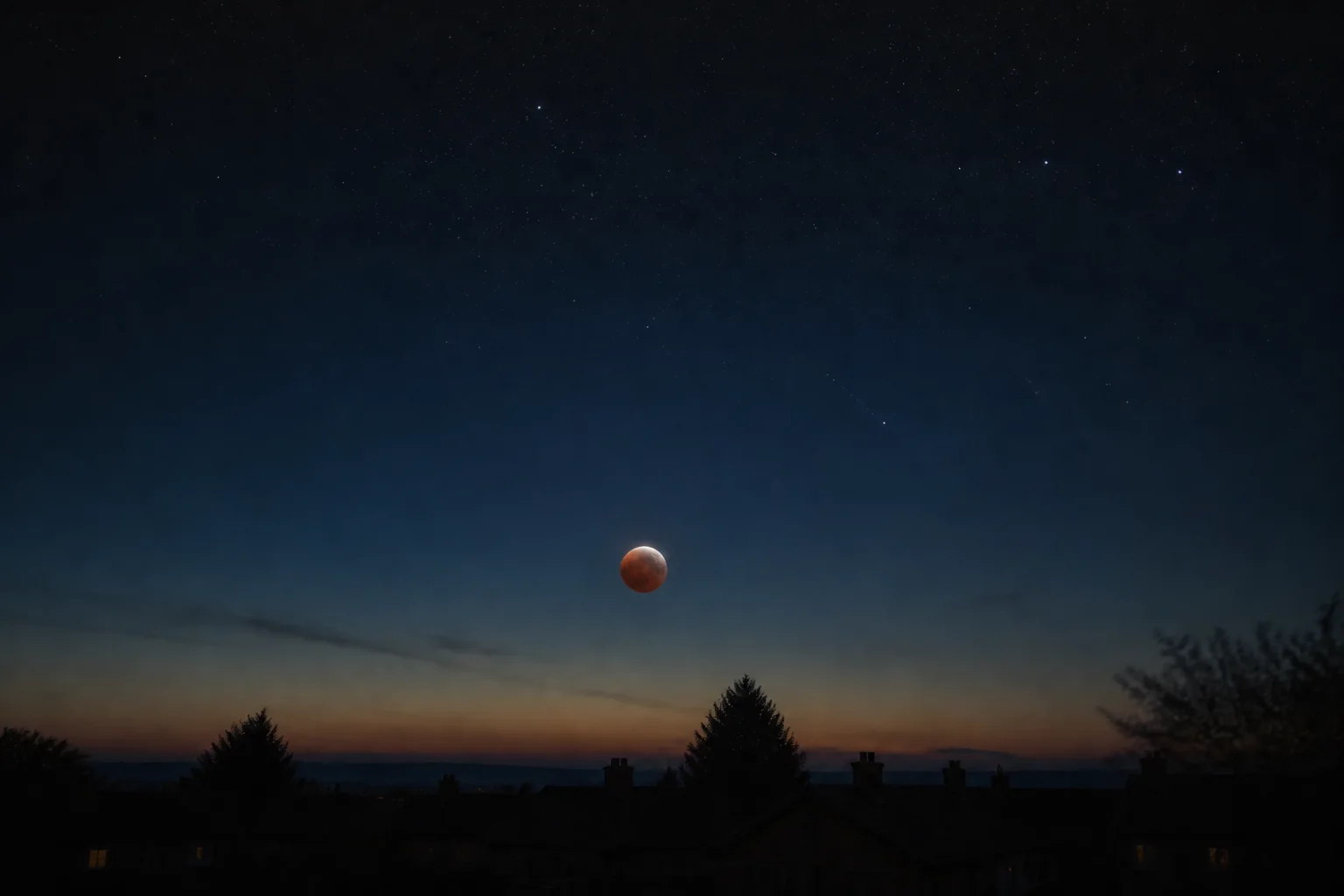
The shadowed part may look orange or red because sunlight reaching it has passed through Earth's atmosphere. NASA explains that shorter blue and violet wavelengths scatter more easily, while longer red and orange wavelengths travel through the atmosphere and illuminate the lunar surface. The exact color can vary; the useful prediction is a strong contrast between the dim shadowed disk and the thin bright edge, not a guaranteed shade of red.
A simple viewing checklist
- Confirm the date split. In much of the Americas, the event begins on August 27 and peaks after midnight on August 28 in eastern time zones.
- Prioritize the partial phase. The early penumbral shading can be difficult to notice. The umbral shadow becomes much clearer after the partial phase begins.
- Check the Moon's direction and altitude. A low Moon can disappear behind a roofline or trees even when your region is inside the visibility zone.
- Skip solar-viewing gear. Ordinary binoculars can improve the view, but no solar filter is required for a lunar eclipse. If using a tripod or camera, keep the setup simple enough that you still watch the change unfold.
- Use local circumstances. Convert from UTC carefully or use a trusted city-specific eclipse calculator, especially where the Moon rises or sets during the event.
What to watch at maximum
Near 04:12 UTC, look for the boundary between the bright remaining rim and the much dimmer portion inside Earth's umbra. Because this is a deep partial eclipse, the Moon can resemble a near-total eclipse at a glance, but the uncovered edge is the feature that defines it.
The next planning step is modest: save the partial-phase start and maximum times in your own time zone, then choose a spot with an unobstructed view in the Moon's direction. The event lasts long enough that arriving a few minutes late will not ruin it, but mixing up August 27 and August 28 might.


