
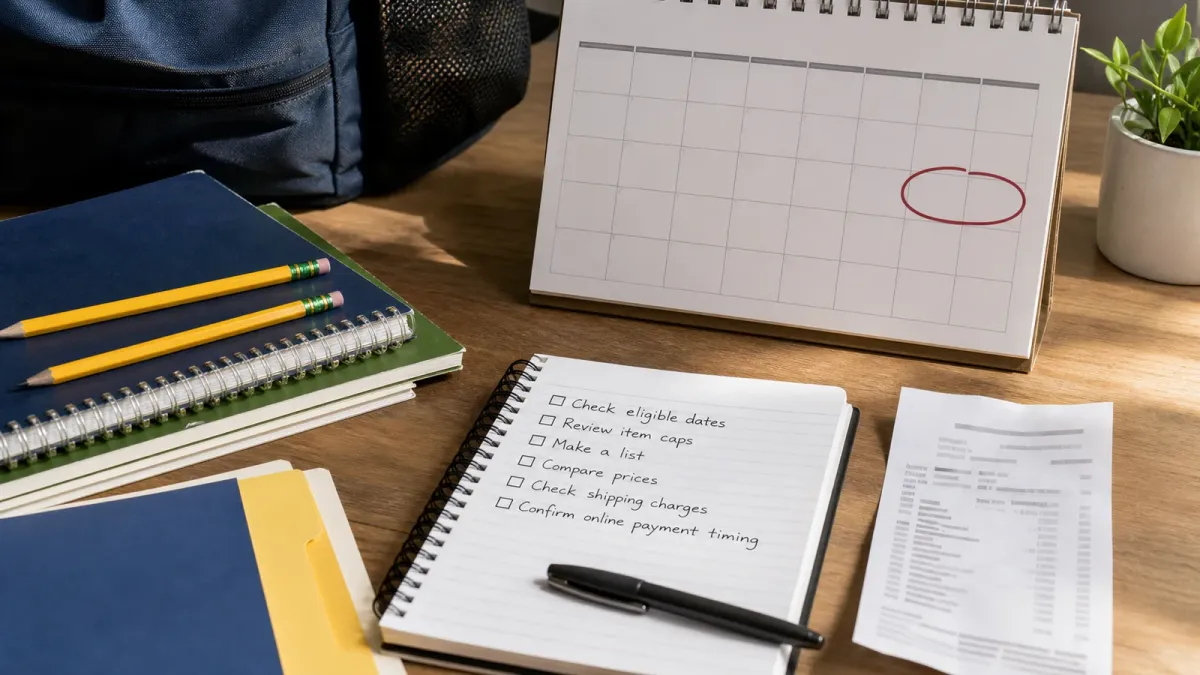
Back-to-school sales tax holidays are already underway in some states and begin soon in several others, giving families a short window to buy qualifying supplies, clothing and some electronics without state sales tax.
The useful catch is that these holidays are not one national program. Each state sets its own dates, eligible items, price caps and online-order rules, so a cart that qualifies in Florida may be partly taxable in Ohio or Texas.
Do this first
- Check your state date before shopping. The Federation of Tax Administrators' 2026 table lists Florida from July 20 through August 20, Arkansas on August 1-2, Tennessee and New Mexico from July 31 through August 2, and many larger state weekends from August 7-9.
- Match the item to the cap. Florida exempts clothing and bags at $100 or less per item, school supplies at $50 or less, learning aids at $30 or less, and personal computers or certain accessories at $1,500 or less for home or personal use.
- Read your receipt line by line. Ohio says its 2026 holiday applies to clothing priced at $75 or less, school supplies at $20 or less, and school instructional materials at $20 or less. Items above those caps do not get a partial exemption.
- Put shipping into the math. Texas treats seller delivery, shipping, handling and transportation charges as part of the sales price. A $95 pair of jeans with a $10 delivery charge crosses the $100 cap and becomes taxable.
Check these details
Online orders can qualify, but the timing rule matters. Texas says qualifying items may be bought in stores, online, by phone, by mail or by custom order, but payment must happen during the holiday period. A Sunday evening online order can still qualify even if delivery lands after the weekend, while a declined payment completed Monday would not.
Exclusions also vary. Florida's 2026 notice says the back-to-school holiday does not cover cellphones, video game consoles, rentals, repairs, alterations, or sales inside theme parks, entertainment complexes, public lodging establishments or airports. Ohio excludes food in restaurants, vehicles, alcohol, tobacco, vape products, marijuana items and business purchases.
Common mistakes
Do not assume every school-related item qualifies. Backpacks may qualify in one state while briefcases, purses, luggage, athletic bags or computer bags do not. Computers qualify in some states but not others, and accessories can have separate caps or exclusions.
Do not average prices across a transaction. If one shirt costs $80 and another is free, Ohio says the taxable decision is based on the actual price of each item, not the average. Bundled items also need attention because states may tax a kit or package if the seller does not separately state the qualifying and nonqualifying pieces.
Why it matters now
NRF says 62% of back-to-school shoppers had already started shopping by early July, and its 2026 back-to-school hub says families are watching prices closely this season. That means the tax holiday is best used as a planning tool, not a reason to buy everything at once.
The bottom line: make the list first, check your state revenue department's current page, and buy the capped items during the right window. The savings are real, but only when the item, date, seller and payment timing all line up.


