
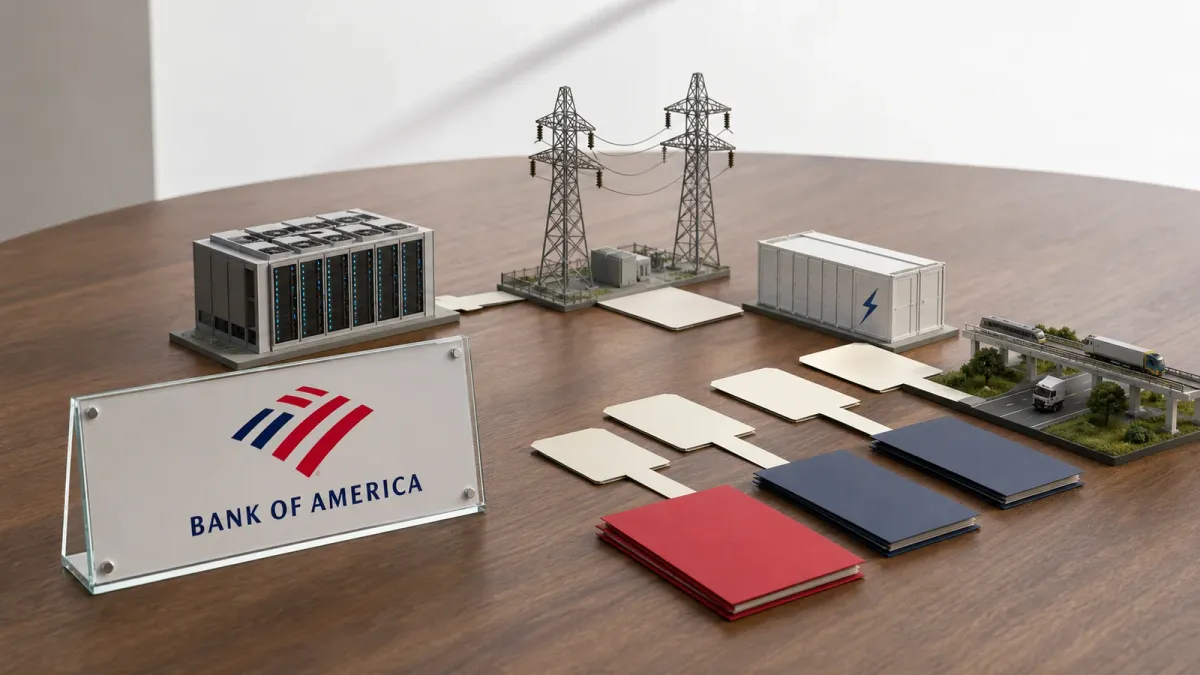
Bank of America said Wednesday, August 12, that it plans to mobilize and deploy $250 billion for U.S. infrastructure projects over an 18-month window, putting one of the country's largest banks deeper into the race to finance data centers, power systems and other physical assets behind the AI economy.
The bank's Critical Infrastructure Finance Initiative is not a single public-works fund or a promise to spend $250 billion from one account. It is a target for eligible financing, investment, advisory and supply-chain activity measured from January 1, 2026, through July 4, 2027.
What Bank of America announced
The company said the initiative will support three broad lanes: digital infrastructure, energy and power infrastructure, and core infrastructure. In practice, that can include data centers and computing capacity, conventional and renewable power generation, energy storage, electric transmission, grid optimization, transportation, water systems, critical minerals and mining.
That list matters because AI investment is no longer just about chips, software and cloud contracts. The next bottleneck is increasingly physical: where compute facilities are built, how much power they can draw, whether grid upgrades arrive on time, and how companies finance equipment and supply chains before revenue catches up.
Bank of America framed the program around America's 250th anniversary, but the business case is more immediate. Surging demand for computing power, manufacturing capacity, modern transportation and diversified supply chains has created a wave of projects that need bank lending, capital-markets access and long-term investors.
Why investors and customers should read the fine print
The headline number is large, but readers should treat it as a financing-capacity target, not proof that $250 billion of new construction will appear by next summer. Bank of America says progress will be measured by eligible activity, including lending, investments, capital markets services, banking, advisory and supply-chain solutions.
That distinction is important. A project can need several kinds of capital before it is finished: construction loans, equipment financing, advisory work, bond issuance, private investment and refinancing once an asset is operating. Reuters reported that Bank of America executives described U.S. infrastructure construction loans as typically running five to seven years, with completed projects often refinanced into longer-term debt.

For companies, the initiative could make it easier to assemble financing packages for expensive projects that sit across technology, energy and industrial supply chains. For communities, it may bring familiar tradeoffs: jobs and tax base on one side, and questions about electricity demand, land use, water systems, transmission lines and who pays for grid upgrades on the other.
The bigger banking race
Bank of America's announcement follows a broader push by Wall Street to make infrastructure and technology buildouts a core business line. Reuters noted that Morgan Stanley recently said it would facilitate roughly $1.5 trillion over the next decade for technology and infrastructure projects, while JPMorgan Chase last year launched a $1.5 trillion effort tied to economic resilience and national-security-related industries.
The common thread is that banks are positioning themselves around a long build cycle. AI data centers need power contracts, cooling, land, chips, network connections and specialized construction. Energy projects need permitting, interconnection, tax-credit analysis and buyers. Critical minerals and manufacturing projects need supply agreements and financing that can survive commodity cycles.
Bank of America's pitch is that it can connect those pieces across its balance sheet, capital-markets platform and advisory teams. Karen Fang, the bank's global head of infrastructure and sustainable finance and co-head of global capital solutions, said large projects require integrated financing across corporate and project-level capital in public and private markets.
What to watch next
The useful test is not whether the bank repeats the $250 billion number. It is whether the initiative produces visible deals, how much of the activity is genuinely incremental, and whether financing reaches projects that solve actual bottlenecks instead of simply chasing the latest AI label.
Watch for three signals. First, named projects: data centers, power plants, transmission upgrades, transportation assets or manufacturing facilities that cite the initiative as part of their financing. Second, risk transfer: whether loans are held, syndicated, securitized or refinanced into longer-term debt. Third, local reaction: whether communities see the promised jobs and infrastructure benefits, or push back over power, water and cost concerns.
The bottom line is that Bank of America's plan shows how the AI boom is spilling into old-fashioned infrastructure finance. The money story is no longer just who owns the fastest model or the hottest chip. It is who can finance the buildings, grids and supply chains that let the technology run.


