
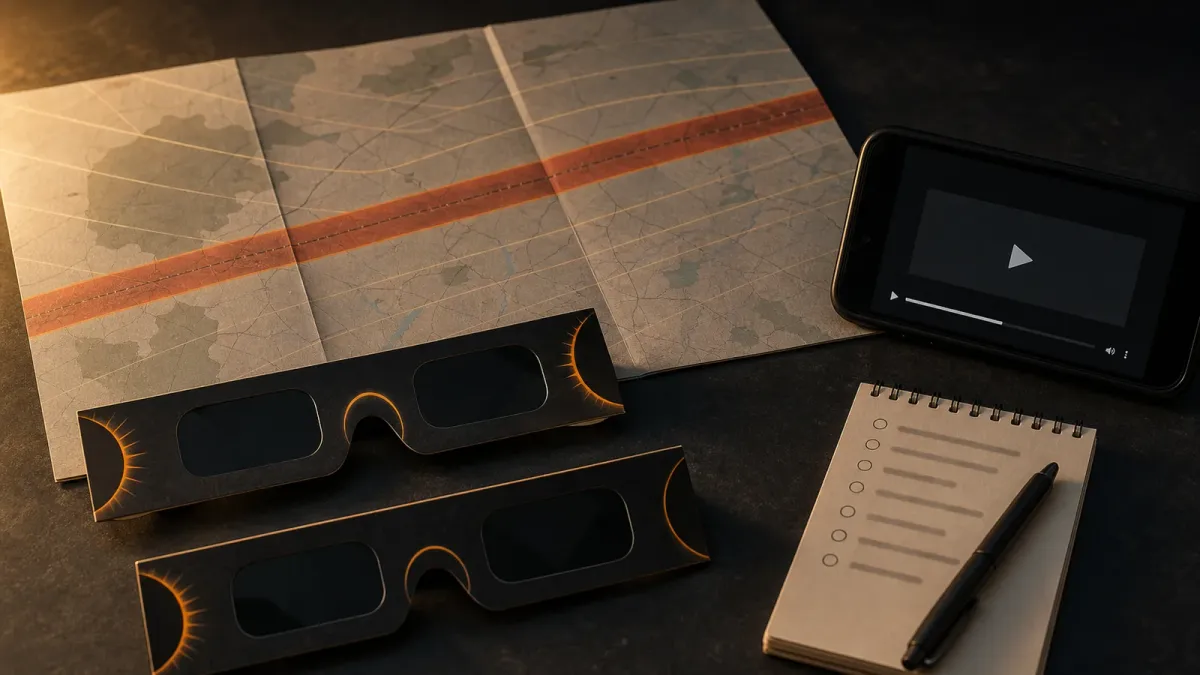
The August 12, 2026 solar eclipse is close enough that the most important question is no longer whether it is happening. It is where you will be when it does.
NASA says the path of totality will sweep across Greenland, Iceland, northern Russia, the Atlantic Ocean, Spain and a small corner of Portugal. Many more people, including viewers in parts of the northern United States, most of Canada, much of Europe and northwestern Africa, will see a partial solar eclipse instead.
The short answer
If you are not inside the narrow path of totality, you must treat the entire event as a partial eclipse and use proper solar protection the whole time. If you are inside totality, you can look without eclipse glasses only during the brief window when the Moon completely covers the Sun, then put protection back on as soon as bright sunlight returns.
NASA also says it will stream the eclipse live beginning at 1:15 p.m. EDT on August 12, which gives viewers outside the best viewing zones a safer fallback than trying to improvise with unsafe glasses, cameras or binoculars.
1. Check whether you are in totality
Totality is not the same as a deep partial eclipse. Inside the red-band path on NASA's eclipse map, the Moon fully blocks the Sun for a short time. Outside that band, even if most of the Sun is covered, direct viewing still requires safe solar viewers.
The main land viewing areas are Greenland, Iceland, Spain and a small area of Portugal, with northern Russia also in the path. NASA notes that most people in the path will get less than two minutes of totality, while locations near the center of the path in Greenland, Russia or the North Atlantic get a little longer, still under two and a half minutes.
2. Know what a partial eclipse means for your location
Partial viewing will cover a much wider area. NASA lists parts of the northern U.S. from Alaska to North Carolina, most of Canada, much of Europe and northwestern Africa as places that can see at least part of the event.
That broad footprint is also where mistakes are easiest. A partial eclipse can look dramatic, but NASA's safety guidance is blunt: during a partial solar eclipse, it is never safe to look directly at the Sun without proper eye protection. Regular sunglasses do not count, no matter how dark they look.
3. Buy viewers from a source you trust
Look for eclipse glasses or handheld solar viewers that comply with the ISO 12312-2 international standard. The American Astronomical Society explains that the standard covers how much ultraviolet, visible and infrared light a viewer can transmit, along with material quality, mounting and labeling.
The label alone is not the whole test, because counterfeit or poorly documented viewers can claim a standard they do not actually meet. A safer approach is to buy from a reputable astronomy, science museum, optical or established eclipse-viewing supplier and inspect the viewer before using it. NASA says torn, scratched or damaged viewers should be discarded.
4. Do not combine eclipse glasses with cameras or binoculars
This is the mistake that can catch careful people. Eclipse glasses protect your eyes during direct viewing, but they are not designed to sit behind magnifying optics. NASA warns not to look at the Sun through a camera lens, telescope, binoculars or another optical device while wearing eclipse glasses or using a handheld viewer, because concentrated sunlight can burn through the filter and injure your eyes.
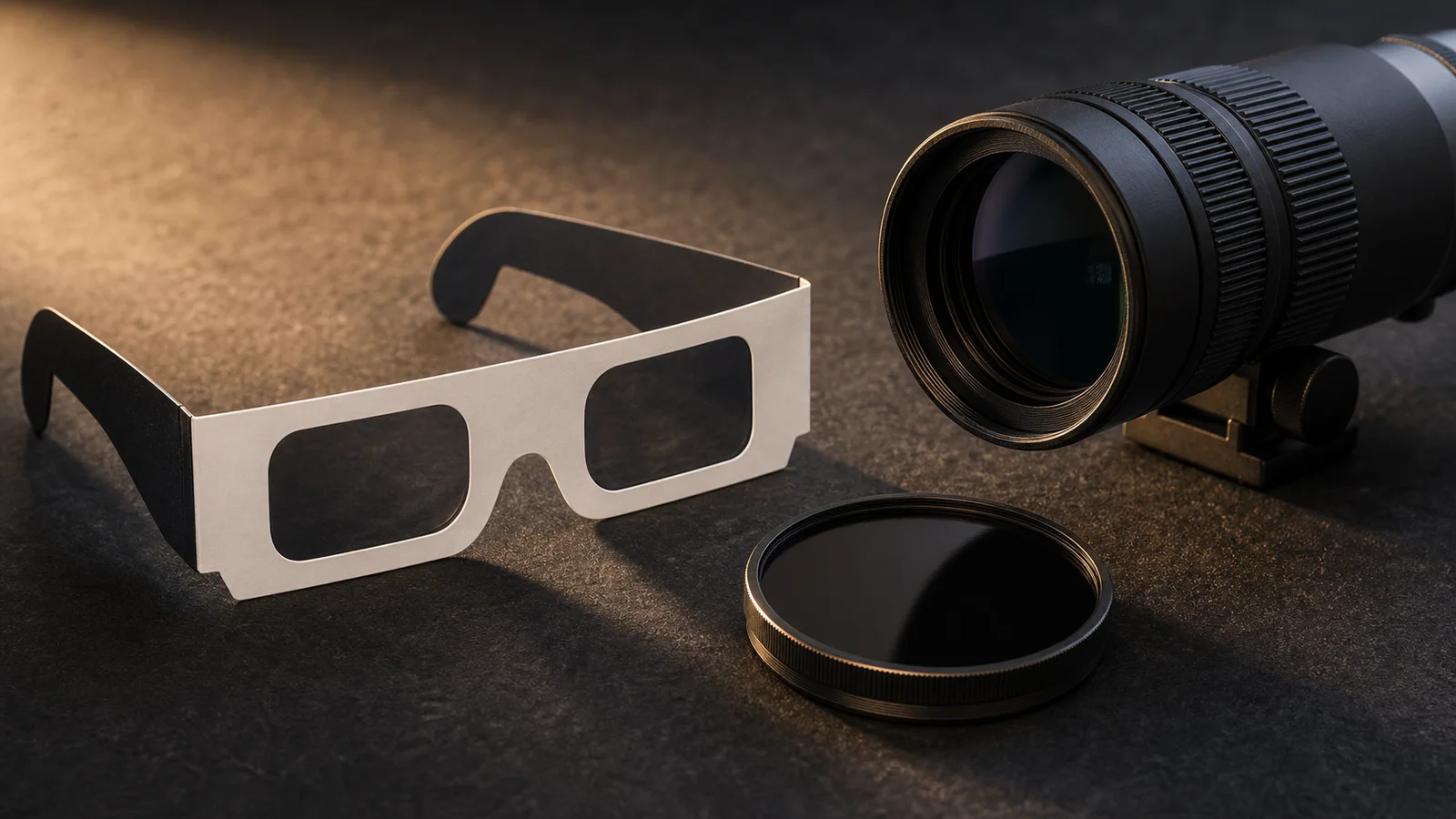
Cameras, telescopes and binoculars need special-purpose solar filters attached to the Sun-facing front of the optics. If you are not already comfortable using those filters, ask an experienced astronomer or use an indirect method instead.
5. Have a no-glasses backup
If safe viewers are unavailable, you can still watch the partial phases indirectly. NASA describes pinhole projectors and other indirect viewing methods that project the Sun's image onto a surface while you keep your back to the Sun.
A simple rule helps: if the method involves looking at the Sun, it needs certified solar protection. If the method projects sunlight onto paper, pavement or another surface while your eyes look away from the Sun, it can be a safer backup when used correctly.
What happens next
ESA is planning a live broadcast from the Observatorio Astrofísico de Javalambre in Teruel, Spain, and a public observation program in León, Spain. NASA's own livestream is scheduled for August 12, and both agencies are publishing safety and education resources ahead of the event.
For most readers, the practical checklist is short: find your location on a reliable eclipse map, confirm whether you are in totality or partial-only territory, get safe viewers before the last-minute rush, and decide now whether the livestream is the better option. The eclipse is a sky event, but the viewing plan is an eye-safety decision.


