
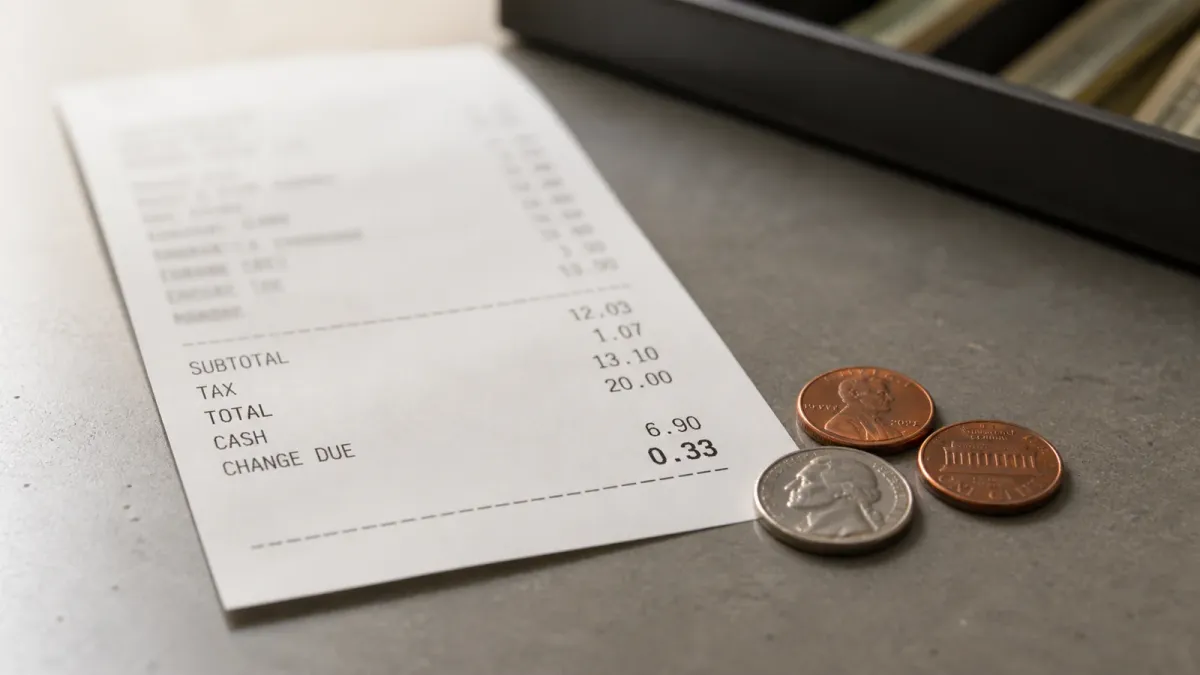
The penny fight is moving from coin jars to checkout counters. The Senate passed S. 1525, the Common Cents Act, by unanimous consent on August 7, 2026, and the bill was received in the House on August 10. It still is not law: the House must pass the Senate bill before it can go to the President.
If it becomes law, the practical question for shoppers is simple: when can a store round your total, and when should it charge the exact cents?
The short answer is that rounding is about final cash totals. It is not a license to round shelf prices, card payments, debit payments, checks, gift cards, or other non-cash payments. The Treasury's penny guidance says non-cash transactions should continue to be priced and processed to the exact cent.
Do this first
Check whether the bill is actually in force. As of August 13, 2026, the Senate-passed bill still needed final House action before it could be sent to the President. A store may have its own penny-shortage policy, and some states have their own rules, but the federal bill is not finished until the same measure clears both chambers and is signed.
Look at the payment method. If you pay by credit card, debit card, check, gift card, or another electronic method, the amount should remain exact. Rounding is meant for cash transactions when pennies are unavailable.
Round only the final cash total. Under the common symmetrical method described by Treasury and the Richmond Fed, totals ending in 1, 2, 6, or 7 cents round down to the nearest nickel. Totals ending in 3, 4, 8, or 9 cents round up. Totals ending in 0 or 5 cents do not change.
Check these details
Existing pennies remain legal tender. That means a penny in circulation does not become worthless just because new production stops or a rounding framework is adopted. The issue is availability: as pennies become harder for stores and banks to supply, businesses may need a consistent way to settle cash totals without one-cent coins.
The cost to consumers should be small in aggregate, but not always exactly neutral. Richmond Fed economists estimated that rounding to the nearest nickel could cost U.S. consumers about $6.06 million a year, using 2023 payment-diary data. They also found that eliminating the nickel would make the rounding burden much larger, which is why the nickel question matters even if the penny feels like the main event.
Common mistakes
Do not assume every rounded receipt is wrong. A $12.32 cash total rounded down to $12.30 and a $12.33 total rounded up to $12.35 follow the common rule. The better check is whether the rounding happened only after tax and only because the payment was cash.
Also do not assume a posted price has changed. A $4.99 item can still be priced at $4.99. Rounding should happen at the end of the transaction, after the full cash amount due is calculated.
When to ask questions
Ask for an explanation if a store rounds a card or debit transaction, rounds every item separately, refuses pennies without a clear policy, or applies rounding in a way that is not consistent from one customer to another. For a larger dispute, check your state consumer-protection or revenue agency guidance, because sales-tax and rounding rules can differ by jurisdiction.
The bottom line: the useful habit is not hoarding pennies. It is reading the final line of the receipt and matching the rounding to the payment method.


