
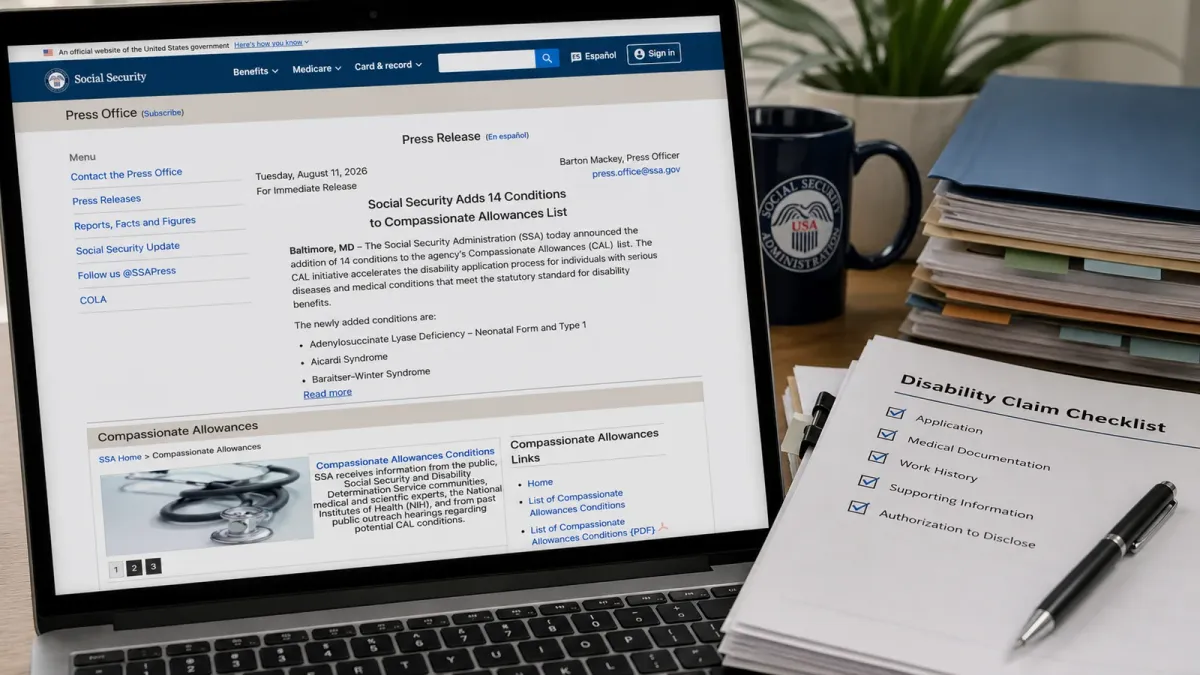
The Social Security Administration expanded its Compassionate Allowances list on August 11, 2026, adding 14 medical conditions and bringing the total fast-track list to 314. For families dealing with a severe diagnosis, the practical question is not just whether a condition appears on the list. It is whether the disability application is filed in a way that lets Social Security identify the case quickly.
The short version: Compassionate Allowances can speed a disability decision when a diagnosis clearly meets Social Security's disability standard, but it is not a separate benefit, a separate application, or an automatic payment. The same SSDI and SSI rules still apply.
That distinction matters because a fast-track flag can reduce waiting time, while an incomplete claim can still slow down a family that needs income support, medical coverage, or a clear appeal deadline.
What changed
SSA said the 14 newly added conditions include rare genetic disorders, neurological conditions, and serious cancers, such as Aicardi Syndrome, CASK-Related Gene Disorders, Hepatosplenic T-Cell Lymphoma, Primary Cardiac Sarcoma, and Uveal Melanoma with metastases. The agency said more than 1.2 million people with severe disabilities have been approved through the accelerated process since Compassionate Allowances began.
The program works by helping SSA identify claims where the applicant's disease or condition clearly meets the statutory disability standard. SSA says it uses technology to identify possible Compassionate Allowances claims and, when available, can receive electronic medical records through its Health IT program.
Do this first
Before filing, check the official SSA Compassionate Allowances list, not a copied list on a law firm or benefits site. The list changes over time, and the exact wording matters. A condition may sound similar to one on the list without matching the listed diagnosis or severity.
Second, gather the records that prove the diagnosis in the language doctors and SSA use: pathology reports, genetic test results, imaging reports, specialist notes, hospital discharge summaries, and treatment records. A fast-track process still needs evidence.
Third, decide whether the claim is for Social Security Disability Insurance, Supplemental Security Income, or both. SSDI is tied to work history and payroll taxes. SSI is needs-based. Compassionate Allowances can apply inside either program, but it does not erase the separate financial and nonmedical eligibility rules.
What the fast track does not mean
Compassionate Allowances does not mean every person with a difficult medical condition automatically qualifies. SSA still applies its strict disability definition, including whether the condition prevents substantial gainful activity and is expected to result in death or last at least 12 months.
It also does not create a bigger check. The National Council on Aging describes CAL as a process that works alongside existing SSDI and SSI benefits, not an extra payment program. If a claim is approved, the payment rules, waiting periods, and program limits still come from SSDI or SSI.
That is why applicants should be careful with social-media claims that frame the list as a shortcut around eligibility. The real advantage is priority review for severe conditions that are already likely to meet the disability standard when documented correctly.
Check these details before you submit
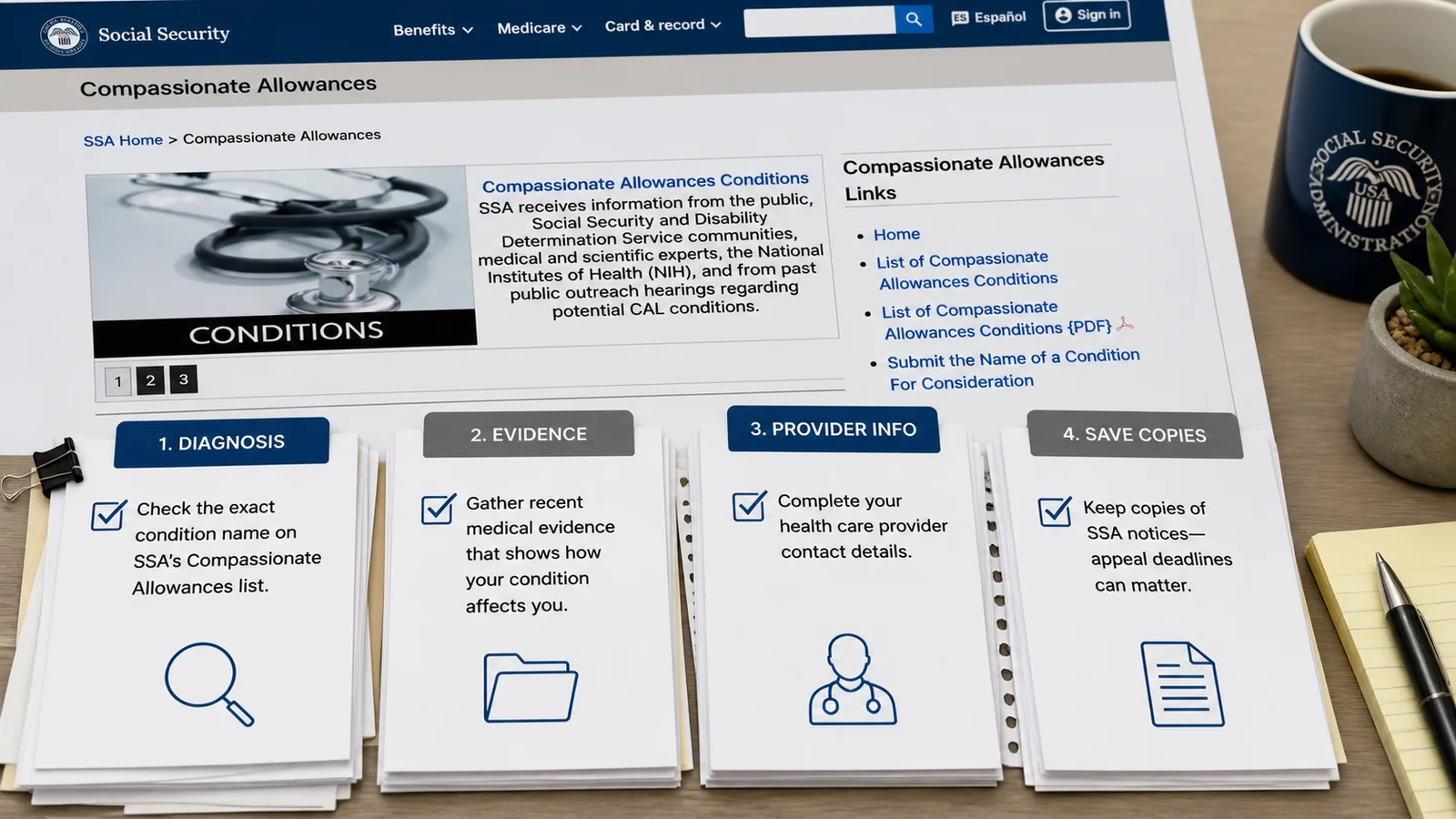
Start with the diagnosis name. If a doctor uses a broader umbrella term, ask whether the medical record also includes the specific condition name that appears on SSA's list. Do not change medical language yourself; the goal is to make sure the record is precise.
Check whether the claim includes the most current evidence. A new biopsy, genetic report, metastasis finding, neurological evaluation, or specialist letter may be the document that lets the system identify the claim quickly.
Make sure contact information for doctors, hospitals, clinics, and labs is complete. Even when electronic records are available, SSA may need to request records or clarify evidence. Missing provider details can turn a potentially fast claim into a follow-up problem.
Keep copies of what was submitted, the filing date, and every SSA notice. If SSA denies the claim, appeal deadlines matter. NCOA notes that people generally must request an appeal within 60 days of the benefits determination.
Common mistakes
The first mistake is assuming the list replaces a full disability application. It does not. Applicants still need to file through SSA and provide the information needed to evaluate the claim.
The second mistake is waiting for perfect paperwork when the family is already in crisis. If a diagnosis is severe and records are available, filing promptly and then responding quickly to SSA requests may be better than delaying for weeks while trying to assemble an ideal packet.
The third mistake is treating a fast approval as guaranteed. Some claims require more review, and some applicants may satisfy the medical test but not the nonmedical rules for the program they chose.
What to watch next
SSA's new list total is 314 conditions as of August 11, 2026. Families should watch the agency's official Compassionate Allowances page for future additions, because advocacy groups, medical experts, the public, and disability determination communities can submit conditions for consideration.
For now, the safest rule is simple: use the official list, match the diagnosis carefully, file the right SSDI or SSI claim, and keep medical proof close. The fast track is most useful when the claim makes the serious condition easy for SSA to recognize.


