
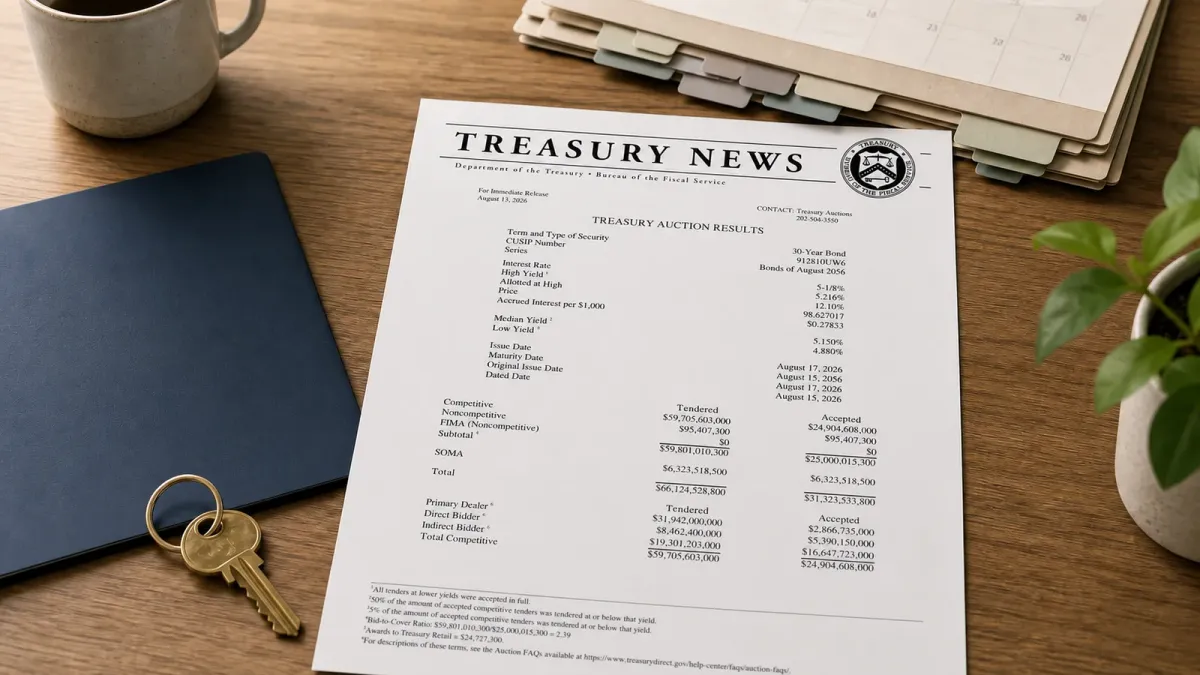
A 5.216% yield on a U.S. Treasury bond can look like a rare chance to lock in income. The catch is the lock itself: the new bond matures in August 2056, and its market value could fall well below what you paid if rates rise and you need to sell early.
The short answer is to match the bond to money you can leave invested for decades. If the cash may be needed for a home purchase, tuition, retirement withdrawals or an emergency, a shorter Treasury ladder may offer less income but much less exposure to a forced sale at the wrong time.
That is the practical consequence of Thursday's auction. On August 13, the U.S. Department of the Treasury sold $25 billion of new 30-year bonds at a high yield of 5.216%, the highest auction yield for that maturity since 2001. The official results show a 5.125% coupon, a price of $98.627017 for each $100 of face value and a bid-to-cover ratio of 2.39.
Yield is not the same as the coupon
The 5.125% coupon is the fixed annual interest rate applied to the bond's face value, paid in two installments each year. The 5.216% auction yield is slightly higher because buyers paid less than face value. If an investor holds the bond to maturity and the Treasury makes all scheduled payments, that below-par purchase price contributes to the overall yield.
This distinction matters when comparing the auction with a brokerage quote. A bond already trading in the secondary market may show a different price and yield even when it carries the same coupon. Look for yield to maturity, not just the coupon, and include any brokerage markup or fee in the comparison.
The main risk is needing an exit
Treasury securities are backed by the U.S. government, but that does not make their market price stable. The Securities and Exchange Commission's Investor.gov guidance says longer maturities generally carry more interest-rate risk. FINRA explains the same relationship through duration: when market rates rise, existing fixed-rate bond prices usually fall, and longer-duration bonds tend to move more.
A simple example shows the problem. If new 30-year bonds later offer a meaningfully higher yield, an older 5.125% coupon becomes less attractive. A buyer in the secondary market will generally demand a lower price to accept that smaller income stream. The original holder still receives the scheduled coupon and face value at maturity, but a sale before 2056 can lock in a loss.
The reverse can also happen. If long-term rates fall, the bond's fixed coupon may become more valuable and its market price can rise. That potential gain is not guaranteed, and it should not turn a cash-reserve decision into a rate bet.

An individual bond is not a bond fund
An individual Treasury bond has a stated maturity date and face value. A bond fund instead holds a changing portfolio, has ongoing expenses and does not promise that an investor's shares will return to a particular price on a particular date. Both can lose market value when rates rise.
That difference changes the planning question. Someone matching a known future expense may prefer individual maturities. Someone seeking diversification and easier trading may prefer a fund, while accepting that the fund itself does not mature. Compare duration, expenses and holdings before treating the two products as interchangeable.
Inflation can erode a fixed payment
A nominal Treasury bond pays the same dollar coupon for 30 years. What those dollars buy is uncertain. If inflation stays elevated for a long stretch, the real purchasing power of the income and the principal returned in 2056 will shrink.
Investors who specifically want inflation protection can compare Treasury Inflation-Protected Securities, whose principal adjusts with the Consumer Price Index. TIPS have their own pricing and tax considerations, so the useful comparison is not simply which stated yield is larger. It is whether the investor wants fixed nominal income or inflation-linked principal.
Check the account and tax rules
TreasuryDirect allows noncompetitive bids in increments of $100, and noncompetitive bidders accept the yield set by the auction. Treasury interest is subject to federal income tax but exempt from state and local income taxes, according to TreasuryDirect. The after-tax advantage can therefore vary by state and account type.
Liquidity also depends on where the bond is held. TreasuryDirect says a marketable security bought there must remain in the account for 45 days before it can be transferred for sale, and selling requires a bank, broker or dealer. A brokerage account can make secondary-market trading easier, but the price at that moment still determines whether the sale produces a gain or loss.
A decision rule before buying
Start with the date the money may be needed, not the headline yield. Divide planned spending into time horizons, then choose maturities that arrive near those dates. A 30-year bond is easiest to defend when the investor wants long-lasting fixed income, understands the inflation tradeoff and can tolerate a large paper loss without being forced to sell.
For money with uncertain timing, consider spreading purchases across shorter bills, notes and bonds instead of placing the full amount at one maturity. A ladder reduces the chance that every dollar must be sold during the same unfavorable rate environment and creates regular opportunities to reassess yields.
Finally, compare the extra income from going all the way to 30 years with the flexibility surrendered. The August 13 auction made long-term Treasuries unusually tempting. It did not remove duration risk, inflation risk or the possibility that life changes before 2056.
This article is general educational information, not personalized investment or tax advice. Consider your time horizon, liquidity needs and tax situation, and consult a qualified professional when appropriate.


