
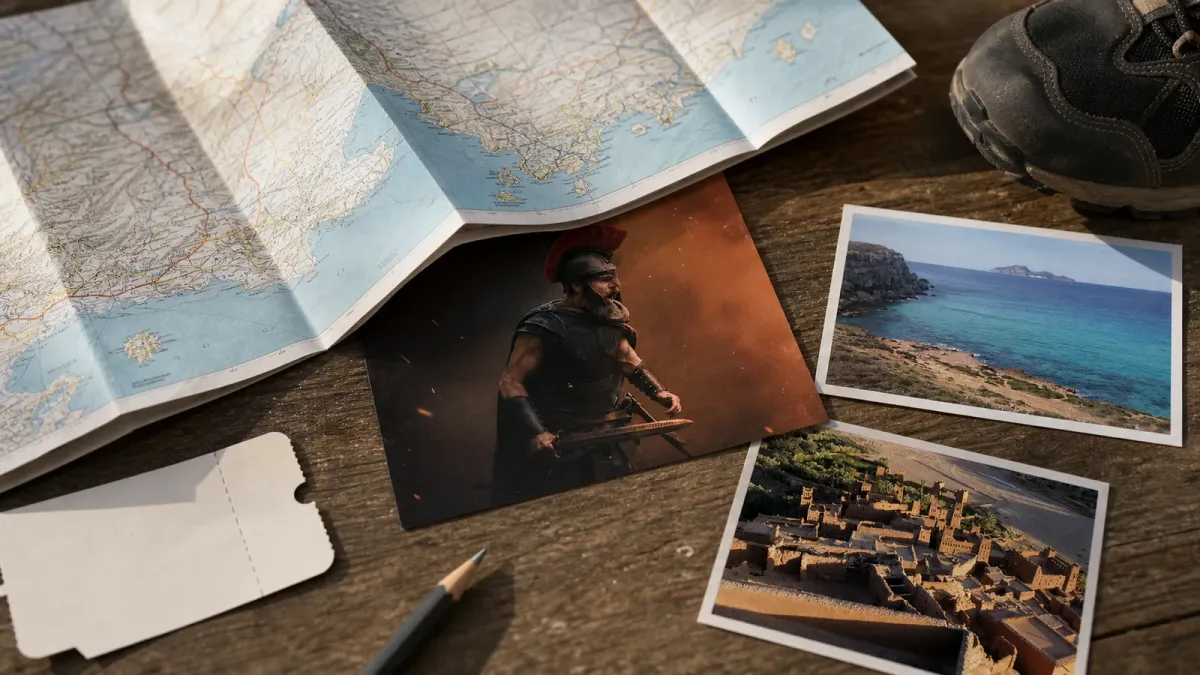
Christopher Nolan's The Odyssey has become more than a moviegoing event. After four weekends in theaters, the Universal release crossed $1.1 billion worldwide, according to studio estimates reported by the Associated Press on Sunday, August 9, and it has put several real filming locations back into travelers' search windows.
The short answer for anyone tempted to build a trip around the movie: choose the place by logistics first, not by myth. A film can make a cliff, beach or fortified village feel like one continuous ancient world. Your itinerary will be ferries, trail conditions, ticket windows, heat, crowds and travel time.
The short answer
If you want the easiest Odyssey-inspired trip, start with one region and build around it. Greece's southwestern Peloponnese gives travelers Voidokilia Beach, Nestor's Cave and nearby Pylos in one cluster. Western Sicily gives travelers Favignana and the Egadi Islands by ferry from Trapani. Morocco's Ait Benhaddou works best as part of a Marrakech or Ouarzazate route, while Findlater Castle in Scotland is better for travelers already comfortable with rural driving, coastal paths and ruins.
Do not assume the movie's fictional geography maps cleanly onto a vacation. Fox News listed locations used for scenes tied to Troy, Ithaca and the Cyclops, while NBCUniversal described production across Morocco, Greece, Italy, Iceland, Scotland and more. That means the emotional route on screen is not the most efficient route on a calendar.
How we chose
This guide weighs three things: a location's connection to the film, the effort required to reach it and the risk that a traveler books the fantasy while missing the practical details. It is not a ranking of the prettiest landscapes, and it is not a claim that every place is easy to visit.
The timing matters because the movie is still in its theatrical run. AP reported that The Odyssey added $31.5 million domestically in its fourth weekend and reached $1.1 billion globally, becoming Nolan's highest-grossing film before adjusting for inflation. CNN has also covered the unusual demand around premium-format screenings, including sold-out IMAX 70 mm showings. That kind of attention can quickly spill into travel planning.
Quick picks
- Best first choice: the Peloponnese, if you want beaches, ruins and a compact route.
- Best island option: Favignana, if ferry timing and summer crowds do not bother you.
- Best architecture stop: Ait Benhaddou, if you are already planning Morocco.
- Best rugged add-on: Findlater Castle, if northeast Scotland fits your trip.
- Best reason to wait: you want lower prices, fewer crowds or more complete official tourism guidance after the first wave of film attention passes.
Greece: best for a compact route
Voidokilia Beach and Nestor's Cave are the most straightforward pair for travelers who want the movie connection and a real landscape that can anchor a trip. Fox described Voidokilia as one of the Greek filming locations and noted that Nestor's Cave sits above the beach, reachable by a rocky, steep trail.
That makes Greece the strongest choice for travelers who want one base, several nearby stops and a route that can still work even if one site is too crowded or too hot on a given day. The tradeoff is that the famous image may attract people who underestimate the terrain. If the cave is the reason for going, check footwear, daylight, trail conditions and whether everyone in the group is comfortable with a climb.
Sicily: best for island scenery with ferry math
Favignana, the largest of Sicily's Egadi Islands, was used to represent Ithaca in the film, according to Fox. The island is reachable from Trapani by ferry, which makes it appealing but also adds a layer of planning that a mainland stop does not have.
For travelers, the key question is whether Favignana is the trip or one piece of a broader Sicily route. If you only have a few days, ferry schedules, luggage, summer demand and lodging availability may matter more than the movie connection. If you already plan to spend time in western Sicily, Favignana can become a focused day or overnight stop rather than a rushed detour.
Morocco: best when architecture is the point
Ait Benhaddou, the fortified settlement near Ouarzazate, is one of the most visually distinct locations tied to the film's ancient-world scale. Fox reported that it served as part of ancient Troy, while NBCUniversal's behind-the-scenes material says the production moved through Morocco as part of its global location work.
This is the stop for travelers who care about architecture, film history and desert-edge landscapes more than beach imagery. The caution is distance. Marrakech is roughly a long overland ride away, and the route can turn a simple movie idea into a full-day commitment. Check whether you want an organized tour, private driver or overnight route before you book flights around it.
Scotland: best as a rugged add-on
Findlater Castle, on Scotland's northeast coast, gives the Odyssey itinerary a different mood: ruins, cliffs and North Sea exposure rather than Mediterranean light. Fox cited the castle as one of Nolan's Scottish filming locations and noted its long history and coastal setting.
For many U.S. travelers, this is not the natural first stop unless Scotland is already on the itinerary. It can be rewarding, but it is less plug-and-play than a city break. Treat it as a rural coastal add-on, not a quick attraction you can safely squeeze between tight train times without checking access.
Common mistakes
The first mistake is chasing every location. The film was built from a global production map; a satisfying vacation does not need to reproduce it. Pick one region and make the trip coherent.
The second mistake is assuming the place on screen is the same as the myth. Ait Benhaddou can stand in for Troy, and Favignana can represent Ithaca, but the real value of visiting is the actual landscape, culture and history in front of you.
The third mistake is booking too close to peak demand. When a film crosses a major box-office threshold and location stories circulate, flights, ferries, hotel rooms and local tour slots can tighten. That does not mean panic-booking is smart. It means checking change policies before committing.
How to choose
Use a simple rule: if the location still sounds worth visiting without the movie, it belongs on your list. If the only reason is a screenshot, wait until more practical information, prices and crowd patterns are clear.
Start with the constraint you cannot change. If you have one week, choose Greece or Sicily, not a continent-hopping route. If you want beaches, do not make Morocco's inland architecture the centerpiece. If mobility is a concern, do not make a rocky trail or rural castle ruin the must-do stop.
The movie's achievement is that it made ancient travel feel physical again. The traveler's job is less romantic but more useful: turn that pull into a route that survives real dates, real budgets and real feet.


