
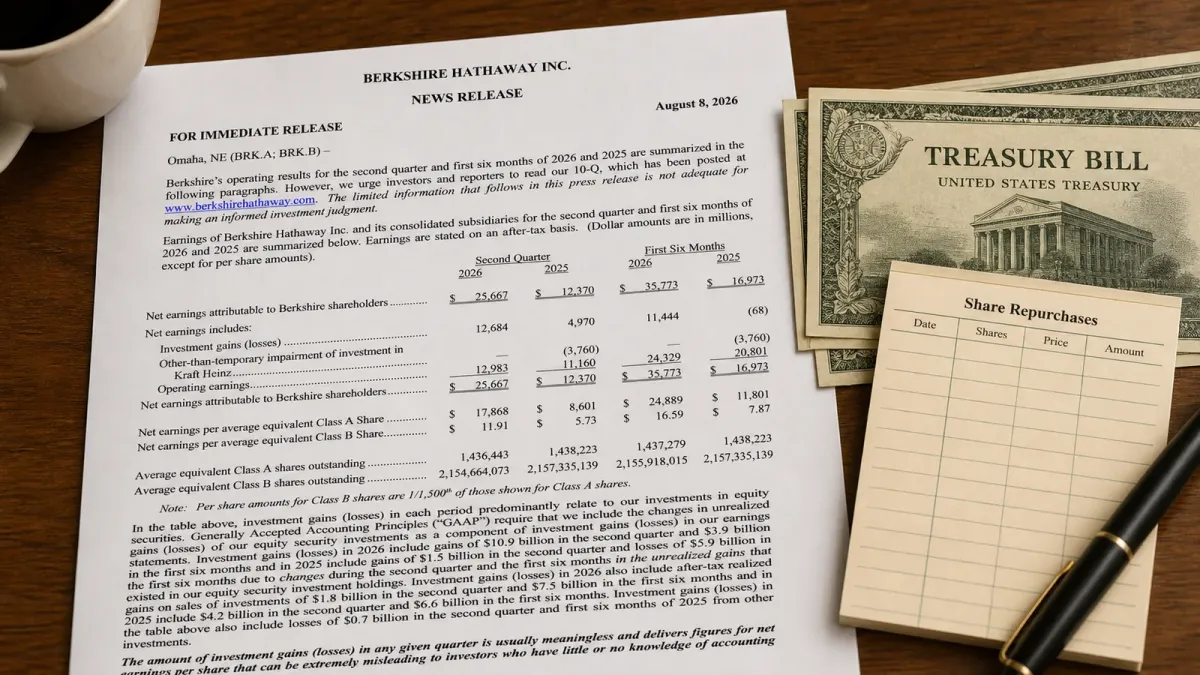
Berkshire Hathaway’s second-quarter report gave investors a clearer first look at Greg Abel’s capital-allocation style: the cash pile is still enormous, but it is no longer standing completely still.
The company said on August 8, 2026, that operating earnings rose to $12.983 billion in the second quarter, up from $11.160 billion a year earlier. Net earnings attributable to Berkshire shareholders more than doubled to $25.667 billion, helped by investment gains that Berkshire itself warns can make quarterly profit look more volatile than the operating business really is.
The numbers
The most visible change was buybacks. Berkshire said it acquired about $4.5 billion of its own shares during the second quarter, bringing the first-half total to about $4.8 billion. The company’s 10-Q says repurchases are allowed only when the chief executive, after consulting the chairman, believes the price is below Berkshire’s conservatively determined intrinsic value.
Berkshire also said its insurance and other businesses held $359.2 billion in cash, cash equivalents and U.S. Treasury bills at June 30, net of unsettled-purchase payables. That is still a fortress balance sheet, not a company running down its reserves. But the buyback, the January purchase of OxyChem and the July 24 completion of the Taylor Morrison acquisition show Abel is willing to move capital when he sees a fit.
The scale matters because even after those moves, Berkshire’s liquidity is larger than the market value of many major public companies. The question is not whether Berkshire has enough cash. It is whether the new leadership will keep finding ways to deploy it without weakening the reserve culture that made the company unusually resilient.
Why investors care
The report matters because Berkshire is no ordinary quarterly earnings story. For years, Warren Buffett’s growing cash position was read as both protection and a warning: protection because Berkshire could act in a crisis, and a warning because attractive large deals were hard to find.
Abel, who became chief executive in January while Buffett remained chairman, is now being judged by the same standard. Investors are watching whether he can keep Berkshire’s discipline while avoiding the impression that the company is too cautious to use its own balance sheet.
The operating picture was mixed. Manufacturing, service and retailing earnings rose to $4.470 billion from $3.601 billion a year earlier. BNSF and Berkshire Hathaway Energy also improved. Insurance underwriting earnings, however, fell to $1.731 billion from $1.992 billion, and Berkshire said GEICO faced higher claims frequency and severity in the first half.
The caveat
This is not a clean buy signal or sell signal. Berkshire’s own release tells investors and reporters to read the 10-Q and says the short release is not enough for an informed investment judgment. The bigger takeaway is narrower: Abel’s Berkshire is still liquidity-rich, but the second quarter showed more willingness to use that liquidity through repurchases and acquisitions.
What to watch next
The next test is whether the new spending pace continues after the Taylor Morrison deal closes into Berkshire’s third-quarter numbers. Investors should also watch whether additional stock purchases appear in future portfolio filings, whether GEICO’s claim costs stabilize, and whether Berkshire keeps buying back shares if the stock rises.


