
Berkshire Hathaway's first year under Greg Abel is starting to look less like a cash-hoarding handoff and more like a capital-allocation test.
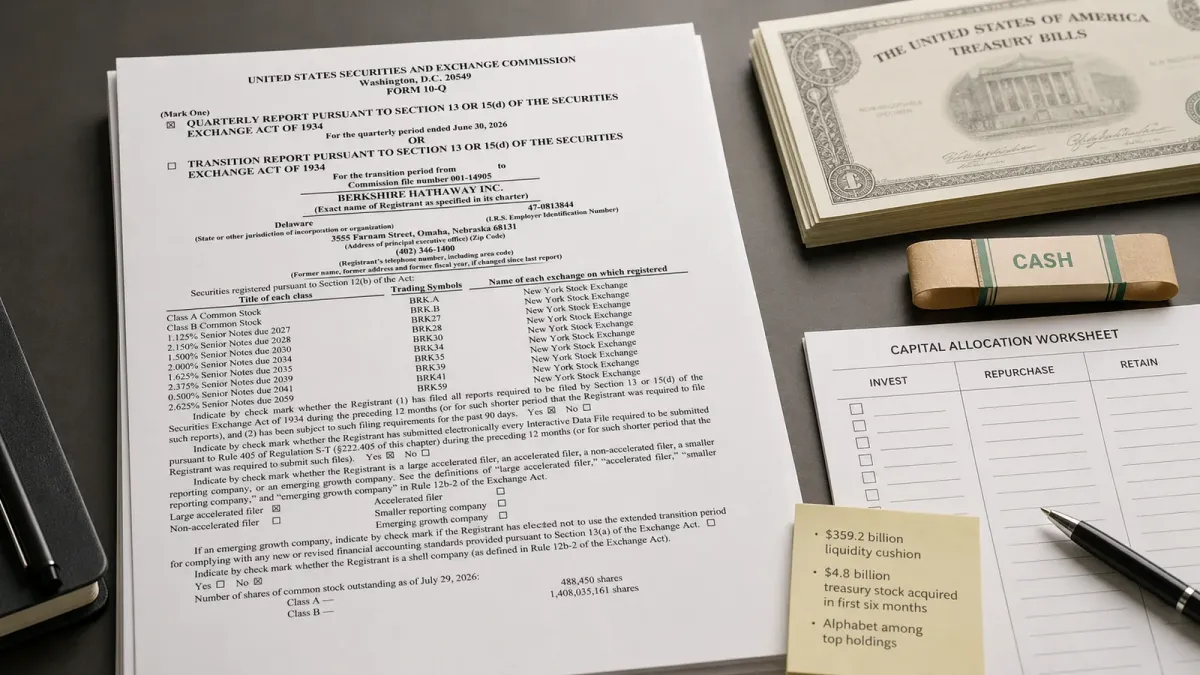
The company said in its second-quarter report that its insurance and other businesses held $359.2 billion in cash, cash equivalents and U.S. Treasury bills, net of unsettled Treasury-bill purchases, as of June 30, 2026. That is still an enormous cushion, but the report also shows Berkshire buying back more of its own shares and putting more money into equities than investors had seen during the final stretch of Warren Buffett's run as chief executive.
The useful question for shareholders is not whether Berkshire suddenly became aggressive. It is whether Abel can spend enough to improve returns without giving up the financial discipline that made the company a refuge for patient investors.
The numbers
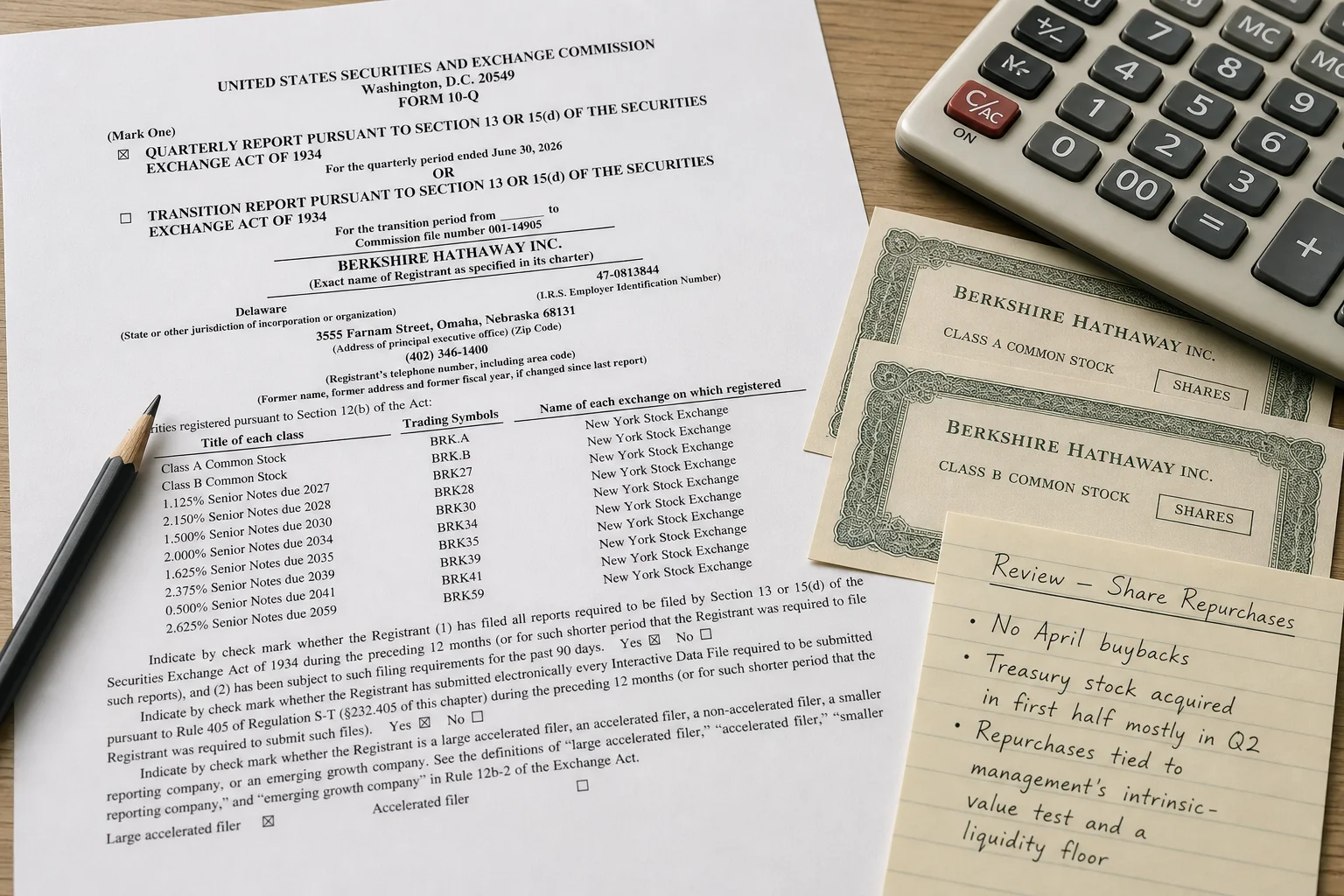
Berkshire said it acquired $4.8 billion of treasury stock in the first six months of 2026, with most of that repurchase activity happening in the second quarter. Its second-quarter table shows no April buybacks, then Class A and Class B repurchases in May and June.
The company also disclosed that its five largest equity holdings at June 30 were Alphabet, American Express, Apple, Bank of America and Coca-Cola. That list matters because Alphabet was not just a passing market headline; it was large enough to appear among Berkshire's biggest public-stock positions at quarter-end.
Berkshire also remained a giant liquidity machine. Shareholders' equity stood at $747.9 billion at June 30, up $30.5 billion from the end of 2025. Net earnings attributable to Berkshire shareholders were $35.8 billion for the first six months of 2026, including about $11.4 billion of after-tax investment gains.
Why investors care
For years, one of the central Berkshire debates was what Buffett's successor would do with the company's cash mountain. Holding cash protected Berkshire from forced selling and gave it optionality, but it also weighed on returns when stocks were rising and acquisition targets were expensive.
Abel's early moves suggest Berkshire is willing to act when management sees value, especially in its own shares. The company says its repurchase program allows buybacks only when the chief executive, after consulting the chairman, believes the shares trade below intrinsic value. The program has no fixed size and no expiration date.
That makes the buyback signal more important than the dollar amount alone. Berkshire is not simply returning excess cash by formula. It is saying management saw a price where repurchases cleared its internal value test.
The caveat
The shift has limits. Berkshire said it will not repurchase common stock if doing so would reduce consolidated cash, cash equivalents and U.S. Treasury bills below $30 billion. It also emphasized that financial strength and redundant liquidity remain paramount.
That language keeps the story from becoming a clean break with Buffett. Abel appears to be using the balance sheet, but the company is still presenting liquidity as a core operating advantage rather than idle money to be drained quickly.
There are operating caveats, too. Berkshire's reported earnings can swing with market prices in its equity portfolio, and the company warned again that investment gains and losses can add volatility that says little about underlying operating performance. Insurance results, railroad performance, energy operations, acquisitions and interest income all still matter alongside the headline cash figure.
What to watch next
The next test is whether the June-quarter activity becomes a pattern. Investors will be watching future filings for the size of the Alphabet position, whether Berkshire keeps buying back shares, and whether the company continues to find operating acquisitions after completing OxyChem in January and Taylor Morrison in July.
For ordinary investors, the takeaway is narrower than a buy or sell call. Berkshire's report shows that the post-Buffett era is not just about who sits in the CEO chair. It is about how often management decides cash is less valuable than a repurchase, a public stock, or a whole business.
If Abel keeps moving slowly, Berkshire remains the same fortress with a little more motion inside it. If he moves faster, shareholders will have to judge whether the new activity improves returns or chips away at the patience that made the company different.


