

The best businesses to start in 2026 are not necessarily the flashiest ones. The stronger opportunities sit where households and companies already feel pressure: adopting AI without wasting money, caring for older relatives, keeping homes efficient through severe weather, and running leaner operations.
Startup appetite is still high. The U.S. Census Bureau said business applications reached 523,971 in May 2026, up 3.7% from April, while projected business formations within four quarters rose to 29,493. Those figures do not guarantee easy money, but they show that many would-be founders are still moving from idea to paperwork.
The useful question is narrower: which businesses solve a problem that customers will keep paying for after the novelty fades? In 2026, that points less toward generic online stores and more toward focused services with clear buyers, measurable savings, or recurring demand.
AI workflow services for ordinary companies
AI is moving from experimentation into daily operations, but many small and midsize companies do not have the staff to pick tools, clean up data, write policies, train teams, or measure whether automation is saving time. Gartner said in May 2026 that AI agent software spending is expected to reach $206.5 billion this year and $376.3 billion in 2027, a sign that companies will keep buying automation even as they become more selective.
That creates room for small businesses that do not try to build a new foundation model. More realistic ideas include AI workflow setup for clinics, law offices, accountants, real estate teams, contractors, local retailers, and nonprofits. A founder can package services around intake forms, customer support drafts, proposal generation, invoice follow-up, inventory alerts, knowledge bases, and internal training.
The durable version of this business is not selling hype. It is documenting a workflow, choosing a safe tool stack, testing outputs, protecting customer data, and showing the client how much time or error rate improved. Industry-specific knowledge matters more than broad AI enthusiasm.
Aging-in-place and caregiver support
Demographics make care-related services one of the clearest 2026 opportunities. The Bureau of Labor Statistics projects healthcare and social assistance to be the fastest-growing major sector from 2024 to 2034, adding roughly 2.0 million jobs. BLS also says home health and personal care aides are projected to add the most jobs of all detailed occupations.
Not every founder needs to run a licensed medical agency. Adjacent businesses can serve families and care providers: nonmedical senior concierge services, transportation coordination, home safety audits, meal-prep support, caregiver scheduling, respite-care matching, billing help, and technology setup for remote check-ins. The compliance line is important, so founders should understand local rules before offering anything that looks like medical care.
Home resilience, energy and maintenance
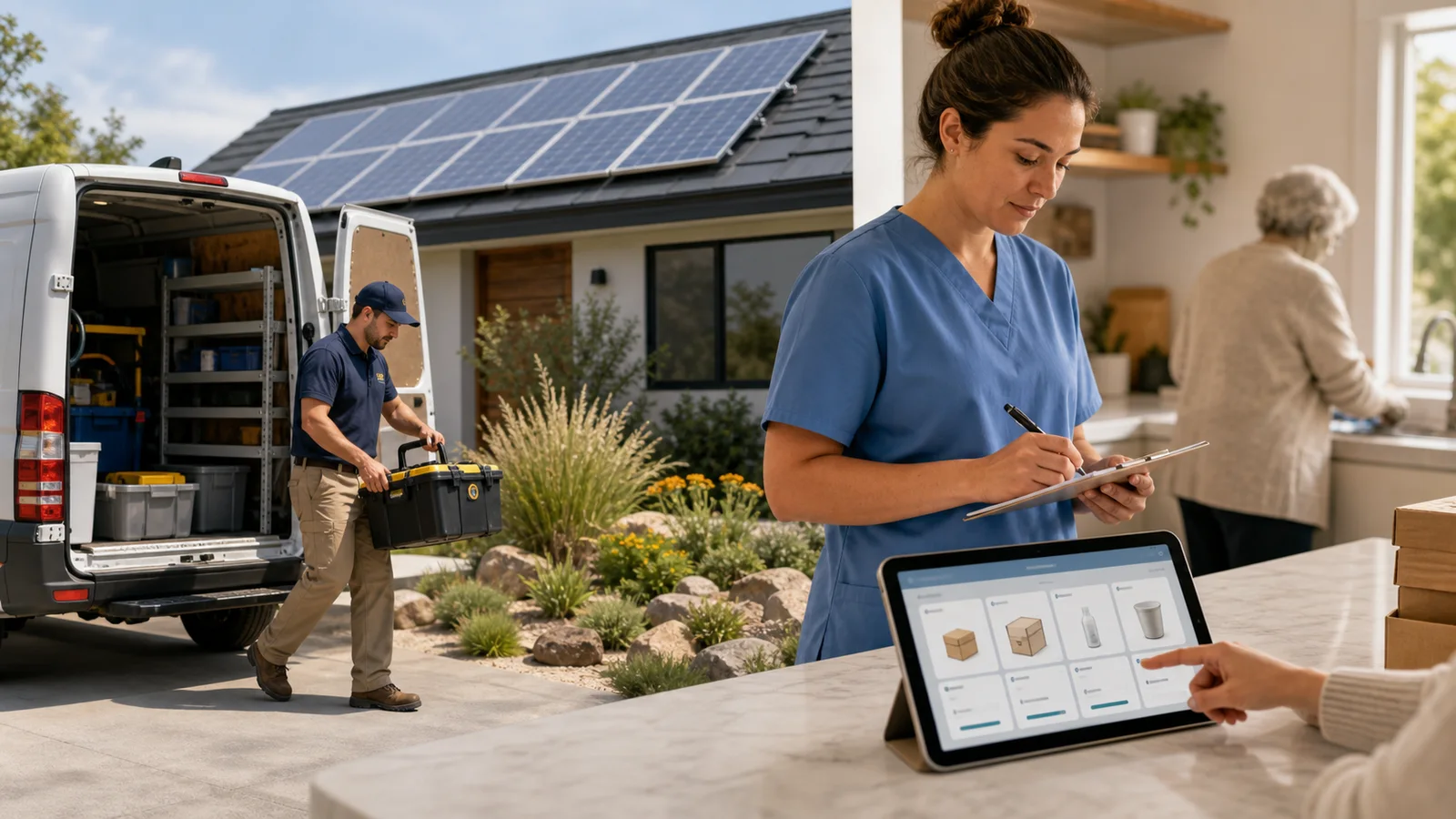
Homes are becoming more complicated to maintain. Solar panels, batteries, heat pumps, smart thermostats, leak sensors, backup power, wildfire defensible-space work, storm preparation and energy-efficiency upgrades all create demand for installers, inspectors, maintenance providers and coordinators. BLS lists solar photovoltaic installers among the fastest-growing occupations in its 2024-2034 outlook.
For a small founder, the opening may be in the unglamorous layer around the trade: lead qualification, maintenance plans, post-installation monitoring, rebate paperwork, home-energy checkups, emergency-prep kits, or specialized cleaning and inspection. In many markets, homeowners do not need another vague green brand; they need someone who can show up, explain the options plainly, and coordinate reliable work.
B2B services around the physical economy
Some of the fastest-growing industries are too capital-intensive for most new founders. IBISWorld lists hyperscale data center services among the fastest-growing U.S. industries in 2026, for example, but few people can start a data center. The small-business opportunity is often in the support layer: electrical subcontracting, site security, specialty cleaning, logistics, staffing, permitting support, technical recruiting, environmental monitoring, catering, and maintenance.
The same pattern applies to construction, local manufacturing, healthcare offices, and professional services. Companies that grow quickly still need bookkeeping, compliance calendars, CRM cleanup, vendor management, safety training, and customer onboarding. A narrow B2B service with a clear monthly retainer can be more resilient than a broad consulting offer.
Repair, resale and specialized local services
Consumers remain price-sensitive, and that can favor repair and resale businesses when they are specific enough. Appliance repair coordination, phone and device refurbishment, furniture repair, children’s gear resale, tool libraries, specialty moving, estate cleanouts, and subscription maintenance for rental properties can all work when the founder understands local demand and unit economics.
The mistake is starting with a product category because it sounds trendy. Start with a customer segment: landlords with too many small maintenance calls, families helping older relatives downsize, busy parents buying used gear, or small retailers that need inventory photographed and listed online. Then build a repeatable service around the work they already avoid.
How to choose one
A good 2026 startup test is simple. Can you name the buyer? Can you reach 50 of them without paid ads? Does the service save time, reduce risk, increase revenue, or handle an obligation they cannot ignore? Can you deliver the first version with tools and labor you already understand?
Founders should also be careful with licensing, insurance and data privacy. Care, finance, home contracting, transportation and AI services can cross regulatory lines quickly. The safest path is often to begin with a narrow, well-defined service, charge for a pilot, collect proof of value, and expand only after the operational details are boring.
The opportunity in 2026 is not just to chase the newest technology. It is to build a business where technology, demographics and practical household or company needs meet. The founders with an edge will be the ones who can turn a broad trend into a service customers understand on the first call.


