
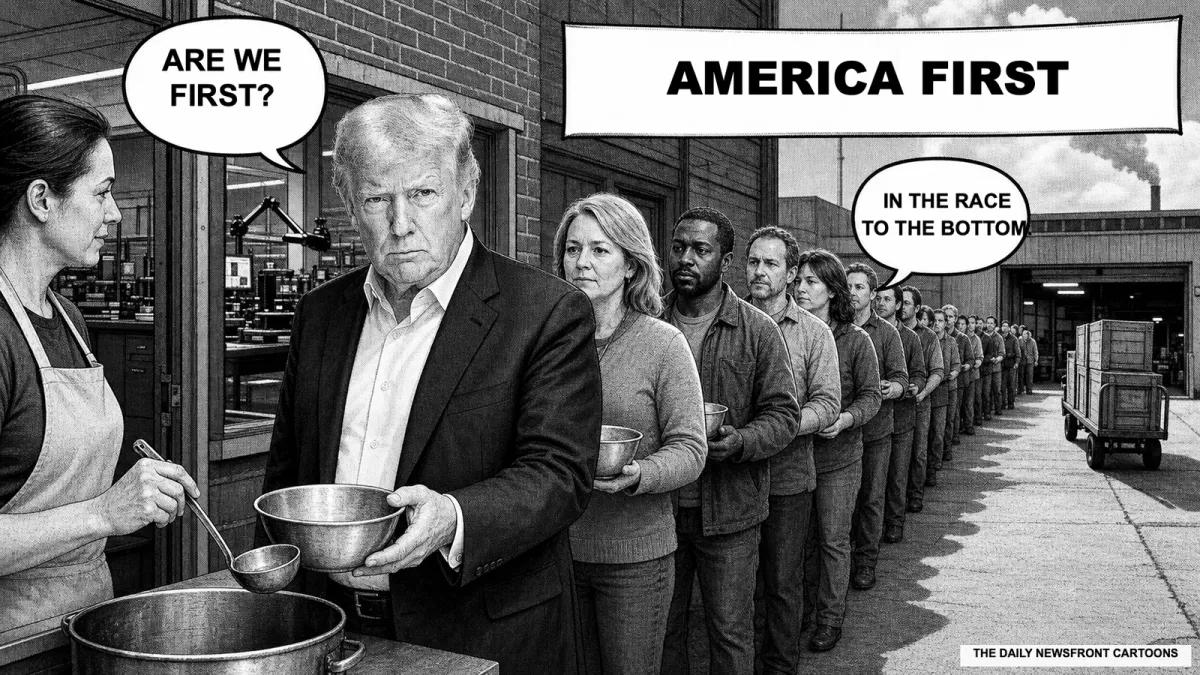
Donald Trump leads a long line of Americans into a fictional soup kitchen beneath an “AMERICA FIRST” banner. Behind the line sit the visual leftovers of lost competitiveness: an idle factory loading bay, a dark research bench and trade crates moving away. Trump asks the volunteer, “Are we first?” The answer: “In the race to the bottom.”
The people waiting for soup are not the joke. The target is the economic wager behind America First policies: that tariffs, economic separation and a smaller foreign-born workforce can make the country stronger even when they raise costs, narrow access to talent and reduce the pressure to compete.
What is fact
The White House argues that its America First trade policy protects American workers, encourages manufacturing investment and strengthens economic security. Those are real goals, and some protected industries can gain production as imports become more expensive.
The Congressional Budget Office identifies the other side of the tradeoff. Its 2026 outlook says higher tariffs weigh on growth by increasing the cost of imported goods and production inputs, reducing foreign investment and lowering the efficiency of the U.S. economy. CBO also says reduced immigration slows labor-force growth and potential output. Its longer-run projections connect higher tariffs with weaker productivity growth.
International Monetary Fund staff estimated in their 2026 U.S. review that the tariffs then in place would reduce the level of U.S. GDP by about 0.6 percent. The IMF also estimated that stricter immigration enforcement and removals would reduce economic activity by about 0.4 percent by 2027. Exact effects remain uncertain because tariff policy keeps changing, businesses adapt and tax or regulatory changes may offset part of the drag.
What is satire
No economic forecast says every American will become poor, and Trump did not lead a real soup line or speak this dialogue. The soup kitchen exaggerates a directional risk: policies sold as national strength can leave the country less productive, less attractive to investment and less able to afford what it needs.
The cartoon’s argument is simple. Being first in a slogan is not the same as staying competitive in the world.


