
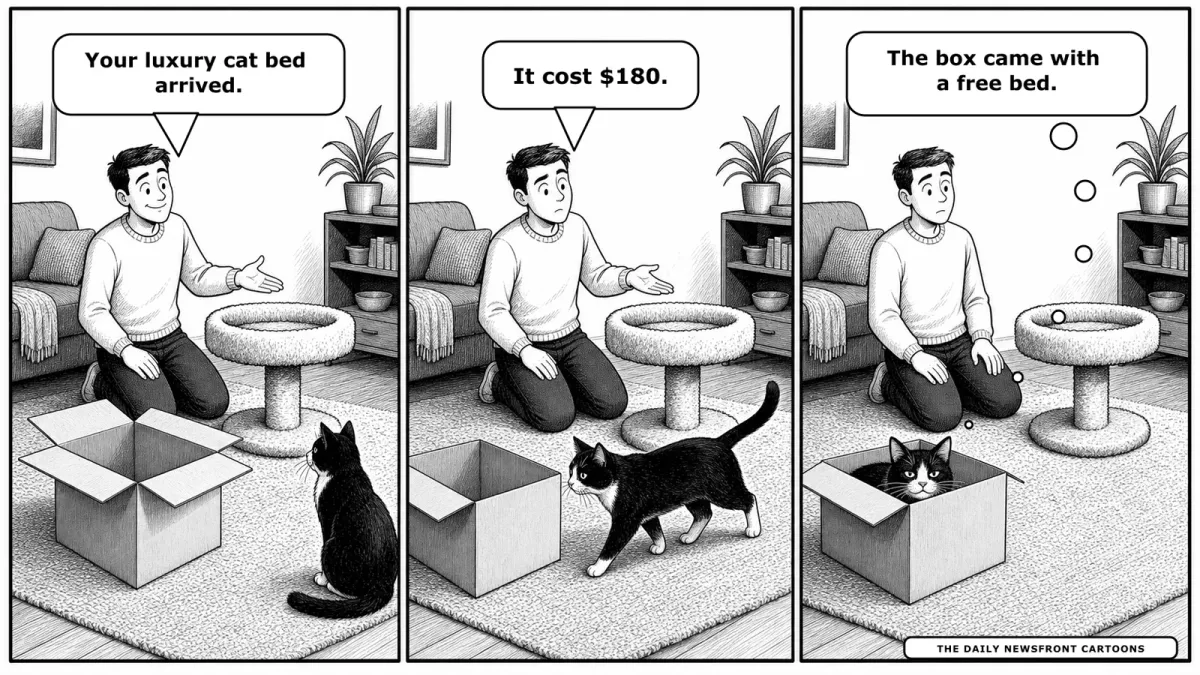
The purchase arrives with every promise a cat owner could want: a soft surface, a carefully engineered shape and a price that suggests permanent gratitude. The human assembles the new bed. The cat watches with the grave attention of an inspector who has already found a more important feature.
That feature is the shipping carton. In this fictional household, the cat walks past the finished bed, settles into the box and calmly reclassifies the entire transaction: the box came with a free bed.
Why the box gets a fair hearing
The joke is exaggerated, but cardboard can be a perfectly respectable part of a cat's environment. The Cornell Feline Health Center notes that cardboard boxes and paper bags can be entertaining for cats and that useful enrichment does not have to be expensive.
There is also limited evidence for boxes as hiding enrichment in specific settings. In a randomized trial involving 23 newly arrived Dutch shelter cats, the group given hiding boxes reached lower behavioral stress scores faster than the group without them. The study was conducted in shelter quarantine, so it does not prove that every household cat prefers packaging to a purchased bed.
The joke, and the practical part
The cat, human, product, price and dialogue in the cartoon are invented satire. The target is the familiar collision between human ideas of value and a cat's apparently simpler product review.
Before offering a shipping box, remove staples, loose tape, string and anything a cat could swallow. Use a clean, stable box and replace it if it becomes damaged. A sudden or persistent change in hiding, sleeping or social behavior can have many causes; ask a veterinarian when it comes with other health or behavior concerns.


