
Caterpillar reported the first $20 billion quarter in its history on Tuesday, giving investors and customers a clearer look at how the artificial-intelligence buildout is spilling into industrial equipment, power generation and construction demand.
The company said second-quarter sales and revenues rose 24% from a year earlier to $20.5 billion. Profit per share increased to $7.77, and adjusted profit per share reached $8.17, according to Caterpillar's August 4, 2026 earnings release filed with the Securities and Exchange Commission.
The headline is not just that a heavy-equipment company had a strong quarter. It is that AI infrastructure is becoming a physical construction and power story, not only a chip or software story.
The numbers
Caterpillar said the revenue increase was driven mainly by $3.1 billion in higher sales volume and $595 million in favorable price realization. Operating profit margin rose to 20.9% from 17.3% a year earlier, while adjusted operating profit margin rose to 21.9% from 17.6%.
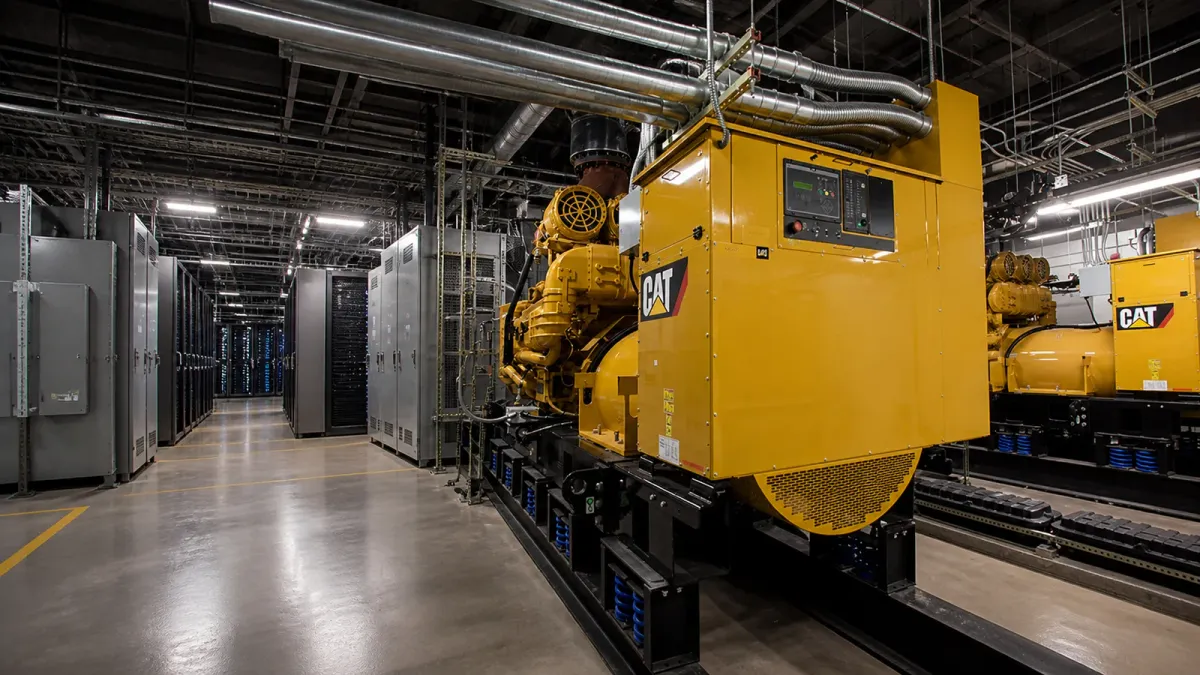
The Power and Energy segment was one of the clearest signals. Caterpillar said segment sales increased by $1.1 billion, or 17%, to $7.6 billion. Within power generation, the company cited higher sales of large reciprocating engines, turbines and turbine-related services, primarily in data-center applications.
Construction Industries sales also rose sharply, increasing 35% to $8.3 billion. Resource Industries sales increased 20% to $4.6 billion. Caterpillar Chairman and CEO Joe Creed said strong order rates and a growing backlog reflected momentum across all three primary segments.
Why AI buyers care about engines and turbines
AI demand is usually described through Nvidia chips, cloud contracts, model releases and electricity use. Caterpillar's report shows the same demand can also land in generator sets, turbines, earthmoving equipment, site work and backup-power systems.
Data centers need land, construction equipment, grid connections, cooling, backup power and maintenance capacity before they can run racks of AI servers. When cloud companies and other large technology customers race to add computing capacity, the spending can reach suppliers that are several steps away from the model itself.
That is why the Caterpillar quarter matters beyond one stock move. It is another signal that AI infrastructure is acting like a capital-spending cycle for industrial companies, utilities, equipment makers and local permitting agencies.
The caveat
A record quarter does not mean the data-center buildout is risk-free. Higher power demand can collide with grid constraints, local opposition, permitting delays and questions about whether AI revenue will justify the scale of spending. Caterpillar's own results also include price increases and broad industrial demand, not a single data-center line item that explains the whole quarter.
Investors also have to separate an earnings result from a stock recommendation. A company can benefit from a powerful theme and still face valuation risk, cyclical demand, tariff costs, project delays or customer pullbacks if the AI investment cycle cools.
What to watch next
The next useful signals are Caterpillar's backlog commentary, power-generation order rates, data-center permitting fights, and earnings from cloud and chip companies that are driving capital spending. If those customers keep raising AI infrastructure budgets, the industrial beneficiaries may remain part of the story.
If the spending pauses, the first warning signs may show up in delayed construction, slower equipment orders, lower generator demand or softer guidance from suppliers that have become tied to the AI buildout.
For readers, the practical takeaway is simple: the AI boom is no longer confined to software screens. It is showing up in factories, construction sites, power systems and the companies that make the machinery behind the cloud.


