
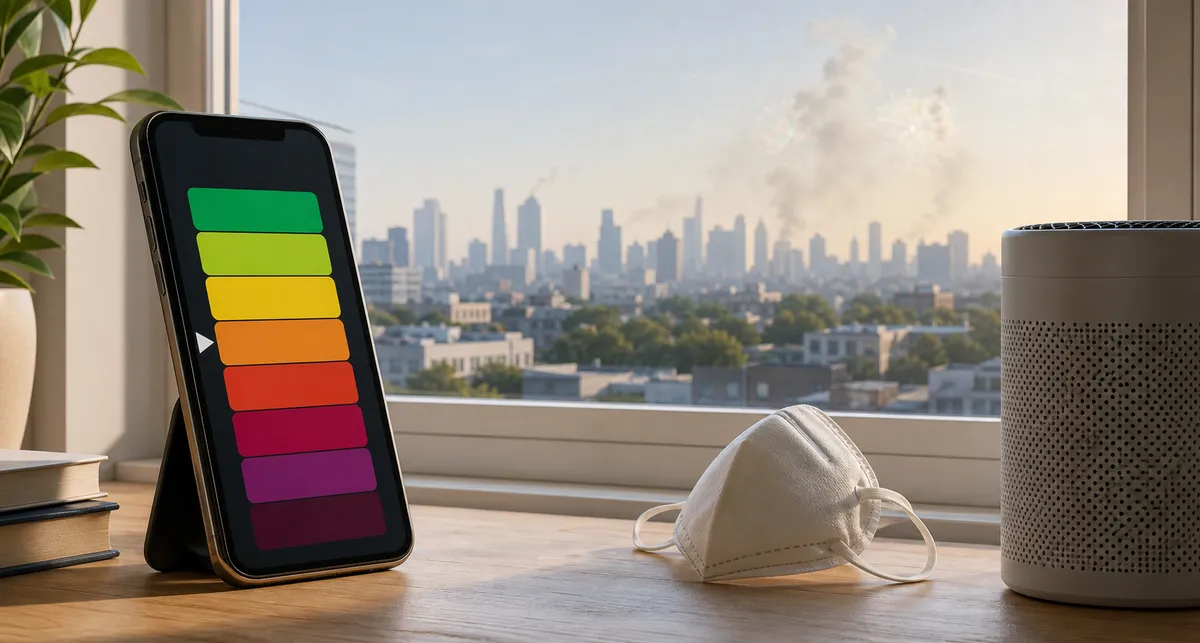
Fireworks smoke does not always disappear when the show ends. Fine particles can linger overnight and into the next day, especially when winds are light, humidity is high, or a city sits in a basin where pollution builds up.
That makes Sunday, July 5, 2026, a useful morning to check the Air Quality Index before a run, youth sports practice, outdoor brunch, dog walk, or cleanup shift. Google Trends showed several fireworks searches rising in the United States late Saturday, and South Coast AQMD warned that July Fourth fireworks were expected to drive particle pollution across parts of Southern California through Sunday afternoon.
The pollutant to watch is usually PM2.5, a fine particle small enough to reach deep into the lungs. AirNow, the federal air-quality site, turns monitored pollution into AQI colors so people do not have to interpret raw measurements.
Start with the color
Green means good air quality. Yellow means moderate conditions, which are usually acceptable but may bother unusually sensitive people. Orange means unhealthy for sensitive groups, including many children, older adults, pregnant people, and people with heart or lung disease. Red means unhealthy for everyone, while purple and maroon signal very unhealthy or hazardous conditions.
The important threshold is 100. Above that, AirNow says air quality first becomes unhealthy for sensitive groups and then, as the number rises, for the wider public. If your local AQI is orange or worse, move strenuous outdoor activity indoors or shorten it. If it is red or worse, even healthy adults should scale back exertion outside.
Check the right map
Use AirNow.gov, your state or local air district, or an official weather and air-quality app rather than a social screenshot from hours earlier. Fireworks smoke can be extremely local. One neighborhood may clear quickly while another stays smoky because of wind direction, valley terrain, or continued backyard fireworks.
If wildfire smoke is also in the region, check the AirNow Fire and Smoke Map. The CDC advises people to track local air quality, keep smoke outside when possible, and wear a properly fitted NIOSH-approved respirator if they must be outside in smoky conditions.
Keep indoor air cleaner
When outdoor air is smoky, close windows and doors, run air conditioning on recirculate if available, and use a portable air cleaner if you have one. AirNow also advises avoiding indoor particle sources during smoke events, including candles, fireplaces, smoking, and unnecessary vacuuming that stirs up dust.
Heat changes the decision. Staying inside with windows closed can be unsafe if the home becomes too hot, especially for older adults, infants, or people with medical conditions. In that case, look for a cleaner-air and cooling option such as a library, community center, mall, relative's home, or official cooling site.
The quick rule is simple: look before you linger outside. If the sky is hazy, you smell smoke, or the AQI is orange or worse, treat the morning after fireworks as an air-quality day, not just a holiday cleanup day. Recheck later in the day because changing wind can clear one area while pushing smoke into another.


