
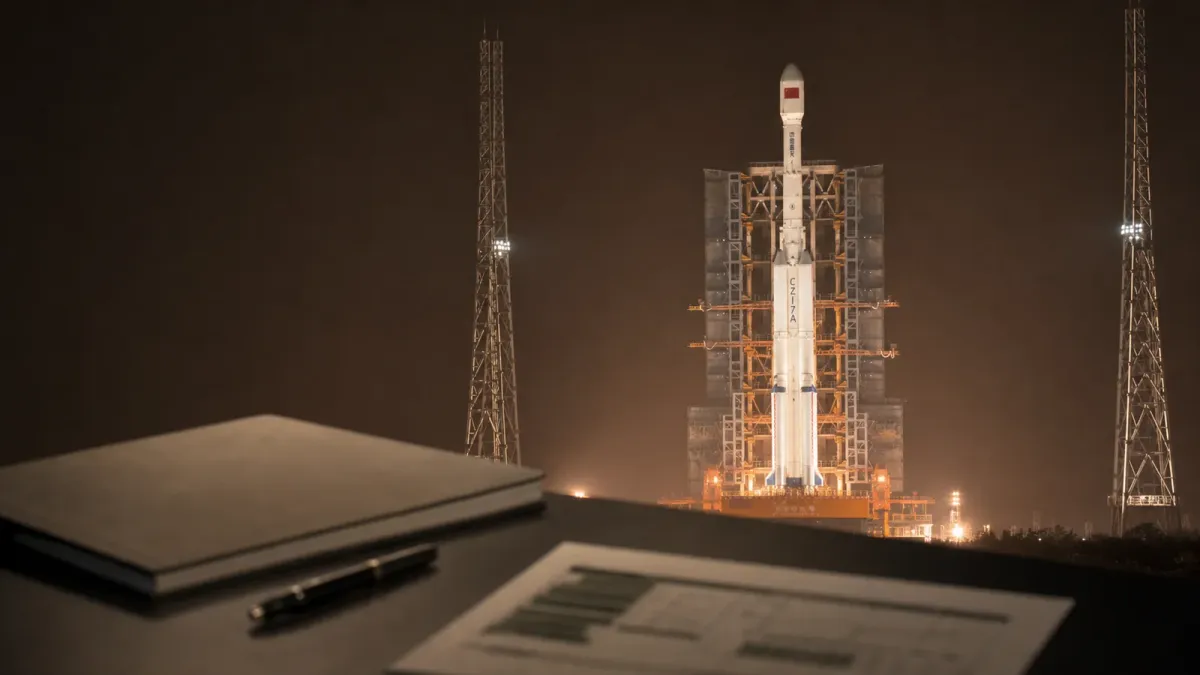
China's launch of the ChinaSat-4B communications satellite failed after a Long March 7A rocket lifted off from the Wenchang Spacecraft Launch Site on Hainan Island on Monday evening, August 10, 2026, according to state media reports cited by the Associated Press and Reuters.
The immediate fact is simple: the satellite did not reach orbit, the mission failed, and Chinese officials said an investigation into the cause was underway. The larger question is whether the failure stays contained to one rocket and one payload, or forces a broader review of China's increasingly busy launch schedule.
For readers, the story matters less as a single dramatic launch video and more as a reliability test. Modern space programs depend on rhythm: communications satellites, military payloads, lunar probes and commercial launch plans all become more expensive when confidence in a vehicle family is interrupted.
What changed
The Long March 7A was carrying ChinaSat-4B, a communications satellite, when the flight suffered an anomaly after liftoff from Wenchang. The Guardian, using Reuters video, said the rocket had lifted off at 8:02 p.m. Beijing time and that Xinhua reported an investigation was underway.
Space.com and the South China Morning Post reported that the failure happened less than 90 seconds after liftoff. AP described it as the first reported failure for the Long March 7A since the rocket's debut in March 2020, while noting that China has used Long March vehicles for many successful communications and internet-satellite launches.
That distinction matters. A launch failure does not automatically mean a whole space program is in crisis. Rockets are complex, and even mature systems fail. But a failure early in flight can trigger hard engineering questions about propulsion, staging, flight software, range safety, manufacturing quality, prelaunch checks or environmental conditions at the pad.
Why one launch failure matters
The Long March 7A is part of China's modern carrier-rocket family and is used for missions that need to place satellites into higher orbits. A lost communications satellite can mean delayed service, replacement costs and a new queue problem for the next payload waiting for a ride.
The more strategic issue is schedule pressure. China is trying to maintain a high launch tempo while also advancing commercial rockets, satellite networks, space-station logistics and lunar ambitions. When a failure occurs, officials have to decide whether to pause similar missions, inspect hardware already in flow, or keep moving while the investigation narrows the fault.
The safest answer is not always the fastest answer. A short pause can protect future missions if investigators find a shared component, supplier issue or flight-condition problem. A narrow finding, by contrast, can limit disruption if the failed mission had a vehicle-specific flaw that does not apply elsewhere.
What we do not know yet
Officials have not publicly identified the cause of the anomaly. Available reports do not establish whether the problem began with an engine, booster, guidance system, structure, ground process or another part of the launch stack.
It also is not yet clear how quickly China can replace the lost ChinaSat-4B capacity, whether a backup spacecraft is available, or whether upcoming Long March 7A missions will be delayed while engineers review the data.
That uncertainty is why early reporting should be careful. The visible explosion explains the outcome, not the cause. Until investigators release more detail, the strongest factual conclusion is that the mission failed shortly after liftoff and that the reliability review now becomes the next story.
What happens next
The next useful signal will be the investigation result or any notice that similar launches are being rescheduled. Watch for whether Chinese space authorities describe the issue as isolated, order inspections, or make public changes to future Long March 7A launch plans.
For China, the practical goal is to show that the failure can be understood without slowing the wider program more than necessary. For the rest of the space industry, the episode is a reminder that launch cadence only counts when reliability keeps up with it.


