
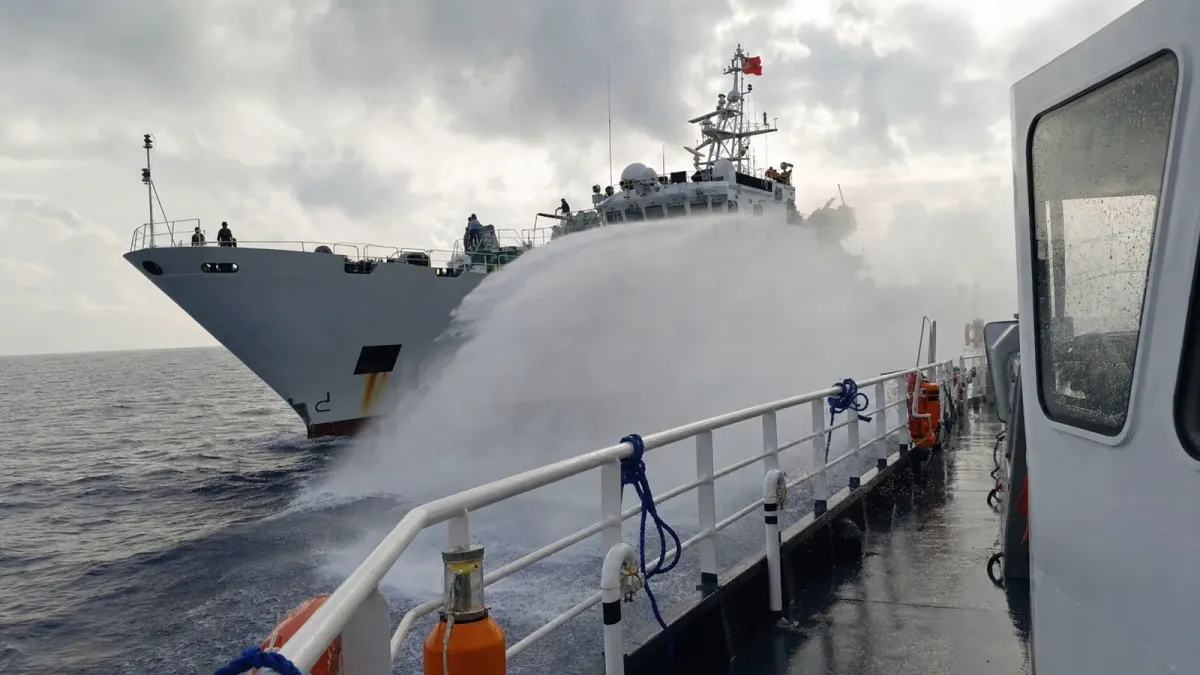
China Coast Guard ships used water cannons against two Philippine government fisheries vessels near Scarborough Shoal on Friday, July 24, 2026, in the second straight day of confrontations at one of the South China Sea's most contested features.
The clash mattered beyond the ships involved because it happened as Southeast Asian foreign ministers and their counterparts met in Manila, where maritime disputes and a proposed code of conduct with China were already on the agenda.
The Philippine Coast Guard said a Chinese vessel came within about 7 meters, or 23 feet, of a Philippine fisheries boat, creating what Manila called a serious risk of collision. China said Philippine vessels had illegally gathered in waters it claims around Huangyan Dao, Beijing's name for Scarborough Shoal, and said its coast guard used warnings, route-control measures and water cannon to expel them.
What changed
The July 24 confrontation was the third reported China-Philippines incident in the South China Sea that week. A separate clash on Monday near Second Thomas Shoal left two Philippine sailors injured, according to Philippine accounts cited by The Associated Press and Reuters. China has disputed Manila's version of that earlier encounter.
Reuters reported that the Philippine Coast Guard condemned the July 24 actions as dangerous and unprofessional, while China's Foreign Ministry said the China Coast Guard response was lawful and faulted the Philippines for what it called provocation and publicity.
Scarborough Shoal is claimed by multiple parties and has been controlled by China since a 2012 standoff. A 2016 arbitration ruling under the U.N. Convention on the Law of the Sea rejected Beijing's sweeping South China Sea claims and found that Chinese conduct around Scarborough Shoal had unlawfully restricted traditional fishing rights. China does not recognize that ruling.
Why ASEAN matters
The timing raised the diplomatic stakes. AP reported that ASEAN ministers discussed serious incidents in the South China Sea and said they wanted to conclude code-of-conduct negotiations with China this year. The goal is to reduce the risk that coast guard, naval or fishing-vessel encounters turn into a wider armed confrontation.
The dispute also sits on a major trade route, so repeated close passes at sea can quickly become a regional security concern even when neither side says it wants a fight.
The United States is part of the backdrop because it has a defense treaty with the Philippines. AP reported that U.S. Secretary of State Marco Rubio and Chinese Foreign Minister Wang Yi discussed the earlier Second Thomas Shoal clash on the sidelines of the Manila meetings.
What to watch next
The immediate question is whether Beijing and Manila continue the cycle of maritime patrols, public video releases and diplomatic protests around Scarborough Shoal. The larger question is whether ASEAN and China can turn code-of-conduct talks into rules that restrain close-quarters maneuvers before another incident produces injuries, ship damage or a military response.
For readers watching the region, the key signal is not one water-cannon burst. It is whether the same disputed waters keep producing confrontations while diplomats say a nonaggression framework is within reach.


