
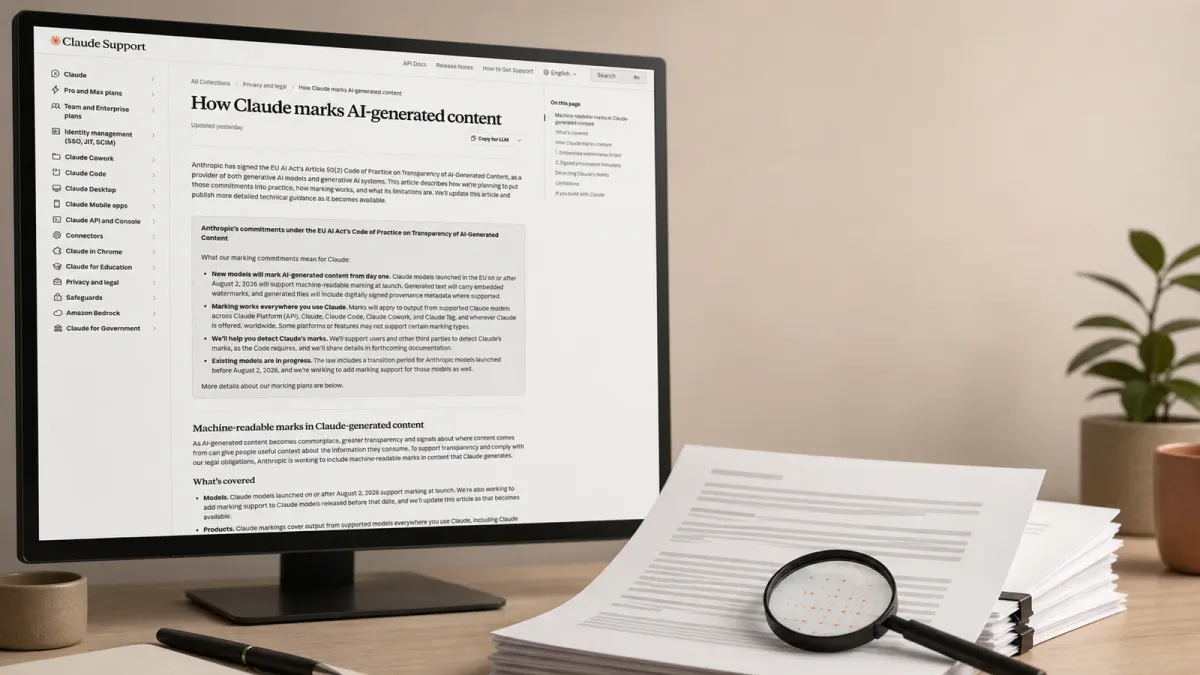
Anthropic says new Claude models will add machine-readable marks to AI-generated text and supported files, turning a European transparency rule into a practical test for anyone who uses AI to draft, edit, translate, or publish work.
The short answer: Claude's future outputs may carry a hidden signal that says the content was processed by Claude, but that signal is not the same as proof that a person submitted fully AI-written work. The mark can help platforms, employers, schools, publishers, and readers ask better questions. It cannot answer every authorship dispute by itself.
Anthropic's updated Claude Help Center says models launched in the European Union on or after August 2, 2026 will support machine-readable marking from launch. The company says the marking will apply worldwide wherever supported Claude models are offered, including Claude, Claude Platform, Claude Code, Claude Cowork, Claude Tag, and cloud partner access through AWS, Google Cloud, or Microsoft Foundry.
What changed
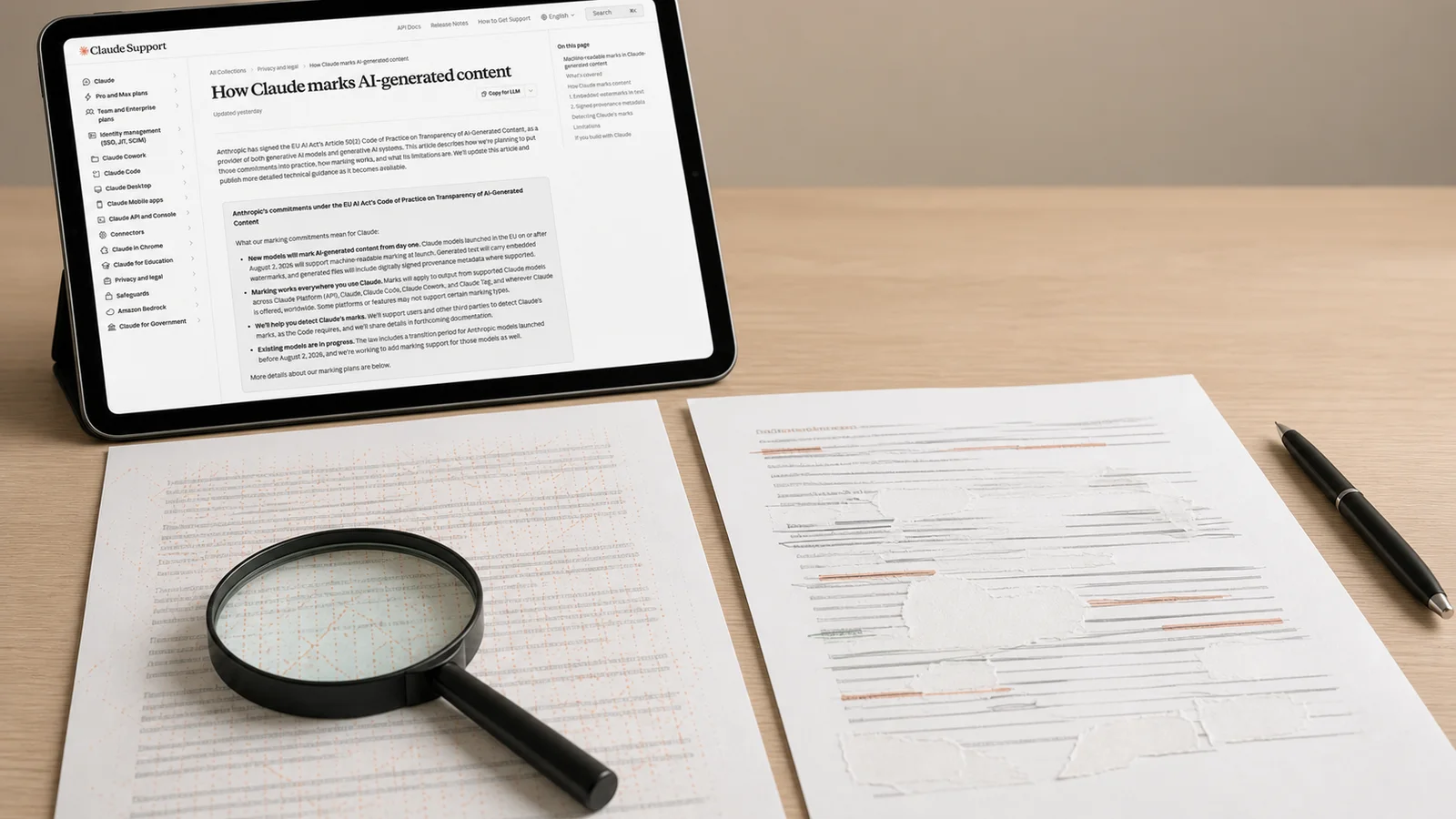
Claude will use two kinds of signals. Generated text will carry embedded watermarks that Anthropic describes as imperceptible to readers. Supported generated files, including common image formats, will receive signed provenance metadata using the C2PA standard where the product surface supports it.
The timing matters because the EU AI Act's transparency rules are now forcing major AI providers to make generated or manipulated content easier for other systems to identify. Anthropic says existing Claude models launched before August 2 are still in transition, and that it is working to add marking support for those models as well.
TechCrunch, Axios, and The Verge all reported the change this week after Anthropic updated its support documentation. Threads searches for Claude watermarking also showed the immediate public question: people are less confused about whether a mark exists than about what the mark actually proves.
What the watermark can show
The useful part is traceability. If a supported Claude model generates text, Anthropic says the watermark is woven into the text itself. Because it is part of the text, the signal may travel when a user copies and pastes the output into another document, email, content-management system, or social post.
That could matter in low-trust workflows. A newsroom might want to know whether a submitted draft was run through an AI tool. A school might want a better signal before opening a misconduct case. A company might need to prove that marketing claims, legal summaries, or public statements went through the review process it promised regulators or customers.
The file metadata side is different. For supported files, Claude can attach signed provenance information that indicates a file was processed by Claude and can help show whether the file changed afterward. That is closer to a chain-of-custody label than a visible badge. It depends on the file type, the product surface, and whether later uploads or conversions preserve the metadata.
What it cannot prove
The limitations are the part readers should remember. Anthropic says a detected Claude mark means content may have been processed by Claude. It does not prove full provenance, the original author, the amount of human writing involved, or whether the user asked Claude to generate from scratch instead of proofread, format, translate, or lightly edit a human draft.
The absence of a mark is also not a clean answer. Heavy editing, translation, combining Claude output with other text, very short passages, unsupported model versions, unsupported file types, file conversions, and metadata stripping can all weaken or remove detection. A document with no detectable mark could still have used AI. A document with a detectable mark could still contain substantial human work.
That means the best use of watermarking is as a starting signal, not a verdict. Schools, employers, publishers, and platforms that treat the mark as automatic guilt will overreach. Users who assume heavy rewriting erases all accountability will also be making a bad bet.
What to check now
If you use Claude for public or professional work, ask three practical questions before the next model rollout reaches your workflow.
First, decide which uses need disclosure. A private brainstorm, a cleaned-up internal note, a translated customer email, and a published essay do not carry the same stakes. A clear policy is fairer than guessing after a detector flags something.
Second, preserve draft history. Version logs, comments, prompts, source notes, and human edits will matter more than a single detector result. The more serious the setting, the more important it is to keep evidence of what changed and who approved it.
Third, separate AI assistance from AI authorship. The new marks can make AI use more visible, but they cannot replace human judgment about accuracy, consent, sourcing, originality, privacy, or whether a document needed disclosure in the first place.
The bottom line is that Claude watermarking gives institutions a new clue, not a courtroom-grade answer. The practical shift is not that AI text becomes impossible to hide. It is that people who rely on AI in serious writing workflows now need cleaner disclosure habits before the hidden signal becomes part of the record.


