
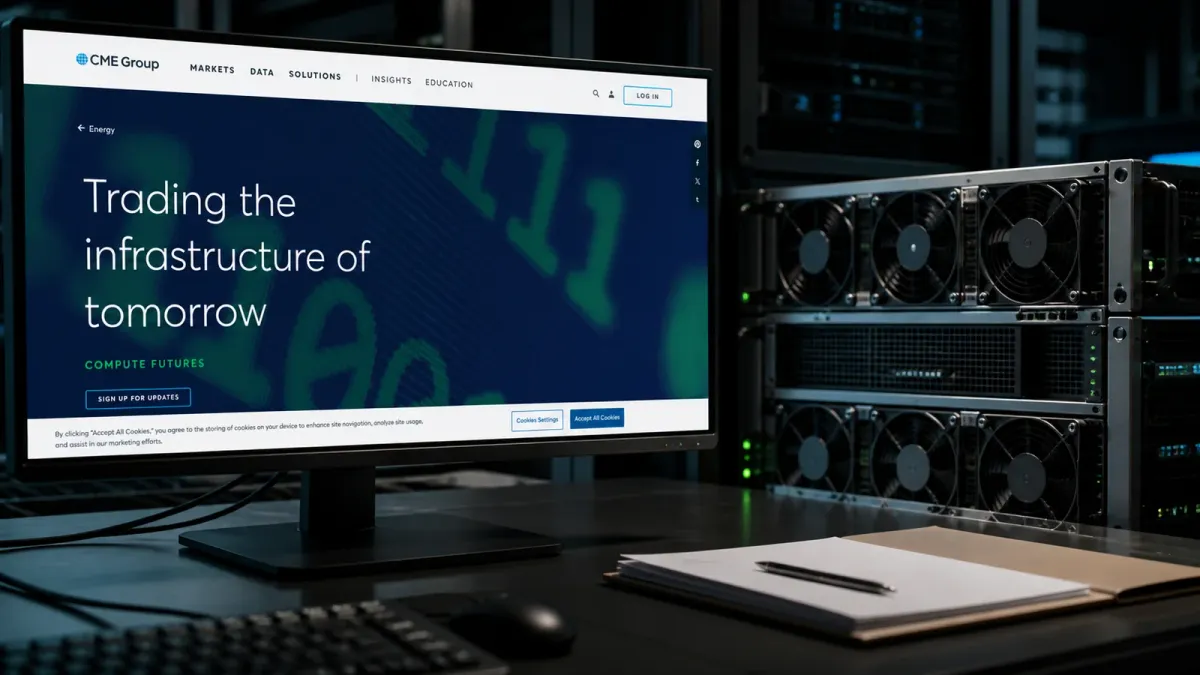
CME Group and Silicon Data said Tuesday, August 11, 2026, that they plan to launch futures contracts tied to the rental cost of AI computing power, a sign that scarce GPU capacity is moving from a private cloud expense into a market price companies can hedge.
The contracts are scheduled to launch October 5, 2026, pending regulatory review. CME said the Silicon Data H100 Rental Index Futures and Silicon Data B200 Rental Index Futures will track indexes measuring hourly rental costs for Nvidia H100 and Blackwell B200 GPUs.
The short version: the AI boom is not only a chip story anymore. If the contracts launch as planned, developers, cloud providers, hyperscalers and market investors would have a regulated place to express a view on where high-end compute costs are going.
What changed
Compute is the processing power and hardware infrastructure used to train and run AI models. For many companies, it has become one of the largest and least predictable inputs in an AI budget, especially when demand for the newest Nvidia systems rises faster than available capacity.
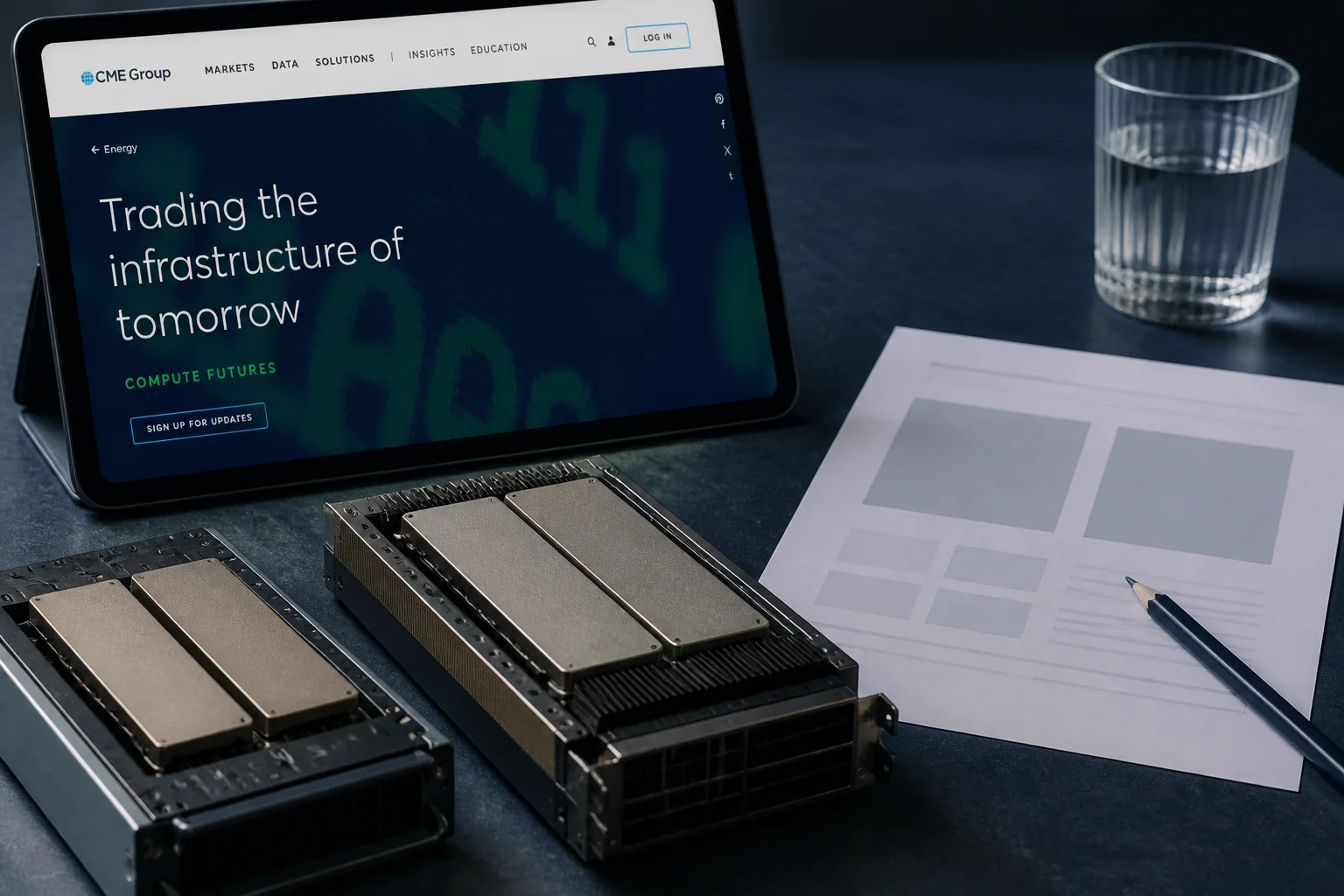
CME's release says each contract will represent a month's worth of rent for one of two GPU families: the H100, which remains central to current AI deployments, and the B200, the newer Blackwell-generation chip expected to shape the next wave of large-scale AI infrastructure.
The exchange said the contracts will be listed under New York Mercantile Exchange rules. CME's product page frames the market as a way for AI builders, cloud-service providers and institutional investors to turn volatile compute costs into a more predictable and tradable asset class.
Why investors and builders care
A futures contract does not create more GPUs. It creates a reference price and a way to manage risk around that price. That matters because the AI infrastructure market still has uneven pricing, long capacity commitments and a gap between public stock-market enthusiasm and the operating costs paid by the companies building or renting the systems.
For an AI lab, a cloud provider or a data-center operator, the practical question is whether compute becomes more like electricity, oil or freight: a critical input that can be budgeted, hedged and watched through a public market. If prices rise, a buyer may want protection. If capacity loosens, a seller may want to lock in economics before rates fall.
For investors, compute futures could become a new signal. Today, markets often infer AI demand from chipmaker results, cloud capital spending, data-center leases and power deals. A traded compute-price curve would offer a more direct reading of expected GPU rental costs, even if volume and liquidity take time to develop. That signal would be new.
The caveat
The launch is still pending regulatory review, and a listed contract is not automatically a deep market. New futures products need participants, reliable benchmarks, market makers, risk controls and enough two-way interest to produce prices that outsiders can interpret with confidence.
There is also a difference between hedging and speculation. Companies with real compute exposure may use futures to reduce uncertainty. Other traders may use them to bet on the direction of AI infrastructure costs. Those two uses can live in the same market, but they create different risks.
The underlying benchmark will also matter. Silicon Data's role is to publish the GPU rental indexes that the contracts track. If buyers and sellers trust the benchmark, the contracts could help standardize a market that has often depended on private negotiations. If they do not, the product may remain a niche tool.
What to watch next
The first test is whether the October 5 launch date holds after regulatory review. The second is whether the H100 and B200 contracts attract participation from the companies that actually buy, sell or finance AI compute capacity.
After that, watch how prices react around major AI earnings, chip-supply updates, data-center financing announcements and cloud-capacity deals. If compute futures start moving around those events, they could become another dashboard for the AI economy.
The larger point is simple: Wall Street is trying to put a price on the machinery behind AI, not just the companies selling it. CME's planned contracts turn that machinery into a market question investors and builders can no longer treat as invisible.


