
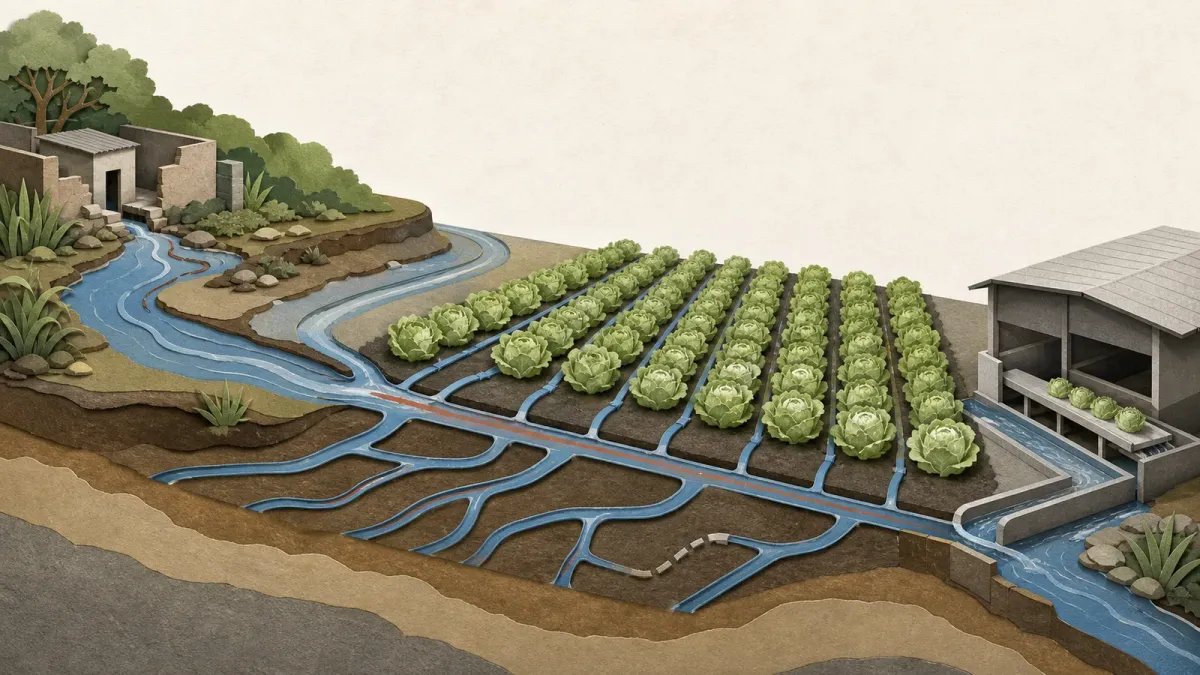
Opinion — The most important fact about Cyclospora cayetanensis is also the most uncomfortable: the parasite that makes people sick originates in human feces. In the five-state outbreak under investigation in July 2026, federal officials traced a large cluster of illnesses to shredded iceberg lettuce supplied from central Mexico. But traceback is not the same as a laboratory-confirmed explanation, and the U.S. Food and Drug Administration said on July 19 that there were no confirmed positive product samples after it reclassified an earlier result as a false positive.
So how might a parasite from a person’s intestine reach a lettuce leaf? My view is that investigators should begin with water—not because the evidence has proved that route in this outbreak, but because Cyclospora’s biology and the architecture of fresh-produce farming make contaminated water the most plausible system-level pathway. The public deserves a farm-to-packing-house water and sanitation audit, not an insinuation about a restaurant employee or a vague assurance that the product has been removed.
That distinction matters. The FDA’s traceback and epidemiological evidence can point strongly to a food vehicle while the precise contamination event remains unknown. According to the agency, 1,644 people in Indiana, Kentucky, Michigan, Ohio and West Virginia who reported eating at Taco Bell were included in the cluster as of July 16; 94 were hospitalized and no deaths were reported. Among 190 patients whose meals were analyzed in detail, 90% reported eating iceberg lettuce. Those findings are powerful evidence about what carried the parasite. They do not yet tell us where fecal contamination entered the chain.
The case for water
The parasite’s life cycle narrows the field of plausible explanations. The Centers for Disease Control and Prevention says Cyclospora shed in a bowel movement must spend at least one to two weeks in the environment before it becomes infectious. That makes immediate person-to-person transmission unlikely. It also makes the common image of one sick restaurant worker touching lettuce an incomplete explanation for a dispersed outbreak: newly shed organisms would generally need time outside the body before they could infect customers.
Water provides that environmental bridge. A sewage leak, a failing septic system, poorly managed portable toilets or runoff carrying human waste could contaminate a canal, reservoir, well or other source. That water could then contact lettuce through overhead irrigation, crop-protection sprays, harvesting operations, cooling or washing. The FDA itself tells growers to assess surface water affected by sewage leaks, manage septic systems and toilets, and consider contaminated early-season irrigation as a route by which Cyclospora can reach produce.
There is another reason water deserves scrutiny: ordinary chlorine-based produce sanitizers are not considered effective against Cyclospora. A control system designed mainly around bacteria can therefore look reassuring while missing a parasite with different biology. The FDA’s produce guidance says treatments such as microfiltration, ozone or ultraviolet light may be needed in regions where the organism is endemic, although the effectiveness of municipal wastewater treatment against Cyclospora remains uncertain.
This does not prove that irrigation water caused the July outbreak. It means investigators should treat every source and use of water as evidence: where it came from, whether it was exposed to human waste, when it touched the crop, how it was tested, whether it was recirculated and what corrective actions were documented.
Other plausible routes must stay on the table
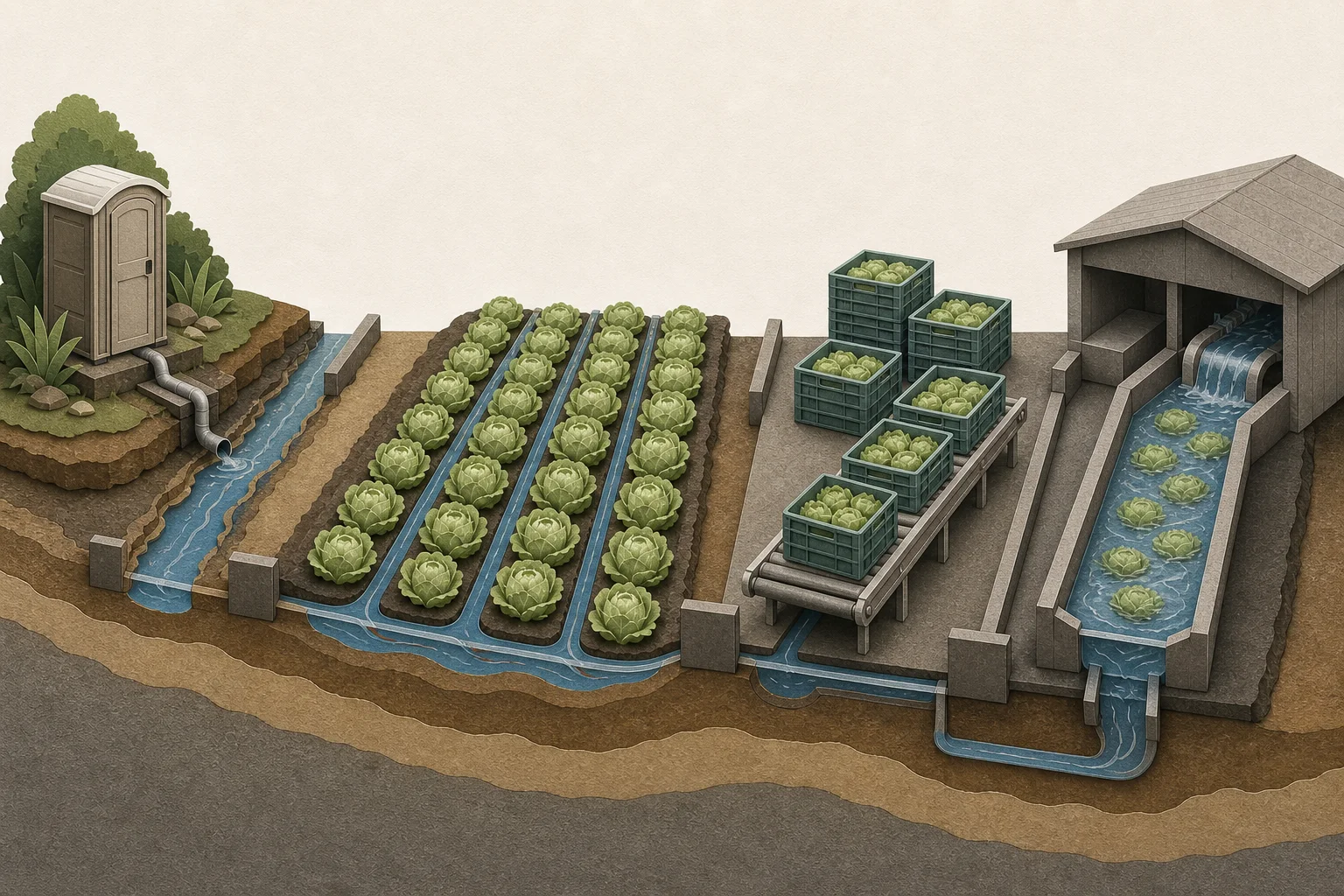
Water is not the only possibility. An infected worker with inadequate access to toilets or handwashing could contaminate soil, equipment or a water source, allowing the parasite time to mature before later reaching produce. A poorly maintained septic system or portable toilet could leak near a field or drainage channel. Contaminated bins, knives, conveyors or food-contact surfaces could move the organism between lots. In a packing house, recirculated wash or cooling water could potentially spread contamination beyond the first affected head of lettuce.
But each scenario requires a chain of events, and that chain should be investigated rather than asserted. Fresh lettuce is exposed to many hands and wet processes, yet a restaurant-level failure is a weaker fit when illnesses span many locations and the common ingredient traces upstream. Michigan health officials have said there was no evidence that poor handling at any single restaurant or fast-food chain caused the outbreak.
Country-of-origin rhetoric is also a distraction. Mexico’s health minister said on July 21 that Mexican authorities had not seen conclusive evidence proving the lettuce was contaminated there, while federal U.S. investigators continued to say their traceback converged on shredded iceberg lettuce from central Mexico. Both positions can be true at the same time: the supply chain can point investigators to a source region without establishing the exact place, date or mechanism of contamination.
The strongest counterpoint
The strongest objection to the water hypothesis is simple: investigators have not reported finding Cyclospora in water, soil or lettuce from the implicated chain. The FDA’s false-positive reversal is a warning against converting a plausible narrative into a verdict. It is also possible that more than one food or contamination event contributed to the wider rise in U.S. cases; the five-state lettuce cluster is only part of the nationwide investigation.
That uncertainty should lower the temperature, not lower the standard of inquiry. Cyclospora is difficult to detect, cannot be cultured in the laboratory like many bacteria, and may be unevenly distributed across a fast-moving product with a short shelf life. A negative sample taken after the fact does not erase epidemiological evidence, but neither does epidemiology identify the leaking pipe, unsafe water source or failed sanitation practice.
What investigators and buyers should disclose
The public should expect a final environmental assessment that answers concrete questions. Which farm, lots, harvest dates and packing lines converged in the traceback? What water sources touched the lettuce before and after harvest? Were canals, wells, storage ponds, spray tanks, cooling water and wash systems sampled specifically for Cyclospora? Were septic systems, toilets and drainage inspected for leaks? Did worker sanitation facilities meet requirements throughout the season? Could shared water, equipment or rework have connected otherwise separate lots?
Large restaurant and grocery buyers should ask the same questions before returning to business as usual. A certificate or generic microbial test is not enough if it was designed around organisms other than Cyclospora. Importers and buyers should require parasite-aware water assessments, sanitation records and corrective-action plans from high-volume fresh-produce suppliers, wherever those farms are located.
What to do with this
Consumers cannot audit an irrigation canal from the produce aisle, and washing at home may reduce dirt without reliably eliminating Cyclospora. The practical response is to follow current FDA and CDC advisories, discard products specifically identified by regulators, and contact a healthcare professional if prolonged watery diarrhea develops; Cyclospora testing may need to be requested specifically.
The broader lesson is not that salad is inherently unsafe or that farm workers should be blamed. It is that a product eaten raw has almost no final kill step. Prevention therefore has to happen before the bag is sealed: protect water from human waste, provide and maintain sanitation, test for the organism that actually threatens the crop, and preserve records detailed enough to reconstruct a failure quickly.
Bottom line
The most defensible speculation is that contaminated water or a sanitation failure created an environmental reservoir, and that irrigation, washing or shared equipment then carried Cyclospora onto lettuce. That is a hypothesis—not a finding. The way to earn public trust is to publish the environmental evidence that confirms or disproves it.
Sources
- FDA outbreak investigation: iceberg lettuce, July 2026
- CDC: About cyclosporiasis
- FDA: Cyclosporiasis and fresh produce
- FDA: Harvest and post-harvest agricultural water requirements
- Associated Press: FDA maintains its traceback after a false-positive test
- Reuters: Mexico disputes that contamination has been proved


