
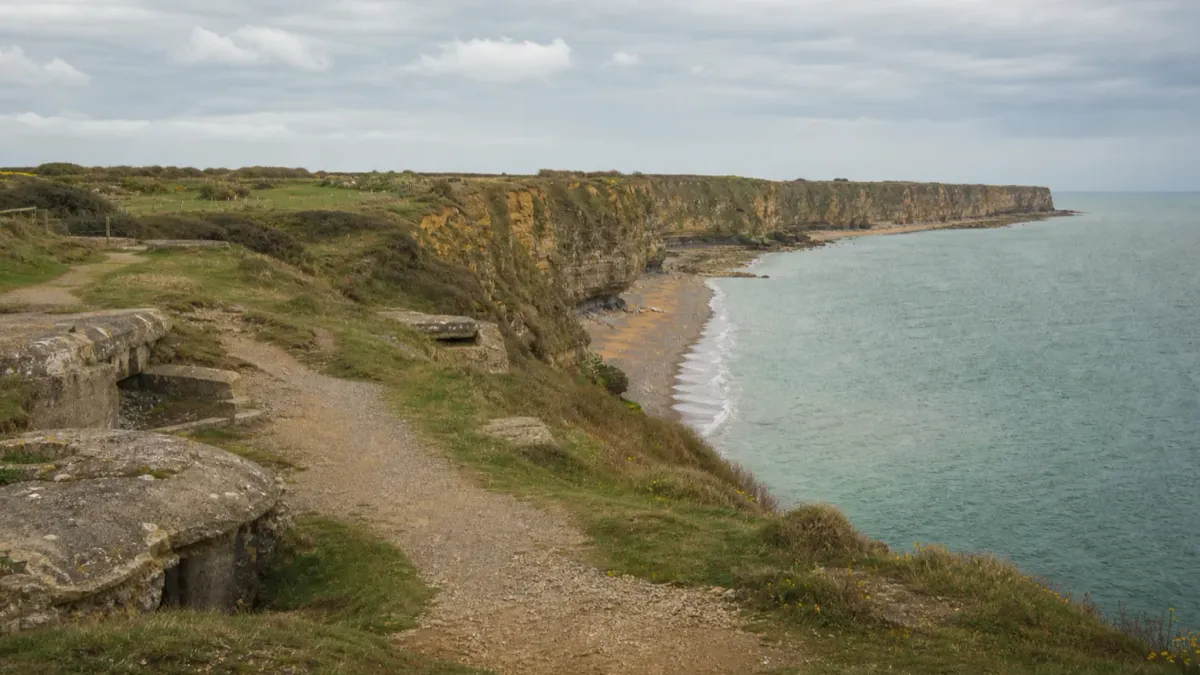
UNESCO added the Beaches of the D-Day Landings, Normandy, 1944, to the World Heritage List on Sunday, July 26, 2026, giving formal global recognition to the coastline where Allied forces began the liberation of Western Europe in World War II.
The short answer: the listing does not turn Omaha, Utah, Gold, Juno and Sword into a museum under glass. It does raise the preservation burden for a living coastal landscape that draws veterans' families, history travelers, school groups and local residents.
What changed
The UNESCO World Heritage Centre now lists the French property with a 2026 inscription date, criterion vi, dossier 1581 and a serial structure. Its public description says the site covers six component parts along about 80 kilometers of Normandy coastline, including the five landing beaches and Pointe du Hoc.
Associated Press reported from South Korea that the decision came during the World Heritage Committee's 48th session in Busan, where the committee is reviewing new nominations through Wednesday, July 29. The same AP report said the French designation was part of a wider round of additions that also included Mount Olympus in Greece, ancient Japanese capitals and South Sudan's Boma-Badingilo Migratory Landscape.
What is covered
The listing is broader than beach names on a map. UNESCO says the protected landscape includes remains of the German Atlantic Wall, casemates, artillery batteries, fire-control posts, resistance nests, battlefield traces, wartime equipment and commemorative places such as the American Cemetery at Colleville-sur-Mer.
That matters because the D-Day coast is both a memory site and a working destination. Visitors often experience it as separate stops: a cemetery, a cliff, a bunker, a museum or a stretch of sand. The World Heritage framing treats those places as one connected cultural landscape shaped by the events of June 6, 1944, and by the way the land has been preserved and remembered since.
Why it matters
World Heritage status is not a simple tourism badge. It signals that France has accepted international expectations for protecting the site's outstanding universal value, including how development, visitor pressure and long-term coastal change are managed around the core property and its buffer zone.
The designation also gives local officials a clearer language for saying no to changes that would weaken the landscape's meaning. That can affect road access, visitor flow, interpretation, conservation funding and how new tourism projects are judged near the most sensitive sites.
For travelers, the practical takeaway is to plan with more patience. A higher profile can bring more demand, especially around anniversary dates and school holidays. It can also mean tighter management of fragile access points, restored military remains, paths, signs and memorial areas.
What to watch
The next question is implementation: how French authorities balance commemoration, daily local life, tourism pressure and conservation across a coastline that is emotionally powerful because it still looks like a real place, not a sealed exhibit.
If you are planning a Normandy visit, check official site hours, cemetery access, museum schedules and local transport before booking around major commemorations. The new designation makes the D-Day beaches more visible globally, but it also makes careful visiting part of the preservation story.


