
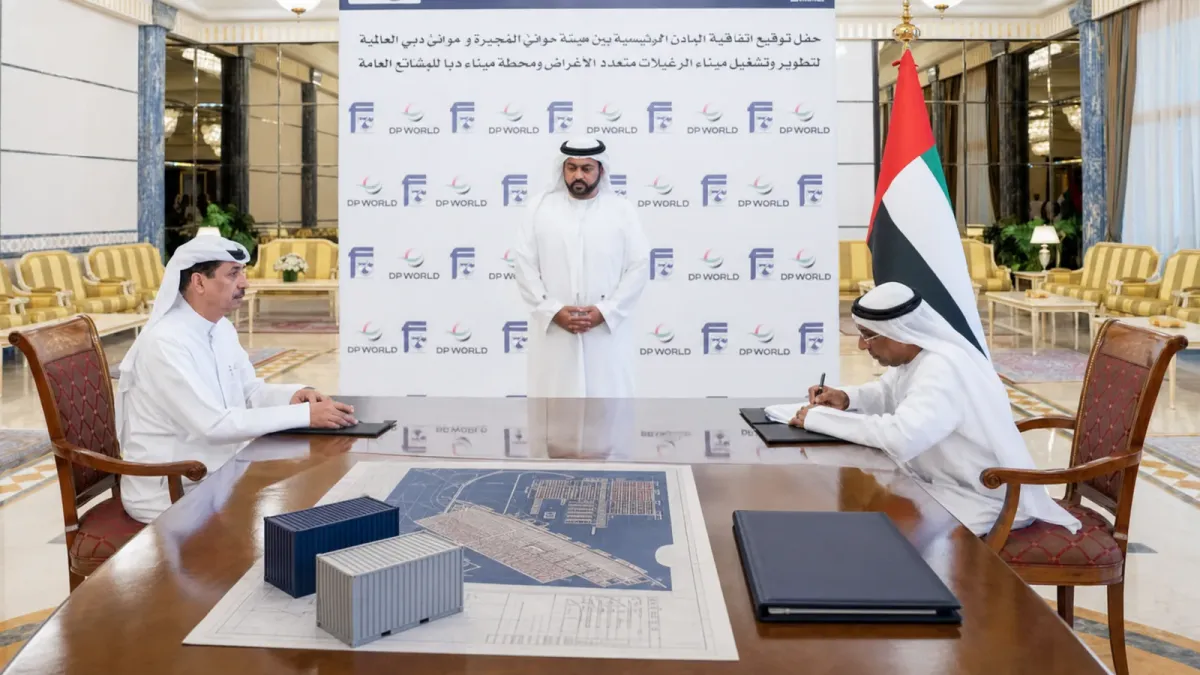
DP World and the Fujairah Ports Authority have reached a preliminary 50-year agreement to develop two new terminals on the United Arab Emirates' east coast, a move that turns the Gulf of Oman into a more important pressure valve for trade moving around the Strait of Hormuz.
The deal, announced Wednesday, July 22, 2026, covers the Al Rugaylat container and multi-purpose terminal and the Dibba General Cargo terminal. The practical point is simple: more cargo would be able to enter or leave the UAE through Fujairah without first passing through the increasingly risky strait.
What changed
Officials described the project as a phased development that could take about 24 to 30 months once construction begins. Al Rugaylat is planned for up to 2.5 million TEUs a year, plus 1.7 million tonnes of general cargo and 190,000 car equivalent units. Dibba is expected to add up to 3.6 million tonnes of annual general cargo capacity.
Once operating, the terminals would lift DP World's UAE container handling capacity from 19.4 million TEUs to nearly 22 million TEUs, according to regional and industry reports citing the company and Dubai Media Office. The terminals would also connect to Jebel Ali and the Jebel Ali Free Zone through inland logistics links, making the project less about one port and more about rerouting the UAE's trade map.
Why it matters
Hormuz is a narrow waterway, but it carries outsize economic risk. When ships slow, detour, or wait near the strait, costs can spread from energy markets into container shipping, supermarket imports, industrial parts, and delivery times. A port outside the strait does not eliminate that risk, but it gives cargo owners another path to price and plan around it.
The timing is what makes the agreement newsworthy. Reporting from The National said logistics providers in the UAE and wider Gulf have been using more road, rail, and alternative sea routes as regional disruption constrains shipping. AP has also reported that Middle East energy and logistics players are accelerating efforts to bypass Hormuz, with the Red Sea and Gulf of Oman becoming more important alternatives.
The caveat
Fujairah is not a magic shortcut. New terminals take years to build, inland movement adds handling costs, and alternative routes can bring their own bottlenecks. The Red Sea has also become riskier after recent attacks and threats against shipping, which means a bypass strategy can reduce dependence on one chokepoint without removing geopolitical risk from the system.
There is also a difference between capacity on paper and reliable capacity in a crisis. Ports need customs processes, storage, trucking, rail connections, labor, insurance, and carrier schedules to work together. The planned terminals would help only if those pieces can move cargo at scale when the main Gulf route is under strain.
What to watch next
The next signals are the construction start date, financing details, carrier commitments, and how quickly DP World links the Fujairah sites with Jebel Ali and Jafza. For businesses that ship through the Gulf, the bigger question is whether this becomes a routine backup route or a permanent redesign of regional supply chains.


