
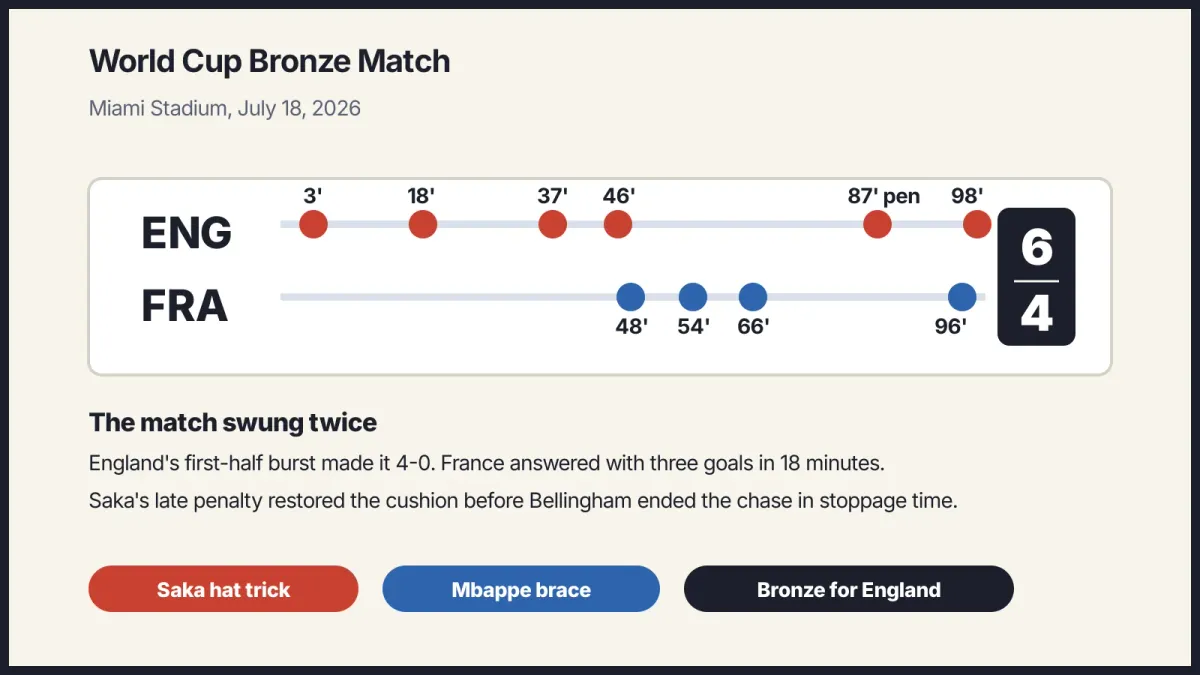
England beat France 6-4 on Saturday, July 18, 2026, in the FIFA World Cup bronze match at Miami Stadium, turning the tournament's third-place game into one of its wildest scorelines.
Bukayo Saka scored a hat trick, England led 4-0 at halftime, and France still made the last half-hour uncomfortable before Jude Bellingham settled it in stoppage time. The result gave England its best men's World Cup finish since 1966, according to the official England match centre and FIFA's tournament coverage.
Why it stands out
Third-place matches are often treated as emotional afterthoughts. This one became useful because it answered a different question: which team could recover fastest from semifinal disappointment and still play with purpose?
England's answer came early. Declan Rice scored in the third minute, Ezri Konsa added another in the 18th, and Saka scored on both sides of halftime before completing his treble from the penalty spot in the 87th minute. England's official report listed Saka alongside Geoff Hurst, Gary Lineker and Harry Kane among men's World Cup hat-trick scorers for the country.
Key moments
- 3rd minute: Rice put England in front with a low finish after carrying the ball toward the edge of the area.
- 18th minute: Konsa headed in from Rice's corner, giving England a two-goal cushion before France had settled.
- 37th and 46th minutes: Saka's first two goals stretched the lead to 4-0 and made the game look finished.
- 48th to 66th minutes: Kylian Mbappe scored twice and Bradley Barcola also struck as France cut the margin to 4-3.
- 87th and 98th minutes: Saka's penalty and Bellingham's late goal gave England just enough distance after Ousmane Dembele's injury-time reply.
The bigger picture
The match mattered beyond bronze because several individual races and records were still moving. AP reported that Mbappe's two goals lifted him to 22 career World Cup goals, while Saka's treble became the headline performance for an England side still processing its semifinal exit.
It also gave the tournament one last chaotic showcase before the final. FIFA's venue coverage said Miami Stadium closed its World Cup program with a sold-out crowd of 64,478, and the 10-goal finish helped the bronze match feel less like a consolation fixture and more like a final audit of both teams' depth.
That is the practical takeaway for fans checking the result after the fact: the medal was secondary, but the scoring pattern changed how the match will be remembered.
For France, the defeat also closed Didier Deschamps' long run as national-team coach. The scoreline will not erase the disappointment of missing the final, but it gives both teams a clear post-tournament snapshot: England found attacking fluency too late, while France's comeback showed why it remained dangerous even after a poor first half.
What is next
The World Cup focus now moves to Sunday's final between Argentina and Spain. England leaves with bronze and a sharper question for the next cycle: whether the attacking risk it showed against France can become a starting point rather than a recovery plan.


