
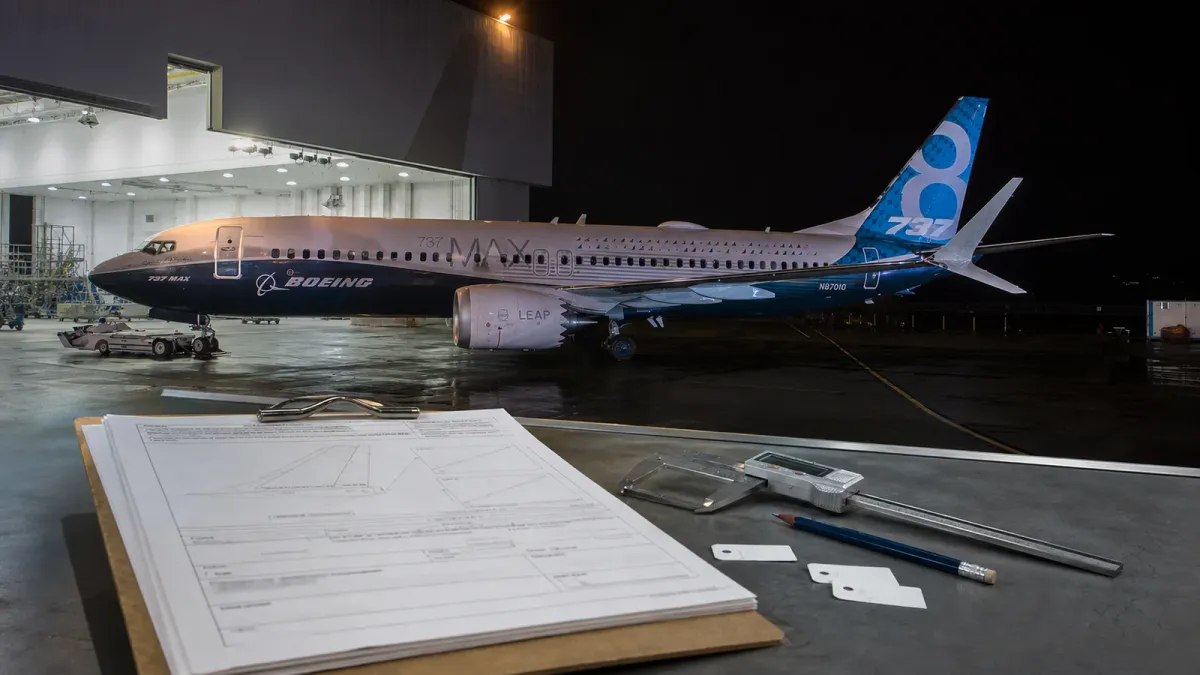
The Federal Aviation Administration has ordered inspections of 471 U.S.-registered Boeing 737 Max jets for possible cracks in a structural area near the forward galley door.
The final airworthiness directive was published on August 6, 2026, and takes effect September 10, 2026. It applies to certain Boeing 737-8, 737-9 and 737-8200 airplanes.
The practical point for travelers is narrow but important: the order is an inspection-and-repair rule, not a fleet grounding. Airlines will have to check affected aircraft on the FAA's compliance schedule and take follow-up action if repairs or cracks are found.
What the FAA found
The directive was prompted by reports of cracks in the bear strap at the forward upper corner of the forward galley door cutout. The FAA says cracks in the fuselage skin and bear strap could weaken a principal structural element and adversely affect the airplane's structural integrity if left unaddressed.
The rule requires an external general visual inspection of the fuselage skin for existing repairs. Depending on what operators find, the aircraft may also need detailed inspections, high-frequency or low-frequency eddy-current inspections, Boeing repair instructions, FAA-approved alternative inspections, or crack repairs.
Why it matters beyond one part
The order lands during a sensitive stretch for Boeing. The Max family has been under intense regulatory scrutiny since the crashes of Lion Air Flight 610 in 2018 and Ethiopian Airlines Flight 302 in 2019, and since the January 2024 Alaska Airlines 737 Max 9 door-plug incident renewed concerns about quality control.
This directive is different from those events, and the FAA did not say the newly covered Max aircraft are unsafe to fly today. But it adds another required maintenance item to a fleet that Boeing and U.S. regulators have been trying to move back toward more routine oversight.
Boeing supported the proposed rule without change, according to the FAA. The agency also said Boeing is introducing manufacturing-process changes to address the root cause on airplanes still in production.
The numbers
The FAA estimates the first visual inspection will cost operators $85 per airplane, or $40,035 across the affected U.S. fleet. Additional detailed and eddy-current inspections could cost up to $340 per airplane per inspection cycle, or up to $160,140 across U.S. operators.
Those figures do not include potential repair costs. The FAA said it did not have definitive data to estimate on-condition repairs or alternative inspections.
The dollar amounts are modest compared with airline operating budgets, but the compliance trail matters because it creates a documented inspection record for each affected aircraft.
What happens next
Operators must comply within the timing set by the directive and Boeing's referenced requirements bulletin, using September 10 as the effective date. If an inspection finds a relevant repair or crack, the airline will need to follow the required inspection interval, repair path, or FAA-approved alternative method.
For passengers, the useful signal is not whether a booked plane is labeled Max. It is whether regulators, Boeing and operators detect structural issues early enough that maintenance happens before a crack reaches a critical length. That is the explicit purpose of the FAA order.


