
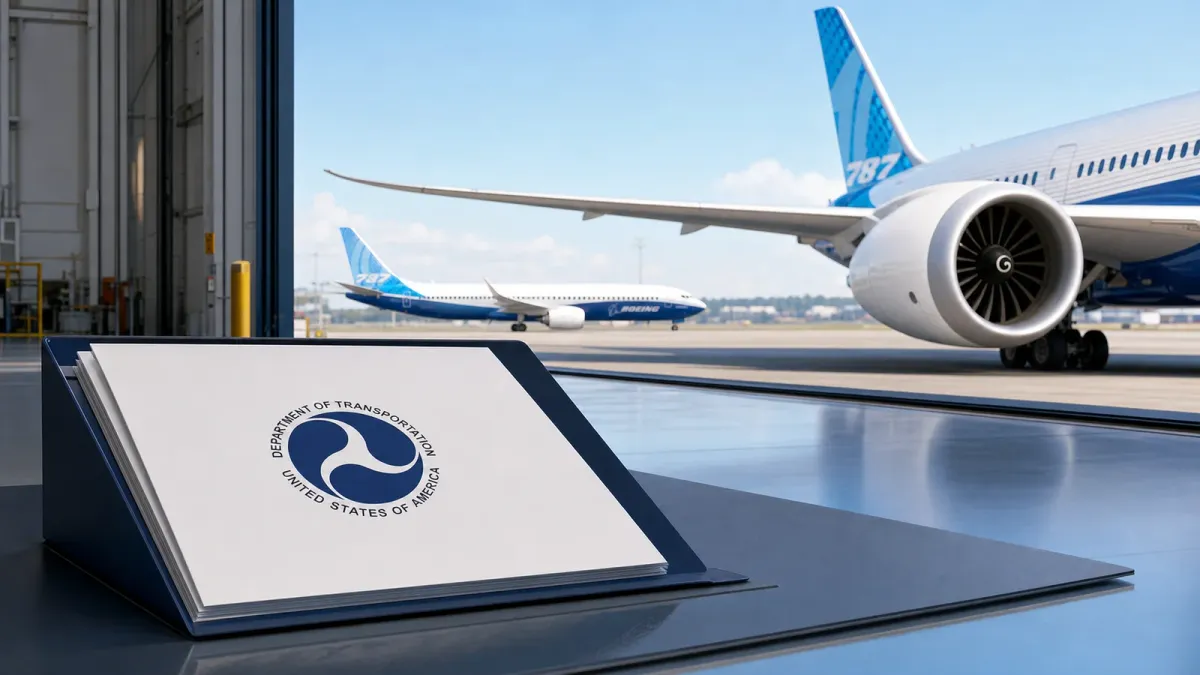
Boeing is regaining a key piece of final jet-delivery authority on Monday, July 20, 2026, as the Federal Aviation Administration lets the company resume issuing airworthiness certificates for all newly built 737 MAX and 787 aircraft.
An airworthiness certificate is the final regulatory signoff that allows a finished aircraft to be delivered and operated. The FAA said Friday that the decision follows months of review and eight months in which Boeing and agency inspectors alternated certificate work on some 737 MAX and 787 airplanes.
The practical effect is narrow but important: Boeing can again handle the last production-stage certificate for those aircraft through its FAA-authorized unit, while the regulator shifts more attention to factory inspections, audits and earlier risk detection.
What changed
The FAA said Boeing may issue certificates at the end of production for all 737 MAX and 787 airplanes starting July 20. Since September 2025, the company and the FAA had been taking turns on that work, giving regulators a comparison of Boeing findings and FAA findings on the same aircraft families.
The agency said those findings were comparable over the eight-month review period. That is the basis for returning the responsibility to Boeing under the FAA's Organization Designation Authorization program, where authorized company representatives perform certain certification functions on behalf of the agency.
What did not change
The decision does not mean Boeing is free of federal oversight. The FAA said it will continue inspections, audits and monitoring of Boeing's production system, including critical assembly work, production-quality trends, compliance with approved designs and engineering requirements, and the company's safety-management system and safety culture.
That distinction matters because Boeing's authority had been limited after two separate safety chapters. The FAA stopped allowing Boeing to issue 737 MAX airworthiness certificates in 2019 after the Lion Air and Ethiopian Airlines crashes. It stopped allowing Boeing to issue 787 certificates in 2022 because of Dreamliner production-quality problems.
Why airlines and travelers care
For airlines waiting on aircraft, the change may smooth part of the delivery process if Boeing production quality remains stable. For Boeing, it is another sign that regulators are willing to restore some trust after years of tighter control. For travelers, it is not a change they will see at the gate, but it is part of the system that decides whether a newly built aircraft can enter service.
The Associated Press reported that Boeing said it will keep working under FAA oversight to build commercial airplanes that comply with airworthiness requirements. The more useful question now is not whether oversight disappears, but whether the FAA's promised audits and factory monitoring catch problems earlier than the old process did.
What to watch next
The next test is consistency. If Boeing's certificate work continues to match what FAA inspectors would have found, the decision becomes a production milestone. If quality findings diverge or new manufacturing issues appear, the FAA can face pressure to tighten control again. Watch future FAA statements, Boeing delivery numbers, and any regulator action tied to 737 MAX or 787 production quality.


