
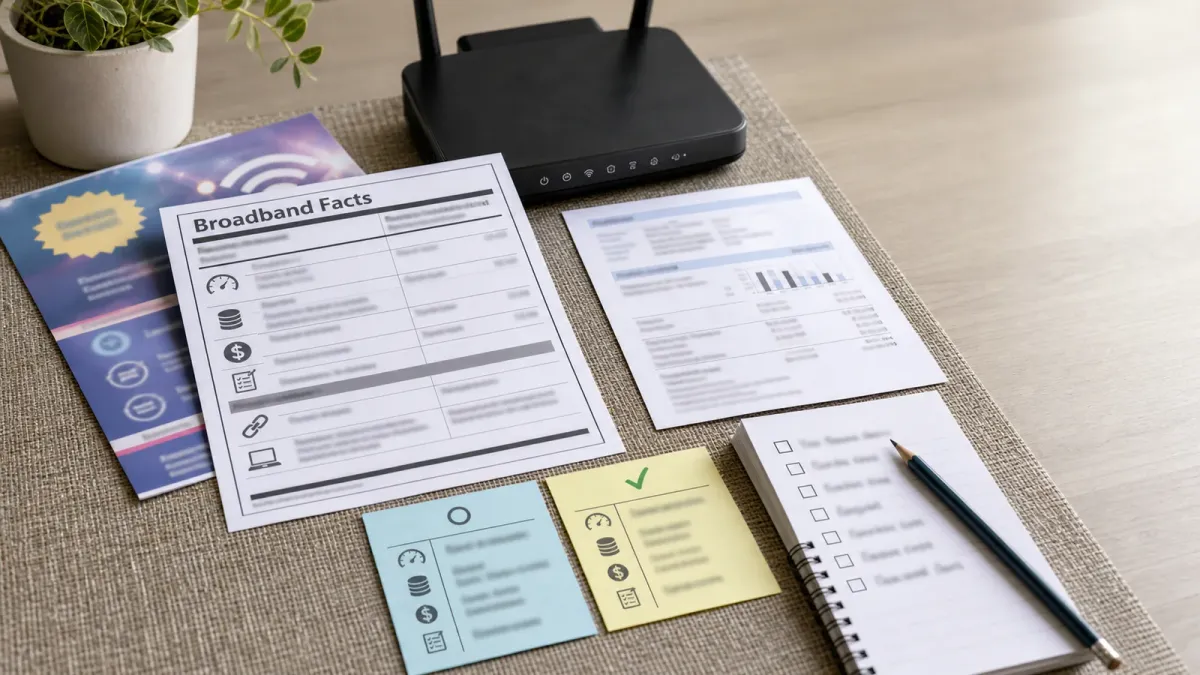
The short answer: do not choose a home internet plan from the promotional price alone. The Federal Communications Commission voted on July 22, 2026, to revise its broadband consumer-label rules, but the label is still the place to compare what a plan actually promises.
The labels, often compared to nutrition labels, are meant to put key broadband facts in one place. The FCC says providers must have a label for each standalone broadband service plan they currently offer, showing introductory rates, data allowances and broadband speeds, with links to network-management and privacy information.
The new order is supposed to make those labels clearer and easier to access while reducing compliance burdens for providers. For shoppers, the useful question is not whether the label exists. It is whether you know which line on the label can change your monthly bill.
Check the monthly price first
Start with the recurring monthly charge, then look for any introductory rate. A low first-year price can be useful, but it should be compared with the regular price that follows. If you are comparing two plans, write down the price after the promotion ends, not just the number in the ad.
Match speed to how you use the connection
The label should help you compare advertised speeds. More speed is not always better if it pushes you into a plan you do not need. A household with several video calls, streaming devices and game downloads has a different requirement than one person browsing and checking email.
Also check whether upload speed matters for your use. People who work from home, send large files, livestream or back up photos to the cloud may care about upload performance more than a basic entertainment-only household.
Look for data limits and added costs
Data allowances can matter if a plan slows, charges extra or requires an upgrade after heavy use. The FCC says labels must show data allowances, so look for caps before assuming a cheaper plan is a better deal.
Then check whether equipment, installation, early termination or other monthly fees are separate from the headline price. The FCC's July 22 announcement says the updated rules are intended to help consumers visualize the monthly cost of service more clearly, but the burden is still on shoppers to compare like with like.
Use the label during phone sales
The FCC says the updated rules give providers flexibility to discuss the label conversationally over the phone instead of reading it word for word. That can be convenient, but it also means shoppers should ask for the label link, QR code or icon before agreeing to a plan.
If a sales representative describes a deal, pause long enough to match the pitch to the written label. Ask where the introductory period, data allowance, speeds and privacy-policy link appear. If those details are hard to find, that is a reason to slow down.
Bottom line
The broadband label is not perfect, and it will not create more providers in a market with limited competition. But it is still one of the simplest tools for comparing internet plans. Before switching, renewing or accepting a retention offer, use the label to compare the full monthly cost, speed, data limits and fees in writing.


