
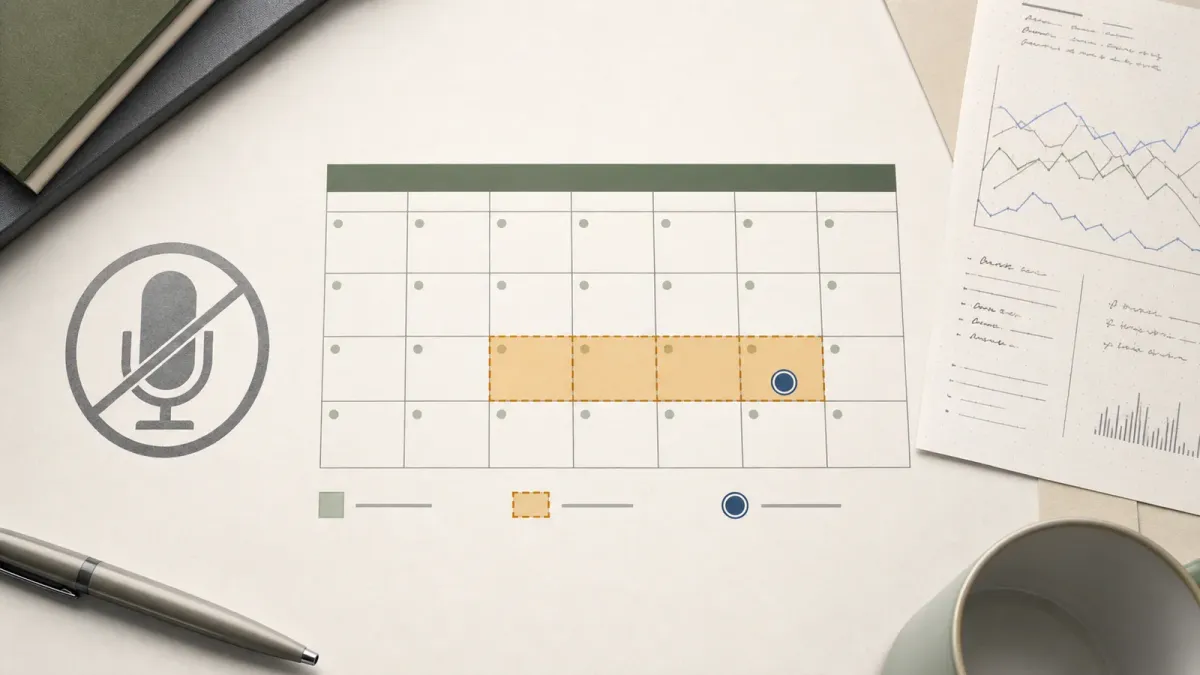
The Federal Reserve is in its pre-meeting blackout period before the next Federal Open Market Committee decision on July 28-29, 2026. That does not mean policy work stops. It means officials and staff sharply limit public monetary-policy comments while markets wait for the statement and press conference.
The timing matters because the blackout runs through a week when investors, mortgage shoppers, savers and businesses may still react to inflation data, bond yields and rate expectations. With fewer Fed speeches to parse, market pricing and official documents carry more weight than stray commentary.
The Fed lists the July FOMC meeting for July 28-29, and Federal Reserve blackout calendars identify the July 2026 window as Saturday, July 18, through Thursday, July 30. The central bank's general rule says the quiet period starts at 12:00 a.m. Eastern on the second Saturday before a regular meeting and ends at 11:59 p.m. Eastern the day after the meeting.
The short answer
A Fed blackout period is a communications rule. During the window, Federal Reserve policymakers and many staff members avoid public remarks, interviews and private monetary-policy discussions that could appear to signal a decision before the full committee acts.
It is not a legal blackout for markets, banks or news coverage. Traders can still update rate expectations. Analysts can still publish forecasts. Economic data can still move stocks, bonds, mortgage rates and savings yields. The difference is that official Fed interpretation becomes intentionally scarce until the decision is released.
How it works
The Federal Reserve usually holds eight scheduled FOMC meetings a year. Before each one, the blackout rule is meant to reduce the risk that one official's speech, interview or private comment is mistaken for the committee's final view.
For the July meeting, that means the public calendar is fairly clear: the quiet period began July 18, the two-day meeting is July 28-29, the rate decision and press conference are scheduled for July 29, and the blackout ends July 30. Minutes from the meeting are scheduled for release three weeks later, on August 19.
The rule does not guarantee a calm market. CME's FedWatch tool tracks implied probabilities from fed funds futures, and those probabilities can shift even when officials are silent. Bond yields, inflation expectations, energy prices, employment data and global risk can all change the market's view before the Fed speaks again.
Why it matters
For borrowers, the blackout can make the days before a decision feel noisier, not quieter. Mortgage and credit-card rates are not set directly at the FOMC table, but they are affected by Treasury yields, bank funding costs and expectations for where short-term rates may go next.
For savers, the same logic applies in reverse. High-yield savings accounts, CDs and money-market funds can adjust when banks anticipate a different rate path, sometimes before the official decision arrives.
For investors, the main mistake is treating silence as certainty. A lack of speeches does not mean a decision is locked in, and a market-implied probability is not a promise from the Fed. The statement, the vote, any dissents and the chair's press conference still matter.
What to watch
Before July 29, watch the Fed's official calendar, incoming economic releases, Treasury yields and market-implied rate probabilities. After the decision, compare the statement with the prior one, then listen for how the chair describes inflation, labor-market risks and the balance between holding steady, cutting or raising later.
The practical takeaway is simple: during a blackout, separate official sources from market guesses. The quiet period limits Fed messaging, but it does not remove uncertainty from your mortgage quote, bond fund, savings rate or stock portfolio.


