
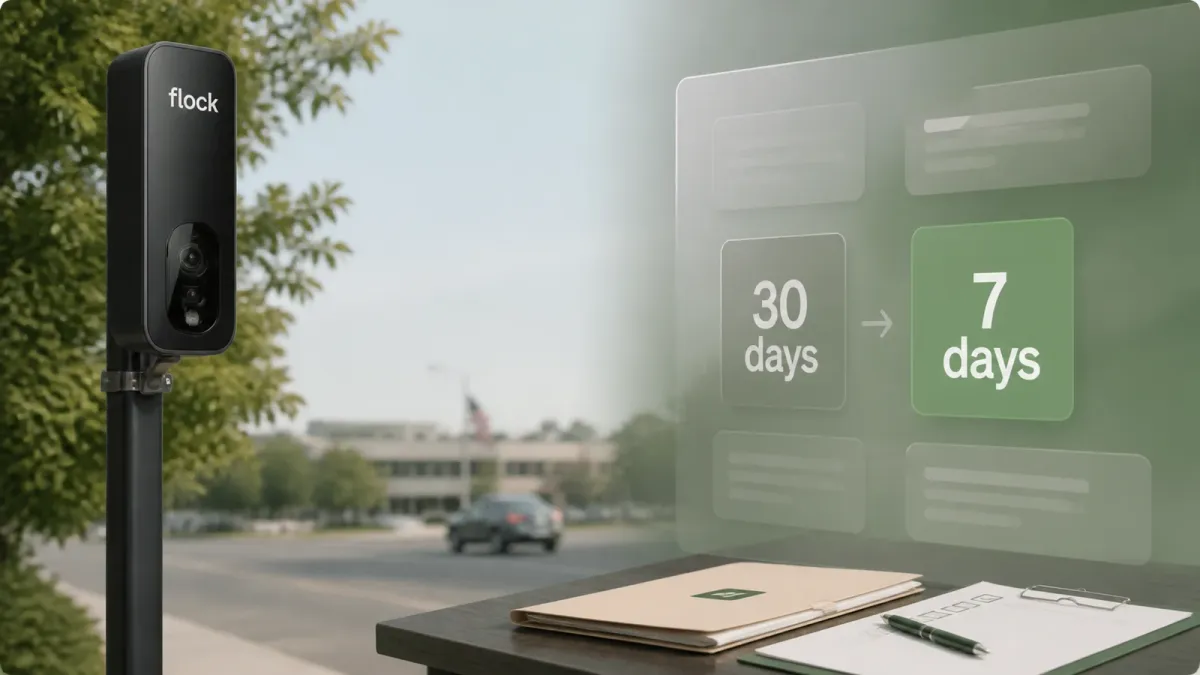
Flock Safety said Thursday it is changing how its automated license-plate-reader network handles data retention, searches and oversight, turning a fast-growing surveillance business into a test of how much control cities and police agencies should keep over location data.
The Atlanta-based company said on August 13, 2026 that it is recommending a seven-day default retention period for ALPR data, down from its older 30-day default, while rolling out an Evidence Mode for investigations that need specific records preserved longer. It also said it will require audit assistance, proactive lockouts and case codes for law-enforcement searches.
The practical question is not whether the cameras are useful. Police agencies have credited license-plate readers with helping locate missing people, find stolen vehicles and investigate violent crimes. The question is whether Flock's new controls are enough to prevent misuse before a search happens, or whether communities will demand stricter rules, warrants and contract limits of their own.
What changed
Flock's most visible change is the retention shift. The company says customers that adopt the seven-day recommendation will still be able to preserve specific data as evidence for active investigations through Evidence Mode, consistent with local law and agency policy. Existing customers will not automatically lose their current retention periods; Flock says each community can still choose the period that fits its public-safety strategy.
The company is also moving several oversight tools from optional to standard. Audit Assistance is designed to detect abnormal activity and flag it for administrator review. Proactive lockouts are meant to suspend access when user behavior meets defined criteria for potential misuse. Case codes, which Flock introduced as an optional requirement in July 2025, are scheduled to become mandatory for all law-enforcement searches by the end of 2026, with emergency bypasses flagged for later review.
Flock is also giving agencies more granular sharing controls. A city could allow another agency to search its cameras for stolen vehicles, missing people or violent crimes while blocking searches tied to immigration enforcement, according to the company's announcement. That puts more responsibility on local governments to decide what uses are acceptable before the system is shared outside their borders.
Why communities are watching
The announcement follows months of criticism from civil-liberties advocates, local officials and residents who argue that a large network of vehicle-location cameras can become a tool for broad tracking. The Associated Press reported Thursday that dozens of cities and agencies have canceled, suspended, rejected or deactivated Flock relationships amid concerns over data sharing, immigration enforcement and unauthorized searches.
Flock's critics are not only focused on retention length. Their harder complaint is that license-plate-reader databases can let officers search movement records first and answer oversight questions later. AP cited critics who said Flock's reforms still leave too much discretion with police users, while Fox Business reported that the ACLU described the package as inadequate for deeper privacy concerns.
That is why the local-control language matters. A shorter retention default reduces how long most records sit in the system, but it does not decide which agencies may search, what crimes qualify, who reviews emergencies, how often audits are published or whether a judge should authorize access. Those decisions still sit with contracts, state law, department policy and city councils.
The caveat
Flock says its customers own their data and decide who can access it. It also says more than 1,500 agencies have published transparency portals that show policies, retention periods, sharing partners and search activity. The company says it will publish a plain-English explanation of its contract language to make those ownership commitments easier to understand.
But a transparency portal is not the same thing as an enforceable rule. A city that keeps Flock cameras may still need to decide whether to require public votes before expansion, limit data sharing with outside agencies, publish search statistics, narrow acceptable offenses, require routine independent audits or set penalties for unauthorized use.
For residents, the next useful check is local rather than national. If Flock cameras are already in a community, the questions are straightforward: how long is data kept, who can search it, whether every search needs a case number, which outside agencies can access it, whether emergency bypasses are reviewed, and whether elected officials can change the contract without a public process.
What happens next
The new safeguards will roll out in stages. Flock says Evidence Mode is coming in the next few weeks, while mandatory case codes for law-enforcement searches are planned by the end of 2026. The company is also launching a coordinated vulnerability disclosure program for security researchers.
The bigger test will come at the local level. Communities that were already comfortable with Flock may treat the safeguards as proof that the company is responding. Communities that were already skeptical may view the changes as a starting point, not the final rulebook. Either way, the seven-day default makes the privacy debate more concrete: the fight is now over who gets to search, who gets to share and who has to prove the search was justified.


