
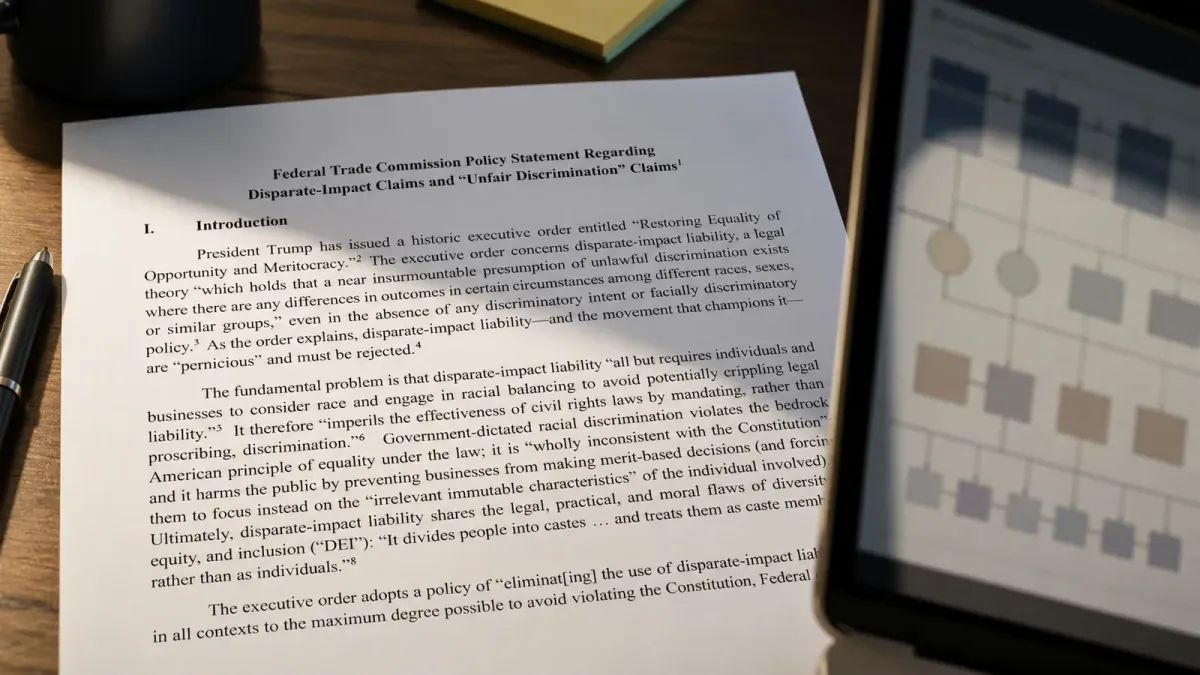
The Federal Trade Commission said Friday, August 7, 2026, that it will no longer pursue claims based on disparate-impact or "unfair discrimination" theories, a policy change that could reshape how the agency approaches credit, consumer-protection, and automated-decision cases.
The short version: the FTC is saying it will focus on intentional discrimination and deception, not statistical disparities alone. That distinction matters as banks, employers, landlords, insurers, and software vendors use algorithms that can produce uneven results even when no one wrote an explicitly discriminatory rule.
Disparate impact is the legal theory that a neutral policy can still be unlawful if it disproportionately harms a protected group and cannot be justified. The FTC's new statement says the agency lacks authority to bring that kind of claim under Section 5 of the FTC Act and under the Equal Credit Opportunity Act.
What changed
The FTC said it had previously pursued disparate-impact claims in two contexts: Section 5 cases framed as unfair-discrimination claims and ECOA cases involving credit. The new statement says both uses exceeded the agency's authority.
That does not mean every bias or discrimination case disappears. The agency can still bring deception cases, unfair-practice cases, and intentional-discrimination claims where the law supports them. But it narrows one path regulators have used to challenge systems whose outcomes differ across groups.
The move also lands in the middle of the AI-policy fight. In July, the FTC sought public comment on a proposed AI accuracy policy statement, saying companies may deceive consumers if they steer AI outputs toward undisclosed objectives. Separately, civil-rights advocates have warned that disparate-impact tools are especially important when automated hiring or screening systems create biased results that are hard to trace to intent.
Why readers should care
If you are applying for credit, housing, a job, insurance, or another screened service, the practical question is not only whether a tool uses AI. It is whether the company can explain what data the tool uses, how errors are corrected, and what appeal process exists when the result looks wrong.
A denial notice, adverse-action letter, or account restriction may still create rights under other laws. The hard part for ordinary people is that automated systems can make the decision feel final before anyone explains the input data, model rule, vendor role, or human-review option.
For businesses, the FTC statement may reduce one federal enforcement risk, but it does not remove state laws, private lawsuits, contract duties, sector-specific rules, or reputational risk. Companies using automated screening still need documentation, testing, and human review strong enough to show that decisions are explainable and lawful.
What to watch next
The immediate test is whether the FTC applies the new statement in pending or future credit, advertising, data-broker, health-app, or AI cases. Another signal will be how state regulators respond, especially in states that have written rules for automated decision systems.
For consumers, the safest move is practical: keep copies of denial notices, ask for the main reason a decision was made, correct inaccurate files, and use any available appeal channel quickly. The FTC's policy shift changes the enforcement map, not the need to challenge a bad automated decision.


