
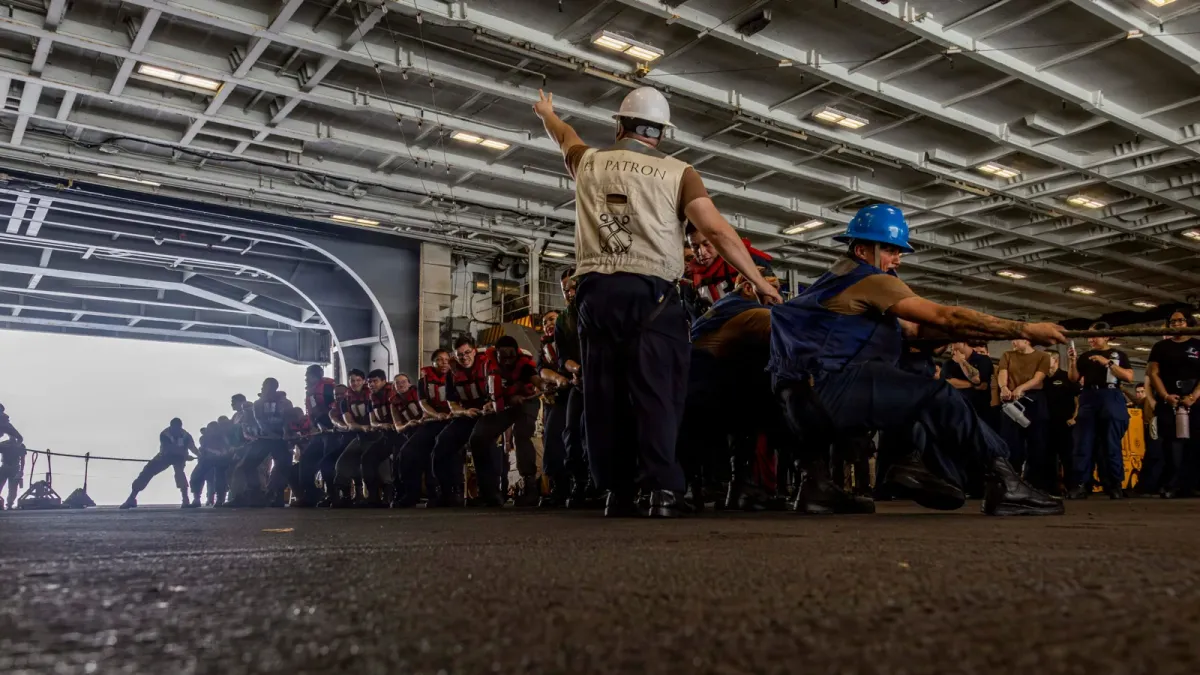
USS George Washington is moving west from the Pacific toward the Middle East as the Navy prepares for another carrier rotation around the continuing Iran mission. The movement could eventually relieve USS Abraham Lincoln, whose deployment has included more than 240 consecutive days at sea, but officials have not announced a handover date.
The Associated Press reported Thursday, August 13, that a Navy official confirmed George Washington was in the Strait of Malacca, the passage linking the Pacific and Indian oceans. The ship’s course puts it on a route toward the region where Lincoln has been operating.
The immediate story is not simply that one carrier may replace another. It is that sustaining a prolonged military operation requires the Navy to transfer the same demanding mission—and its pressure on crews, maintenance and logistics—to a fresh ship.
What has been confirmed
Lincoln entered the Middle East in January after leaving the Indo-Pacific and has supported U.S. operations against Iran. Its current deployment has stretched into a ninth month, including a record run of more than 240 days without a port visit.
The Navy has acknowledged that combat disrupted traditional supply hubs in the Middle East. In a statement reported by the AP, the service said leaders prioritized food first, then hygiene items and mail. The Navy said sailors now have clean water and healthy meal options.
Defense Secretary Pete Hegseth disputed broader accounts of conditions aboard Lincoln, calling them “completely misrepresented.” Speaking in Panama, he said the Navy can maintain the blockade of Iranian ports by rotating ships in and out. Several lawmakers have nevertheless requested investigations or more information about living conditions and crew welfare.
Why the rotation matters
An aircraft carrier is not a single vessel moving alone. It brings an air wing, escorts, logistics support and thousands of sailors into a sustained operating pattern. Replacing Lincoln can provide a path home for its crew, yet sending George Washington west also shifts a major Pacific-based asset toward the Middle East.
That tradeoff is the larger readiness signal. The Navy must cover an active mission near Iran while preserving capacity for other regions, maintaining ships and giving crews predictable time to recover and train. A rotation can address the most immediate deployment strain without resolving the demand that created it.
George Washington is forward-deployed in Yokosuka, Japan. U.S. Naval Institute tracking placed the carrier in the Philippine Sea in July during its first patrol of 2026. Its westward movement now shows how quickly a regional posture can change when an operation lasts longer than planned.
What remains unknown
The Pentagon has not publicly detailed when George Washington would arrive, when Lincoln would depart, or whether the two carriers would overlap in the region. A carrier transit from the western Pacific takes time, and operational schedules can change.
There is also no public end date for the Iran mission. Hegseth’s emphasis on continued rotations signals that planners are preparing to sustain the operation, not wind it down immediately.
The practical measure to watch is the handover itself: when George Washington enters the operating area, whether Lincoln begins its return, and what the Navy says about maintenance and recovery after the extended deployment. Until then, the westward transit is a warning about endurance as much as it is a sign of relief.


