
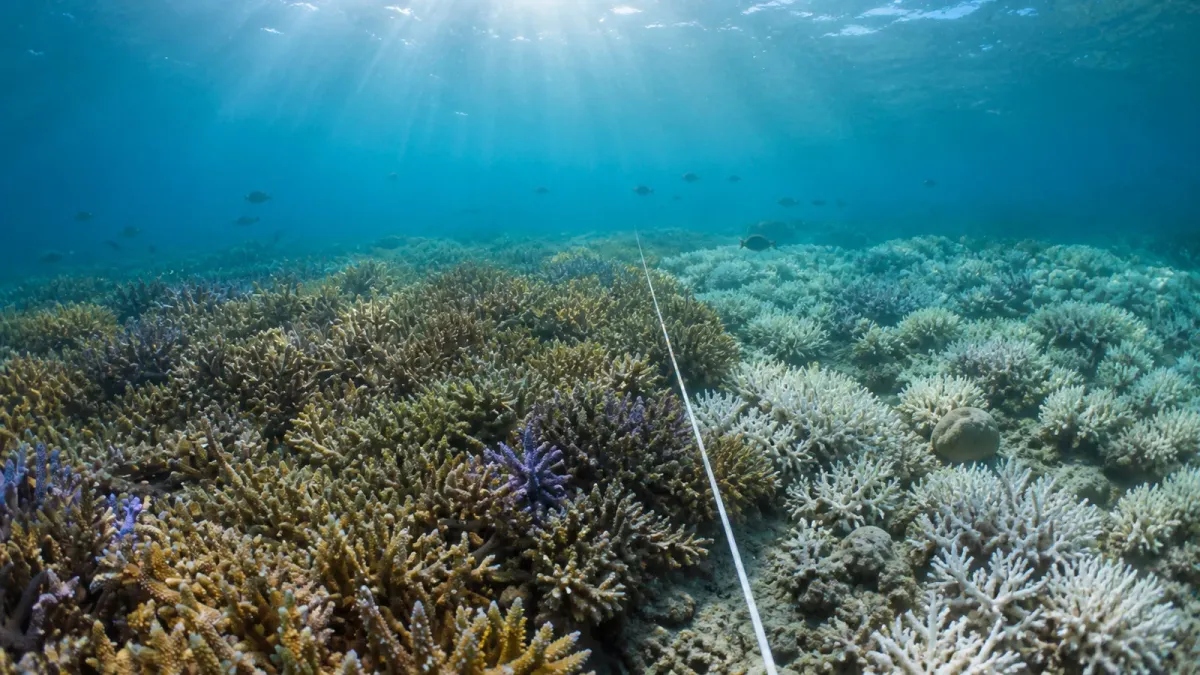
Average hard-coral cover worldwide fell from 30.2% during the 1980-2009 reference period to 27.3% in 2020-2024, according to a major assessment released Monday, August 31. That is a 2.9 percentage-point drop, or a 9.5% relative decline.
The Status of Coral Reefs of the World: 2025 report draws on 21.1 million observations, 87,299 surveys and 36,886 reef sites across 124 countries, territories and economies. The Global Coral Reef Monitoring Network calls it the most comprehensive worldwide reef assessment yet.
The report’s central warning is not that every reef is declining at the same rate. It is that major bleaching events are occurring more often, shortening the time damaged corals have to regrow and reproduce before the next disturbance.
The short answer
Coral reefs can recover, and the global record shows it. Hard-coral cover rose by about 6% between 2017 and 2019 after the third global bleaching event. The problem is that this partial rebound was followed by another period of widespread heat stress before many reefs could regain their earlier condition.
Scientists involved in the assessment say reefs that once had longer gaps between severe disturbances may now get only five or six years. The report links the long-term global decline primarily to human-driven climate change, while also identifying local pressures such as poor water quality, overfishing and coastal development.
What the 9.5% figure means
The report compares average coral cover across two different periods. Moving from 30.2% to 27.3% is not a 9.5 percentage-point collapse. It is a 2.9 percentage-point decline relative to a starting level of 30.2%, which equals roughly 9.5%.
That distinction matters because the global average can hide regional differences. Some reef systems remain in relatively good condition, some have recovered after earlier losses and others have declined sharply. The assessment is a broad signal, not a claim that every monitored reef has followed one identical path.
Why recovery time is the key
Bleaching does not automatically mean every coral dies. Heat stress can cause corals to expel the algae that provide much of their color and energy; survival depends on the intensity and duration of the stress, the species involved and conditions after the event. If disturbances ease, surviving corals can grow and reefs can regain cover.
Repeated events change that equation. A reef hit again before mature colonies reproduce or young corals establish has less capacity to replace what was lost. Local management cannot stop global heat stress, but reducing pollution, overfishing and physical damage can leave reefs in better condition to survive and recover.
Why people beyond the reef should care
Coral reefs occupy less than 0.2% of the ocean floor but support at least a quarter of marine species, according to the report. They also contribute to fisheries, tourism, cultural heritage and coastal protection for communities around the world. About 104 million people live within five kilometers of a reef.
What to watch
The next question is whether monitoring shows sustained recovery after recent bleaching or another step down in coral cover. The report says the strongest path combines faster emissions reductions with local action on water quality, fishing and coastal development.
The new assessment does not describe recovery as impossible. It shows that rebound still occurs when reefs get enough time. The risk is that the interval between major disturbances is becoming shorter than the biological work of recovery.


