
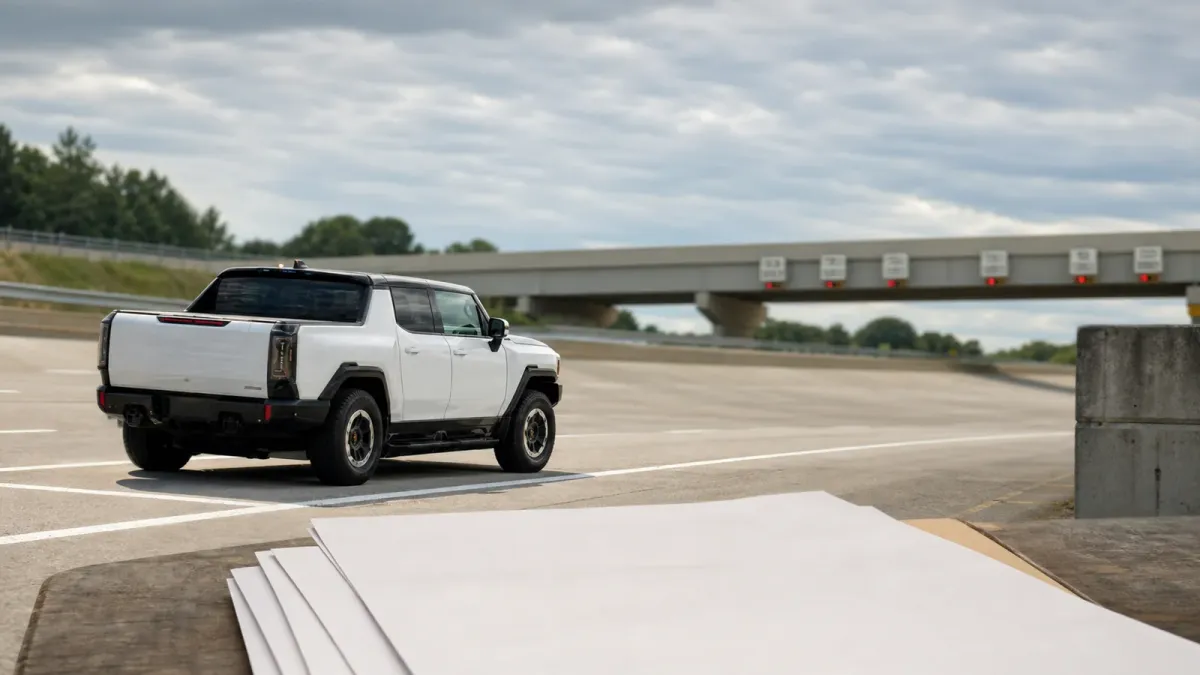
President Donald Trump is scheduled to speak at General Motors' Milford Proving Ground in Michigan on Monday, July 27, putting his tariff-heavy economic agenda in front of one of the states most exposed to auto trade with Canada.
The visit matters because Michigan's auto industry depends on parts, vehicles, engineering work, and border infrastructure that do not fit neatly inside one national market. A tariff framed as protection for U.S. manufacturing can still raise costs for companies and buyers when supply chains cross the Detroit-Windsor corridor repeatedly before a finished vehicle reaches a dealer lot.
GM confirmed the visit in a newsroom notice, describing Milford as the world's first dedicated vehicle testing site, with more than 150 miles of test roads where engineers validate safety systems, driver-assistance technology, and new models. A public presidential schedule lists a vehicle demonstration, tour, gift ceremony, and remarks at the proving ground on Monday afternoon.
Why Michigan is the test
The political setting is unusually sharp. Early voting is already underway for Michigan's August 4 primary, and AP reports that Trump's visit comes as new Canadian tariffs could sting a state whose economy is tied closely to automaking and cross-border trade. The trip lets the White House argue that tariffs support domestic factories, while critics are likely to press the cost question: who pays when imported parts or Canadian goods get more expensive?
The auto industry is not a simple import-versus-domestic story. A vehicle assembled in the United States can include parts made in Canada or Mexico, specialized materials sourced abroad, and engineering work spread across several facilities. That means a tariff can protect one part of the chain while adding friction to another. For buyers, the key question is whether those costs show up in sticker prices, financing terms, repair costs, or delayed model plans.
The bridge backdrop
The timing also overlaps with tension around the Gordie Howe International Bridge, the new Detroit-Windsor crossing meant to expand one of North America's most important trade routes. The Guardian reported last week that Canada canceled a joint bridge-opening celebration with the United States after fresh tariff tensions, underscoring how a trade fight can spill into regional infrastructure and diplomacy.
For Michigan workers and businesses, that backdrop turns Monday's remarks into more than a campaign-style stop. The visit gives Trump a chance to explain how his administration thinks tariffs, auto jobs, consumer prices, and cross-border logistics fit together before the policy effects are fully settled.
What to watch next
The most important signal from Milford will be whether Trump offers specific tariff relief, exemptions, timelines, or enforcement details for automakers, or whether he sticks to a broader defense of tariffs as leverage. Specific carveouts would matter quickly to companies planning parts orders, vehicle launches, and pricing. A general defense would leave manufacturers and consumers watching for later trade negotiations.
Investors will also listen for how GM is positioned in the message. A White House visit to a proving ground highlights U.S. engineering and vehicle development, but the market question is still practical: whether policy changes improve margins, raise costs, or shift production decisions. The answer may not come from one speech, but Monday's stop makes Michigan the place where the tariff argument has to meet the auto supply chain.


