
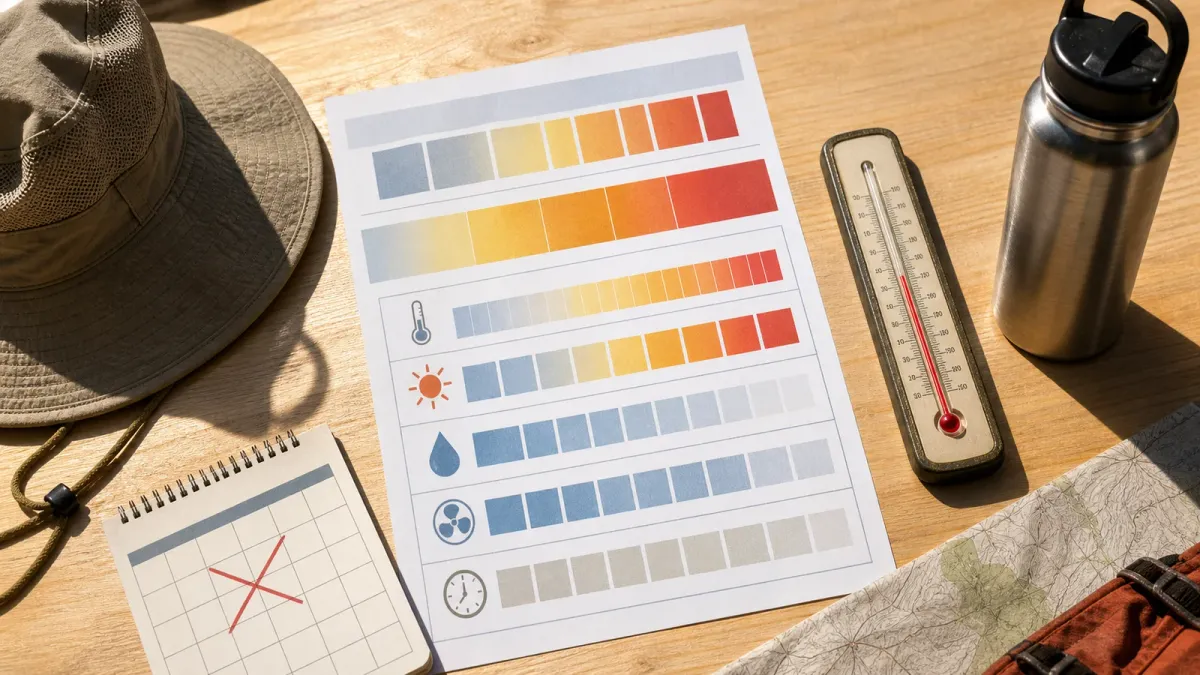
Heat advisories on July 21, 2026, are a reminder that the number on a weather app is not the only heat number that matters. Before outdoor work, sports practice, a long walk, or a trip with older relatives or children, check three related but different tools: heat index, NWS HeatRisk and wet bulb globe temperature.
The short version: heat index tells you how hot the air feels when humidity is added, HeatRisk tells you how unusual and medically risky the forecast heat may be for your location, and wet bulb globe temperature is most useful when exertion, sun and wind matter.
That distinction matters because a 96 F afternoon can feel far hotter when humidity is high. The National Weather Service says heat index values are calculated for shady, light-wind conditions, and full sunshine can add as much as 15 F to the apparent heat.
Do this first
Check your local National Weather Service forecast for official heat watches, warnings or advisories. Those alerts remain the primary signal for immediate local action, especially when a local office is warning about dangerous afternoon heat or poor overnight recovery.
Then check HeatRisk. NWS describes HeatRisk as a supplemental seven-day forecast that uses color and number categories to show potential heat-related impacts. Red, or level 3, means major heat risk for anyone without cooling or hydration. Magenta, or level 4, means rare or long-duration extreme heat that can affect people, health systems, industries and infrastructure.
If the plan involves practice, construction, landscaping, marching band, a race, or another active outdoor task, check wet bulb globe temperature when it is available. NWS says WBGT uses temperature, humidity, wind and solar radiation, making it more useful than heat index for active people and outdoor workers.
Check these details
Look beyond the daytime high. HeatRisk accounts for the time of year, how unusual the heat is for a location, how long it lasts, and whether warm nights keep the body from recovering. A same-day NWS Springfield, Missouri, briefing on July 21, 2026, paired a heat advisory with hourly heat index guidance, maximum WBGT and HeatRisk because each tool answers a different planning question.
The CDC says hot days can affect anyone, but some people need extra caution, including adults 65 and older, infants and young children, pregnant people, people with asthma or heart disease, and people working or exercising outside. CDC guidance also says to stay cool, stay hydrated, know symptoms such as dizziness, heavy sweating, weakness, nausea or headache, and check on people who live alone or have chronic medical conditions.
Common mistakes
Do not treat a fan as a full cooling plan during very hot indoor conditions. CDC guidance says fans may increase body temperature when indoor temperatures are above 90 F. Air conditioning, a cooling center, shade breaks and schedule changes are stronger protections when the risk is high.
Do not wait for a heat stroke emergency to change plans. Move strenuous activity earlier or later, add rest breaks, carry water, and reconsider outdoor exposure when alerts, HeatRisk or WBGT all point in the same direction.
When to get help
Heat stroke is an emergency. If someone is confused, loses consciousness, has a very high body temperature, or cannot cool down, call emergency services and move the person to a cooler place while help is on the way. For non-emergency planning, use your local NWS forecast, HeatRisk, CDC heat-health guidance and local public health alerts together.


