
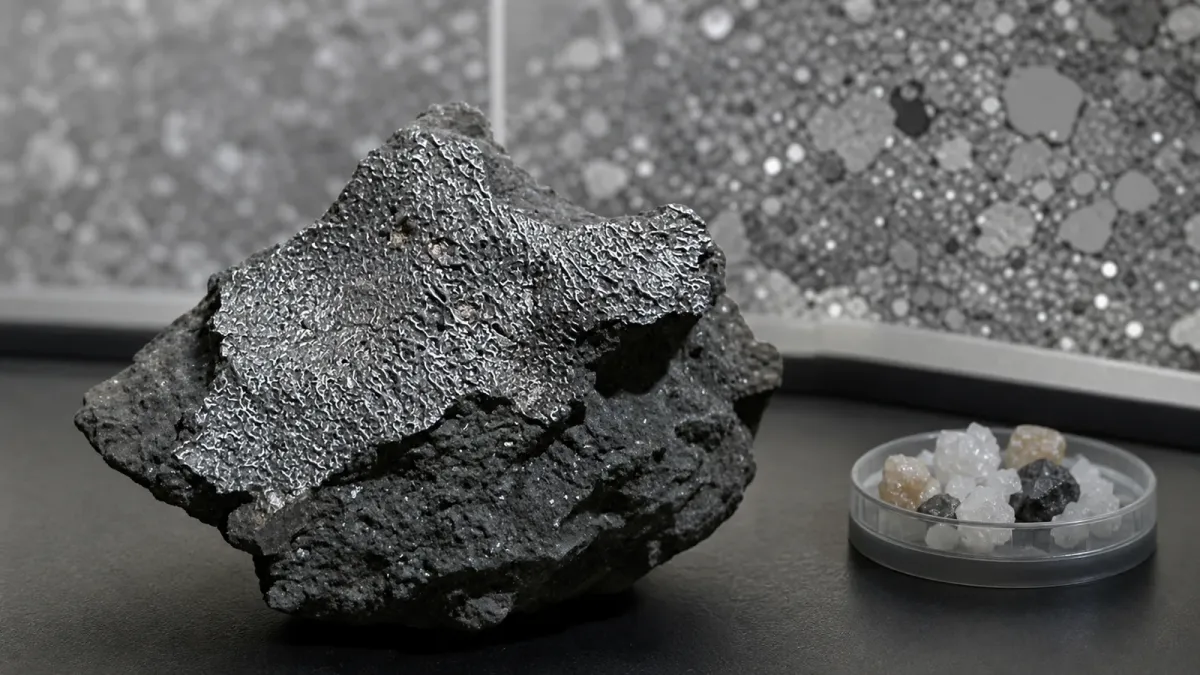
A meteorite that crashed through a Hillsborough, New Jersey, home in 2024 is now helping scientists study how salty fluids inside ancient asteroids may have shaped ingredients associated with life.
The new analysis, published July 15, 2026, in Science Advances and highlighted by NASA, examined the Hillsborough meteorite because it was recovered quickly after the July 16, 2024, daylight fireball over the New York City area. That fast recovery matters: rain, soil and handling can contaminate meteorites before labs get a clean look at their chemistry.
Researchers classified the rock as a CM carbonaceous chondrite, a water-altered class of meteorite that can carry organic compounds. NASA said the sample preserved sodium-rich material and hydrated minerals, evidence that brines once moved through its parent asteroid.
The short answer
The finding does not mean scientists found life. It means a small piece of asteroid rock kept signs of liquid-water chemistry, salts and organic molecules in the same package, giving researchers another clue about how early solar system bodies could assemble and preserve life's building blocks.
Why this meteorite stood out
The Hillsborough fall was unusual because people witnessed the incoming fireball, tracked the event, and recovered material soon after impact. Reporting distributed by the SETI Institute said the meteorite weighed more than 2 pounds and was tied to a daytime meteor that passed over the New York region before striking a house in New Jersey.
That chain of observation lets scientists connect a lab sample to a specific fall, rather than studying an older rock whose time on Earth is harder to reconstruct. The American Meteor Society also logged the July 16, 2024, daylight fireball, adding public observational context to the event.
The paper also gives researchers a sharper comparison point for sample-return missions. Meteorites found long after landing can still be scientifically valuable, but a witnessed and quickly collected fall helps separate asteroid history from later Earth exposure.
What the chemistry suggests
The study found a diverse set of organic compounds and amino acids, according to NASA's summary, while the paper describes mineral evidence for aqueous alteration. In plain terms, the asteroid material appears to have interacted with salty water before it reached Earth.
That is useful because carbonaceous chondrites are often treated as records of early solar system chemistry. If brines helped move or modify organic material inside their parent bodies, meteorites like Hillsborough can help researchers test how common those pathways were.
It also keeps the claim in bounds. Amino acids can form without biology, and salts can record chemical environments rather than living systems. The scientific value is in the preserved pathway, not in a claim that the meteorite carried life.
What to watch next
The next step is comparison. Scientists can put Hillsborough beside other well-studied meteorites, including rapidly recovered falls and returned asteroid samples, to see which chemical signatures are shared and which are specific to one parent body.
For readers, the main takeaway is simpler: a rock that made headlines because it hit a house is now more than a curiosity. Its clean recovery gives labs a rare chance to study asteroid chemistry with fewer Earth-side complications.


