
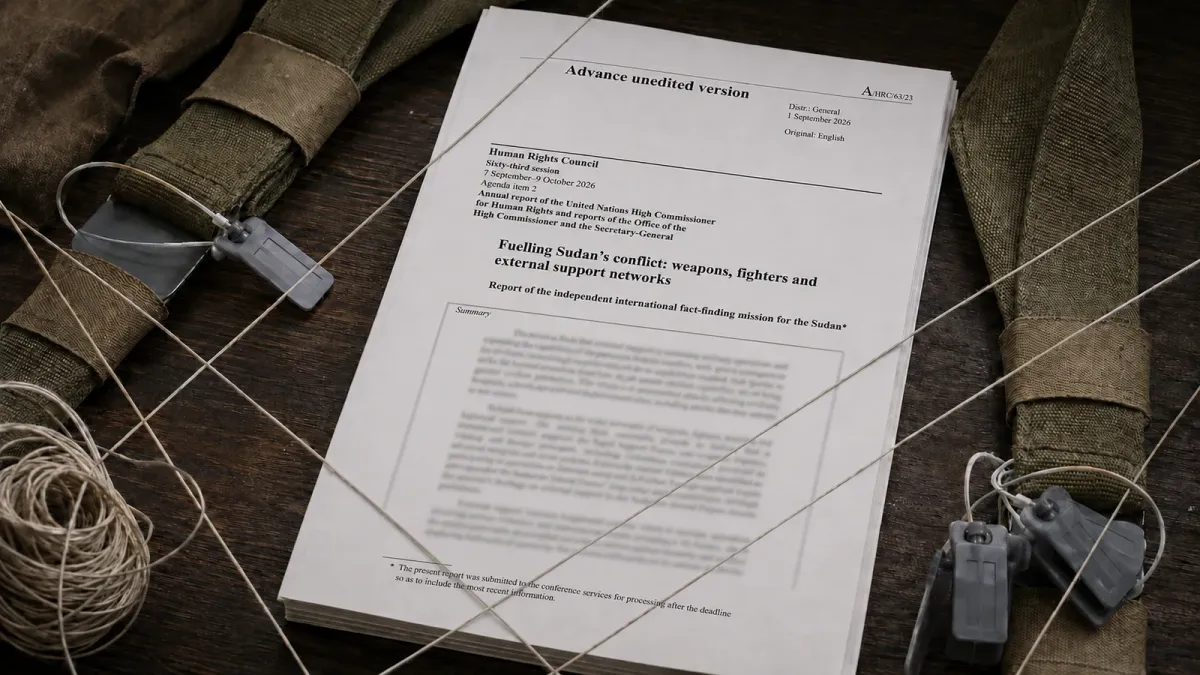
A new United Nations investigation says Sudan's war is being sustained by a cross-border system of weapons, fighters, training, finance and logistics. The report's central warning is that outside support is not merely prolonging the conflict—it is expanding both sides' ability to strike civilians far from the front lines.
The Independent International Fact-Finding Mission for the Sudan said Thursday, September 3, that it found reasonable grounds to believe a transnational network supplied the Rapid Support Forces, or RSF, with military equipment and foreign personnel. Investigators also said foreign-supplied drones expanded the long-range capability of the Sudanese Armed Forces, though they described those findings as preliminary.
The report offers a framework for understanding why a war that began as a power struggle in April 2023 has become harder to contain: armed groups draw on supply chains that cross national borders and involve private companies, intermediaries, contractors and state-linked infrastructure.
The short answer
Foreign support changes the war in two ways. First, it replenishes weapons and personnel that allow the combatants to keep fighting. Second, it gives them more sophisticated drones and other systems that can reach hospitals, markets, schools, displacement sites and essential infrastructure well beyond conventional battle lines.
The U.N. mission said evidence connected the RSF's support network to individuals and entities in the United Arab Emirates, Chad, southeastern Libya, Colombia and Puntland in Somalia. Reuters reported that up to 2,000 Colombian contractors may have helped operate and maintain RSF drone systems and other advanced weapons.
What the numbers show
The mission said more than 1,000 people were killed in drone strikes during the first five months of 2026. It highlighted RSF strikes in Kalogi, South Kordofan, that killed 114 people, including about 60 children, and Sudanese army strikes on Ad-Da'ein Teaching Hospital in East Darfur that killed at least 70 people.
Repeated RSF strikes also damaged electricity and fuel facilities in El Obeid between May and July, disrupting water, health care and transport in a city already under severe pressure. These cases show why the range and persistence of drones matter even when territory does not change hands.
What the accused parties say
The UAE has repeatedly denied providing military support to the RSF. Somalia said it took the allegations seriously and did not authorize its territory, airspace or ports to support the conflict, while acknowledging information-sharing gaps with regional authorities. Colombia said it opposes mercenary activity, and Chad rejected the allegations and said it was working to secure its borders.
The RSF and Sudanese military did not immediately respond to Reuters requests for comment on the new report; both have previously denied abuses. The U.N. findings use a legal fact-finding standard and do not by themselves amount to criminal convictions.
What to watch
The mission urged the U.N. Security Council to extend the existing Darfur arms embargo to all of Sudan and to enforce it more effectively. The practical question is whether governments will investigate the named supply routes, contractors and financial links rather than treating the conflict as an isolated civil war.
Without pressure on the external networks, the report argues, battlefield diplomacy will address only part of the system keeping the war alive.


