
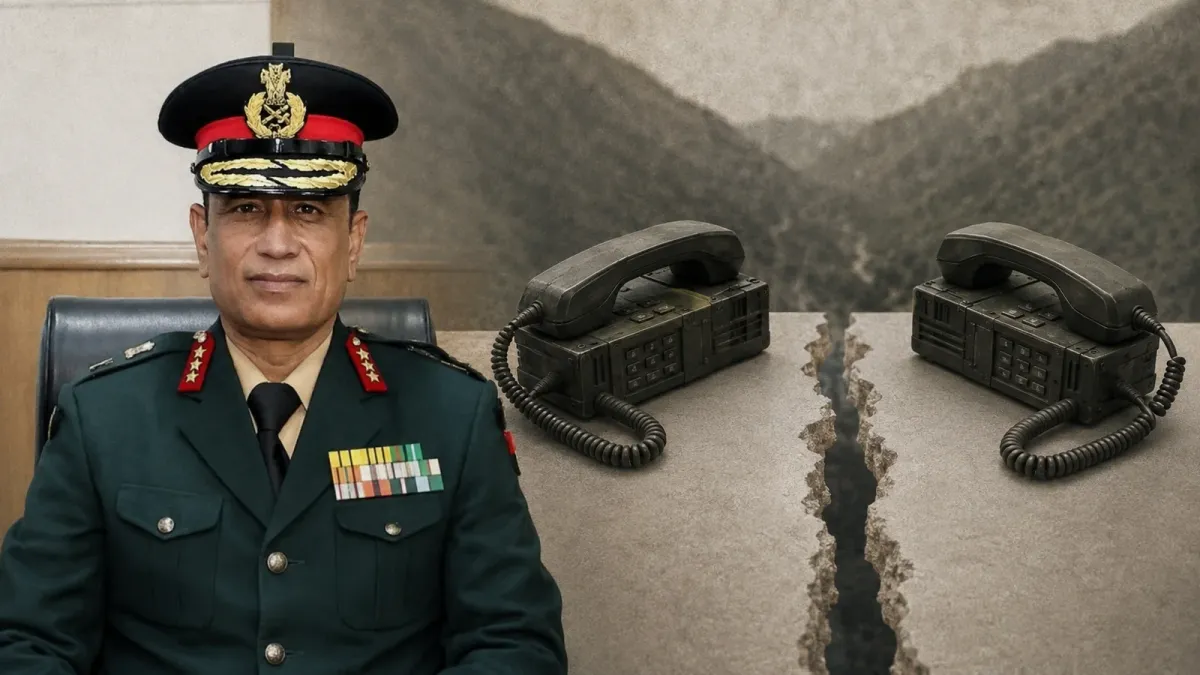
Indian and Chinese senior military commanders met Sunday, September 6, at Wacha-Damai in Arunachal Pradesh, opening the first corps commander-level dialogue in the disputed eastern sector. The meeting creates a higher-level channel for handling local tensions along the Line of Actual Control, or LAC, where the two nuclear-armed countries maintain substantial forces.
The short answer is that the talks can reduce the risk that a patrol encounter or disputed construction project spirals into a broader confrontation. They do not redraw the border, remove all troops or resolve India and China’s competing claims over Arunachal Pradesh.
What happened
Lieutenant General Girish Kalia, commander of the Indian Army’s III Corps, met his Chinese counterpart and other officers at the Wacha-Damai border meeting point on the Indian side of the LAC, the Indian Express reported. The discussion came amid reports of recent tension in the Taksing area of Upper Subansiri district.
The meeting followed an August 25 round of political-level border talks in Beijing between India’s national security adviser, Ajit Doval, and Chinese Foreign Minister Wang Yi. In the published eight-point outcome, the two governments agreed to add two meeting points for senior commanders and two military hotlines in the eastern and middle sectors.
Why a new channel matters
For years, the most prominent corps commander talks focused on the western sector in Ladakh after the deadly 2020 Galwan Valley clash. Extending senior dialogue to Arunachal Pradesh gives commanders responsible for the eastern sector a direct venue to clarify patrol movements, raise complaints and prevent local incidents from being misread as deliberate escalation.
That matters because the LAC is not a jointly demarcated international border. India and China disagree about where it runs in several areas. China claims Arunachal Pradesh, which India administers and describes as an integral part of the country. The two sides also use different figures for the total length of their disputed frontier.
What the talks cannot do
A military meeting can manage risk, but it cannot settle the sovereignty dispute. Any durable border agreement would require political negotiations, detailed delimitation and eventual demarcation accepted by both governments. The August political talks created working groups on boundary delimitation and border management, but neither side announced a breakthrough on the core territorial claims.
Dialogue also does not by itself prove de-escalation. The practical test is whether commanders can use the new channel during a real incident, whether both sides share enough information to avoid surprise and whether agreed procedures lead to changes on the ground.
What to watch next
The first signal will be any joint or parallel statement describing what the commanders discussed and whether they reached a concrete understanding. Officials have not yet publicly announced an outcome from Sunday’s meeting.
The broader sequence also matters. India and China agreed in August to start work on the terms of reference for expert groups, improve military hotlines and hold a September meeting on cross-border rivers and hydrological data. Progress across those channels would indicate that Wacha-Damai is part of a wider effort to stabilize relations rather than a one-off meeting.
For now, the significance is procedural but real: the eastern sector has a senior military forum it did not previously have. Its value will depend on whether that mechanism produces faster communication, fewer surprises and verifiable steps when tensions return.


