
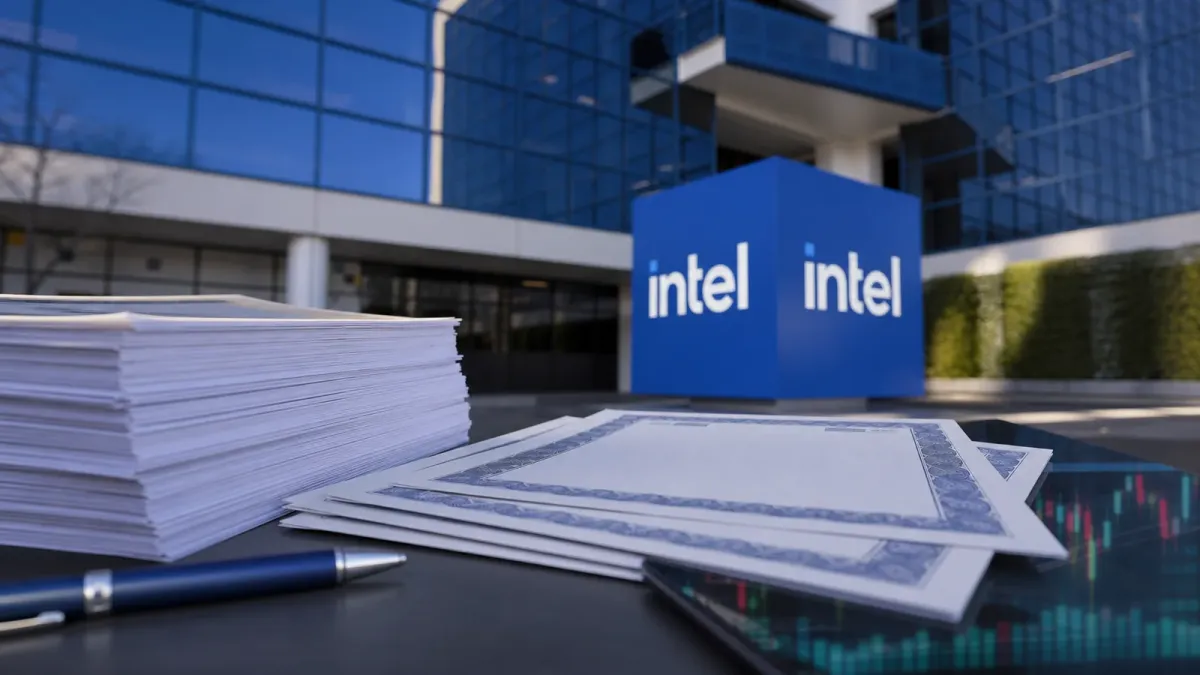
Intel turned a $15 billion stock sale into a $20 billion one on Tuesday, pricing 210,526,315 new shares at $95 each as the chipmaker tries to fund a more expensive AI-era buildout without relying only on debt.
The offering is expected to close on August 12, 2026, subject to customary conditions. Intel said net proceeds should be about $19.7 billion before any exercise of the underwriters' option to buy up to 31,578,947 more shares.
The simple tradeoff is this: Intel gets a large cash infusion for capital expenditures, working capital and other corporate needs, while existing shareholders face dilution because more common shares will be outstanding.
What changed
Intel announced the proposed $15 billion common stock offering on August 10 and then upsized and priced it early August 11. The company said the larger offering reflected the final deal size and that the stock would be sold at $95 per share.
The company listed J.P. Morgan, Goldman Sachs, Morgan Stanley and Citigroup as joint book-running managers, with several other banks also working on the transaction.
Intel's preliminary prospectus filed with the Securities and Exchange Commission laid out the investor risk in plain terms: future sales or issuances of substantial numbers of shares can pressure the market price. That is the dilution concern behind any large follow-on offering, even when the cash is raised for growth plans rather than emergency repairs.
Why Intel wants the cash
Intel said it intends to use the proceeds for general corporate purposes, including capital expenditures and working capital. That wording is broad, but it matters because semiconductor manufacturing requires unusually large upfront investment before new capacity, advanced packaging or foundry work can generate returns.
The timing also fits the AI infrastructure race. Data-center customers are demanding more compute, and chipmakers are spending heavily to support new processors, packaging capacity and manufacturing processes. For Intel, the offering gives management more room to keep investing while preserving flexibility on the balance sheet.
That does not mean the transaction is automatically good for shareholders. A stock sale can strengthen the company while still reducing each existing share's claim on future earnings. The deal only works for long-term holders if the new capital helps Intel earn enough future return to offset the dilution.
The investor test
Investors should separate two questions. First, can Intel raise the money on terms that show real market demand? The upsizing from $15 billion to $20 billion suggests the deal found enough buyers at the offered price.
Second, can Intel turn that money into higher-value capacity, products or customer commitments? That is the harder test. Intel's own risk disclosures point to competition, rapid technology change, expensive manufacturing investments, trade uncertainty, customer concentration and the still-evolving market for AI-capable products.
Those risks are not boilerplate for this story. They are exactly why the stock sale matters. Intel is asking the market to fund a strategy whose payoff depends on years of execution in a chip cycle moving faster than normal.
What to watch next
The first near-term marker is whether the offering closes as expected on August 12 and whether underwriters exercise any part of their 30-day option for additional shares.
After that, watch Intel's capital-spending guidance, foundry customer commitments, gross margin trend and free-cash-flow commentary. If management can tie the new cash to visible demand and better manufacturing economics, dilution will look more like a financing cost. If returns lag, the larger share count will become the story.
For everyday investors, the practical rule is to avoid treating the $20 billion headline as either a rescue signal or a victory lap. It is a financing event. The real answer comes later, when Intel has to prove that selling more stock bought it enough time and capacity to compete in the AI buildout.


