
Intel reported a much stronger operating quarter on Thursday, July 23, but the headline results require a careful read. Second-quarter revenue reached $16.1 billion, up 25% from a year earlier, and the chipmaker posted $1.8 billion of GAAP operating income. Yet Intel also reported an $11.0 billion net loss attributable to the company because a large mark-to-market charge tied to shares held for the U.S. government overwhelmed those operating gains.
The market initially focused on the growth. Intel shares traded near $108 in the first minutes after the 4:01 p.m. EDT release, roughly 8% above the $100.05 regular-session close, according to IEX market data. That early move can change quickly during an earnings call, but it showed that investors were looking past the GAAP loss toward the revenue, margins and outlook.
The numbers
Intel's $16.128 billion of revenue exceeded the top of its previous $13.8 billion to $14.8 billion guidance range. It also came in well above the roughly $14.4 billion consensus cited by S&P Global Market Intelligence before the report. Non-GAAP earnings were 42 cents per diluted share, compared with a 10-cent adjusted loss a year earlier.
The clearest growth engine was Data Center and AI. That unit produced $6.3 billion of revenue, up 59% year over year. Intel's Client Computing and Physical AI Group generated $8.9 billion, up 13%, while Intel Foundry revenue increased 31% to $5.8 billion. Because much of the foundry revenue comes from work performed for other Intel units, the company eliminated $5.5 billion of intersegment sales when calculating total revenue.
Margins also improved sharply. GAAP gross margin rose to 40.4% from 27.5% a year earlier, and non-GAAP gross margin reached 41.8%. Research and development plus marketing, general and administrative spending declined 6% on a GAAP basis to $4.5 billion. The result was an 11.1% GAAP operating margin, compared with a 24.7% operating loss margin in the second quarter of 2025.
Why an $11 billion loss does not mean the business burned $11 billion
The gap between Intel's operating profit and its bottom-line loss came mainly from a non-operating accounting item. Intel recorded a $13.6 billion mark-to-market loss on “Escrowed Shares,” a derivative liability connected to its Warrant and Common Stock Agreement with the U.S. government. Those are Intel shares held in escrow and released to the Commerce Department as the company performs under its CHIPS Act Secure Enclave agreement and receives related cash proceeds.
When Intel's share price changes, the estimated value of that obligation changes too. The company said the second-quarter charge reflected the fair-value movement of shares released during the quarter and shares still held in escrow at quarter-end. That accounting adjustment flowed through “interest and other, net,” turning $1.8 billion of operating income into a $10.8 billion pretax loss.
The charge was not a same-quarter cash payment of $13.6 billion. Intel generated $7.0 billion in cash from operations and reported $2.2 billion of non-GAAP net income after excluding the escrowed-share revaluation and other adjustments. That does not make every cash-flow concern disappear: Intel's own adjusted free cash flow measure was negative $8.4 billion, and its reconciliation included a $12.2 billion net outflow from partner contributions. Investors should separate the accounting loss from the company's still-heavy capital and financing demands.
What Intel says is driving the rebound
Chief Executive Lip-Bu Tan said AI demand is increasing the need for compute across Intel's CPU, custom-chip, advanced-packaging and foundry businesses. The quarter included the launch of Xeon 6+, Intel's first server-class product built on its Intel 18A process, as well as high-volume manufacturing for a subset of Panther Lake chips using ASML's High NA EUV equipment.
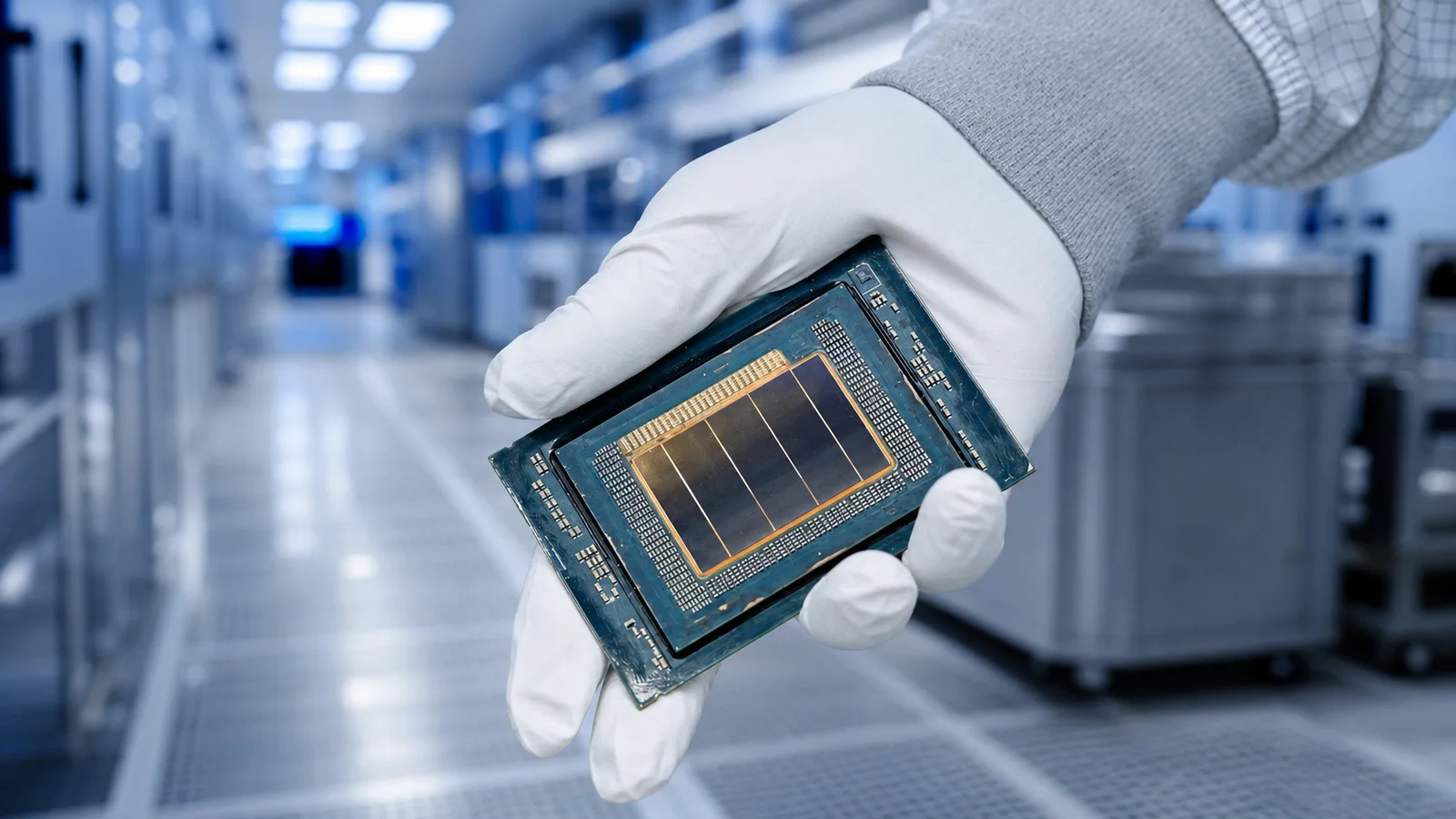
Those milestones matter because Intel is trying to rebuild both sides of its model at once: selling competitive processors and manufacturing chips at advanced nodes. The revenue gains suggest stronger demand and execution, but the company is also increasing investment in equipment, clean-room space and substrates. That spending raises the bar for future foundry utilization and external customer wins.
What to watch next
Intel forecast third-quarter revenue of $15.8 billion to $16.8 billion. At the midpoint, it expects a 41% GAAP gross margin, a 42% non-GAAP gross margin, GAAP earnings of 31 cents per share and non-GAAP earnings of 38 cents per share.
The next test is whether Data Center and AI demand remains strong enough to support that higher revenue level while Intel improves foundry economics and funds additional manufacturing capacity. Investors should also watch for more detail on capital spending, external foundry customers and the cash impact of Intel's partnership and government-financing arrangements. The short version is that Intel's operating recovery accelerated in the second quarter, but the earnings release also shows why revenue growth, accounting profit and cash generation must be judged separately.


