
The U.S. military began a 10th consecutive night of strikes on Iran on July 20, 2026, saying the campaign was intended to reduce Iran’s ability to attack commercial shipping in the Strait of Hormuz. Iran continued retaliatory attacks across the region, including against U.S.-allied Gulf states, as the conflict widened beyond a single battlefield.
At the same time, diplomatic contacts had not disappeared. Reuters reported that mediators had presented ceasefire proposals to Tehran, even as strikes continued and new threats to shipping emerged. The contradiction is the factual starting point for today’s cartoon: military leaders describe additional force as a path toward security while each new round creates another stated reason for retaliation.
What the cartoon is criticizing
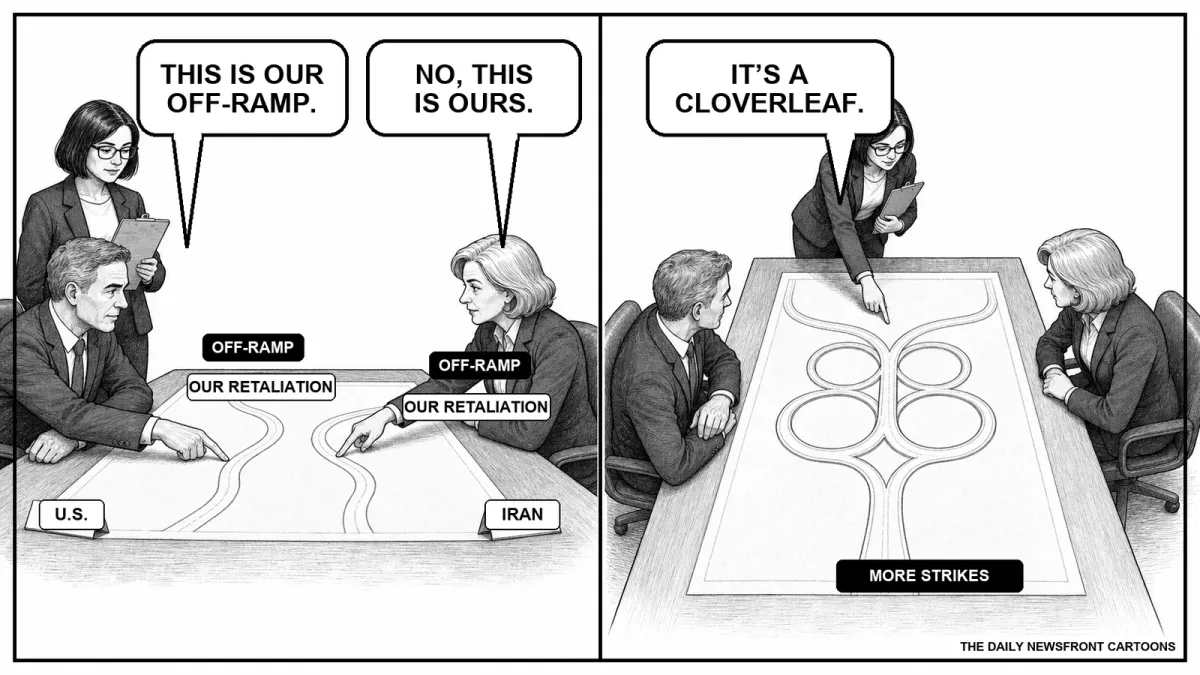
The joke targets the escalation logic used by powerful institutions on both sides, not Iranian or American civilians, service members, or war casualties. Its highway interchange is a visual metaphor. The officials are fictional composites, and every line of dialogue is invented satire; no real official called the conflict a “cloverleaf.”
The two-panel cartoon begins with U.S. and Iranian officials each pointing to a route labeled “OUR RETALIATION” and calling it an off-ramp. The second panel pulls back to show both routes looping into “MORE STRIKES.” A fictional analyst supplies the final line: “It’s a cloverleaf.”
The factual boundary
What is literal: repeated U.S. strikes, Iranian retaliation, pressure on Gulf shipping, and active ceasefire diplomacy were all reported on July 20. What is exaggerated: the shared briefing room, road-map machinery, dialogue, and looping off-ramp. The cartoon argues that retaliation can become self-justifying; it does not claim the two governments have identical goals, capabilities, or legal positions.
Sources: Associated Press live coverage, Reuters reporting via Al-Monitor, and a July 13 CENTCOM account of its campaign objectives.


