
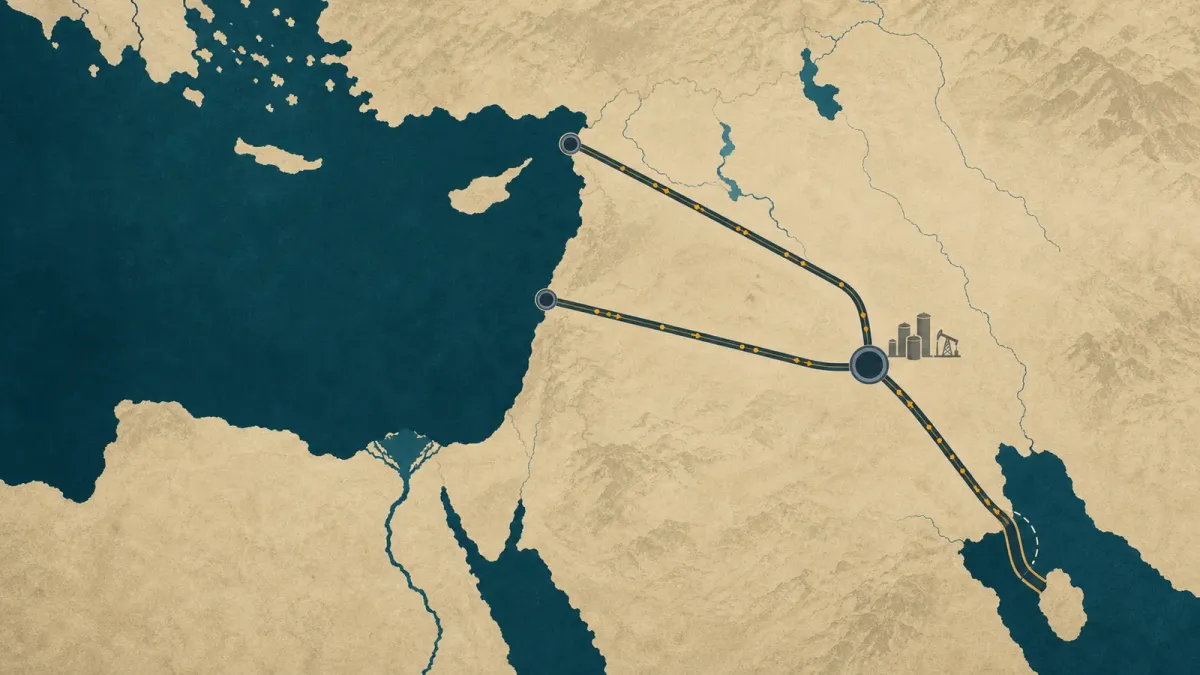
U.S. and Iraqi companies signed more than $60 billion in agreements and memoranda on July 17, including energy deals meant to create alternate routes for moving Iraqi oil out of the Persian Gulf.
The market question is not whether Iraq wants a way around the Strait of Hormuz. It is how quickly a paper agreement can become physical export capacity when the proposed routes cross multiple countries and a region already strained by the U.S.-Iran war.
The U.S. Chamber of Commerce, which hosted the Washington business summit, said more than 50 agreements and memoranda of understanding were signed. The list reached beyond energy into health care, communications and infrastructure, but oil transport is the part with the clearest global-market consequence for households, airlines, truckers and refiners watching fuel costs.
The numbers
Associated Press reported that Chevron signed three agreements with Iraq. Two focus on boosting oil production, while the third involves investment in a pipeline that would create another export route from Iraq to world markets.
The proposed route would connect southern Iraq's Basra area to Haditha in western Iraq, then continue toward Turkey's Ceyhan port and Syria's Baniyas port on the Mediterranean. Iraqi officials have projected initial capacity of about 2 million barrels per day for the Iraq-Syria pipeline once rehabilitated.
That sounds large, but it is not a near-term substitute for Hormuz. AP reported that Goldman Sachs analysts estimate pipelines in one country can take at least two and a half years to build, and these routes would involve two or more nations. The same reporting noted that roughly a fifth of the world's oil normally moves through the strait. Until new capacity is financed, built and protected, traders will still treat Hormuz as the key stress point.
Why investors and drivers care
Oil markets price risk before barrels move. The value of the deals is that they show Iraq, U.S. companies and regional governments are trying to add redundancy to a system that has been exposed by conflict around the Gulf.
For consumers, that matters because oil-route stress can feed into gasoline and diesel prices even when supply has not permanently disappeared. For investors, the agreements shift attention to pipeline builders, producers with Iraqi exposure, shipping costs and the durability of any regional truce.
The caveat
The deals are preliminary, and the hard work is still ahead: financing, engineering, rights of way, border coordination, security guarantees and enough political stability in Iraq, Syria and Turkey to keep the project moving.
That is why the article should be read as an infrastructure signal, not a fuel-price promise. If the projects advance, they could make Hormuz less dominant by the end of the decade. If they stall, the same chokepoint risk will keep showing up whenever the Gulf security picture worsens.
What to watch next
Watch for formal project financing, Chevron and consortium disclosures, Iraqi cabinet approvals, State Department follow-up, and any agreement with Syria and Turkey on construction, security and port access. Those milestones will matter more than the signing ceremony for whether this becomes a real oil-market bypass.


