
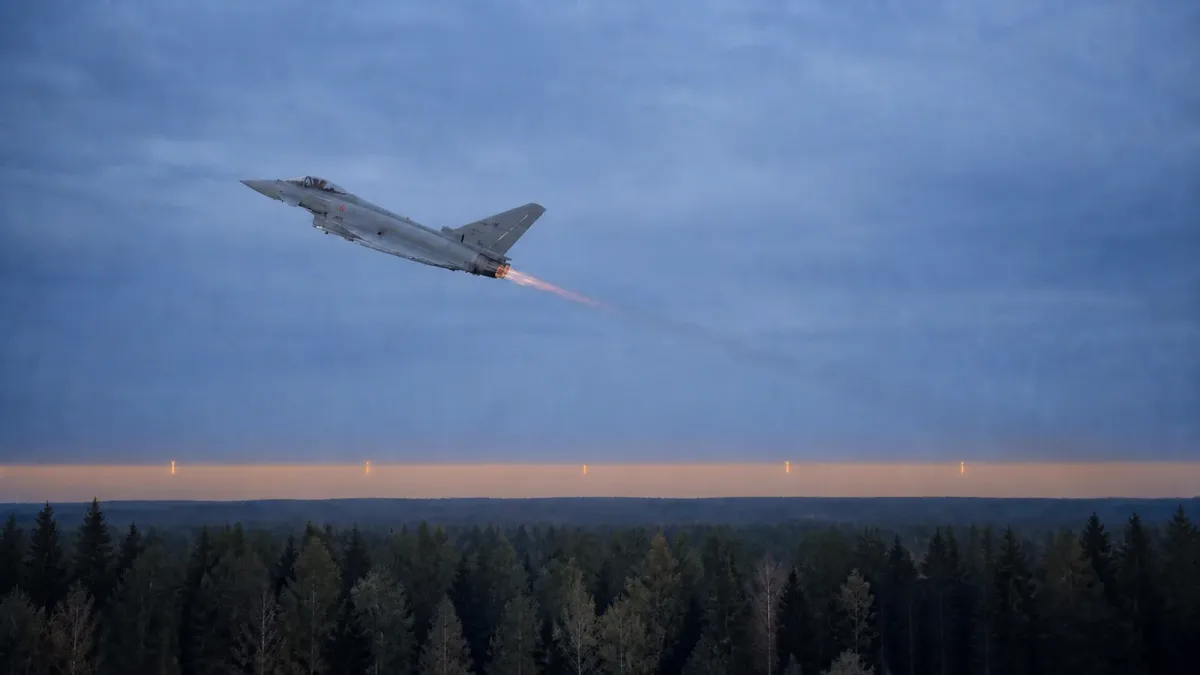
An Italian Eurofighter shot down a drone that entered Latvian airspace early Friday, August 14, after authorities warned residents across five eastern municipalities to take shelter. NATO and Latvia confirmed the interception, but officials had not identified who launched the drone.
Two Italian Eurofighters were scrambled, and one destroyed the aircraft, NATO spokesperson Allison Hart told The Associated Press. Two Turkish fighter jets were also deployed. Latvia said the drone crossed into its territory as a result of Russian electromagnetic warfare, an attribution about the disruption that officials did not pair with a confirmed origin for the drone itself.
The incident matters beyond a single unidentified aircraft. It is another live test of how NATO's Baltic Air Policing mission handles low-cost drones pushed or diverted across an alliance border, while civilians receive real-time warnings below.
What happened
Residents in five municipalities in eastern Latvia received alerts about an airspace threat and were told to seek shelter, according to AP. The warning was lifted after the drone was brought down. Latvia's eastern regions sit close to Russia and Belarus, where the war in Ukraine and electronic interference have repeatedly created spillover risks for NATO airspace.
CNBC also reported the Friday interception, citing Latvia's military and NATO. The agreement between those reports establishes the core facts: an unauthorized drone entered Latvia, NATO aircraft responded, and an Italian jet completed the shootdown. The aircraft's operator and precise type remained unconfirmed in the initial public accounts.
What is still unknown
The most important unanswered question is who launched the drone. Latvia's statement that Russian electromagnetic warfare contributed to the incursion is not the same as saying Russia operated the aircraft. Previous drones believed to be Ukrainian have strayed into neighboring countries after electronic jamming altered their navigation, while other incursions have involved suspected Russian systems.
That distinction is central to avoiding a premature escalation narrative. The immediate fact is an airspace violation and a NATO defensive response. Attribution requires debris analysis, flight-path evidence and any available data from the operator or nearby military systems.
Why Latvia was prepared
This was not Latvia's first recent drone emergency. On June 8, NATO fighters shot down another foreign drone over the Latgale region. Latvia's Defence Ministry said that aircraft had also entered because of Russian electromagnetic warfare and warned that similar incidents could recur while Russia's war in Ukraine continues.
Latvia has since reinforced air defenses along its eastern border, while NATO has continued rotating allied aircraft through its Baltic mission. The alliance established Baltic Air Policing in 2004 because Estonia, Latvia and Lithuania do not maintain the fighter fleets required to police their airspace alone.
What happens next
Investigators will try to identify the wreckage, reconstruct the route and determine whether the drone was deliberately aimed at Latvia or diverted from another mission. NATO and Latvian officials will also review how quickly the object was detected, how the shelter alerts reached residents and whether the multinational response worked as intended.
Until that review produces evidence, the clearest conclusion is narrow but consequential: NATO treated the incursion as a real air-defense problem, acted before the drone could continue across Latvian territory and left the question of responsibility open.


