
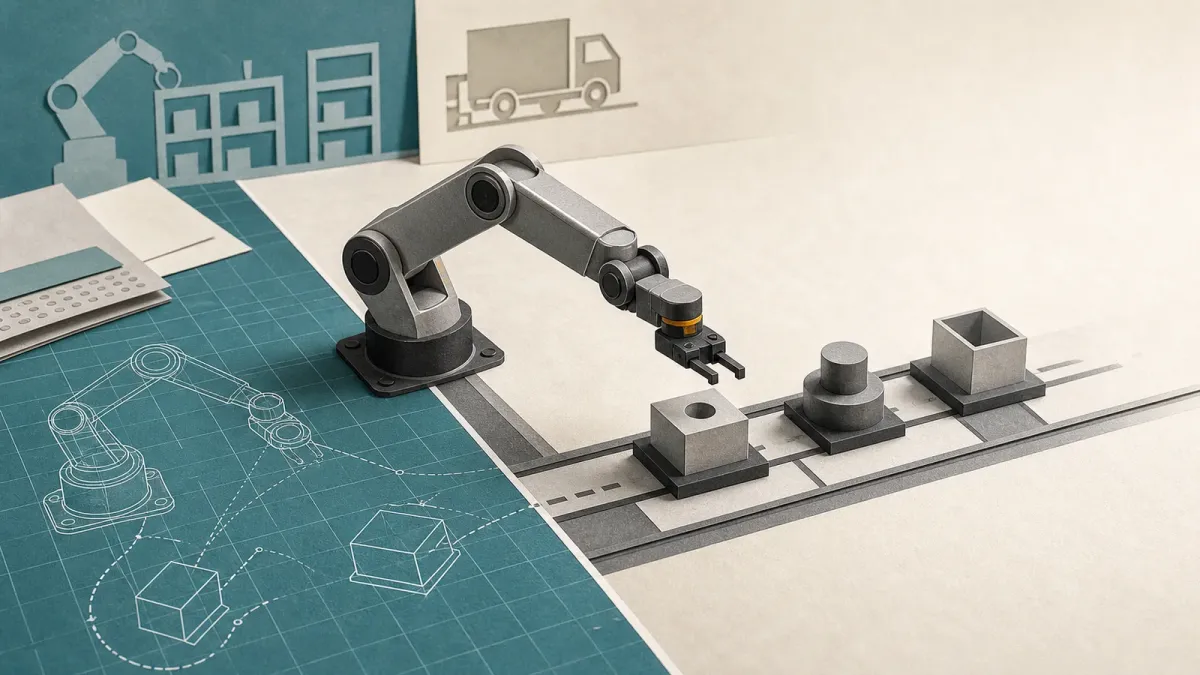
Fujitsu said on Thursday, July 16, 2026, that it has begun exploring physical AI development with Fanuc, Yaskawa Electric and Kawasaki Heavy Industries, using Nvidia technology to connect digital simulations with real-world robots and industrial systems.
The announcement matters because it points to a more concrete phase of the AI race: not just chatbots and office copilots, but machines that can sense, reason and act in factories, logistics networks, hospitals and other physical settings.
What changed
Fujitsu described the project as an effort to promote a collaborative control platform that bridges the digital and physical worlds. The company said it plans to use Nvidia Cosmos in socio-physical simulations and apply the work across manufacturing, logistics and health care.
Nvidia separately said Japanese robotics and manufacturing companies, including Fujitsu, Fanuc, Kawasaki Heavy Industries and Yaskawa Electric, intend to join its Cosmos Coalition to help build open physical AI models. Nvidia also introduced Cosmos 3 Edge, a 4-billion-parameter model meant to support on-device vision reasoning and robot policy deployment on edge computers.
The Associated Press reported from Tokyo that the effort brings together Nvidia's AI systems with Japanese robotics expertise. AP also noted an important caveat: the companies have not announced a joint venture, a detailed commercial rollout or a fixed timetable for when the first systems will be widely deployed.
What physical AI means
Physical AI is shorthand for AI systems that work with cameras, sensors, simulated environments and machines that move through the real world. In a factory, that could mean software that learns from digital twins before helping robots coordinate tasks. In logistics, it could mean better routing and handling. In health care, it could support hospital transport, nursing assistance or surgical support systems, depending on the application and safety approvals.
The key distinction is action. A chatbot can answer a question. A physical AI system may eventually help a robot inspect a part, move supplies, identify a workflow problem or adjust to a changing environment.
Why it matters
Japan has deep industrial robotics expertise and a long-running labor shortage tied partly to its aging population. That makes the country a natural test bed for AI systems that promise to make machines more adaptable without replacing every existing production line.
For Nvidia, the announcement is also a signal that its AI strategy is widening beyond data centers. If more robotics companies build on Nvidia models, chips and simulation tools, the company could gain influence over the software layer that turns industrial machines into AI-operated systems.
What to watch next
The next useful signals will be pilot projects, customer deployments, safety testing details and pricing. Until those arrive, the announcement is best read as a serious ecosystem move rather than proof that general-purpose AI robots are ready for everyday workplaces.
Readers should also watch whether the companies publish benchmarks or case studies that show reliability in messy environments. Physical AI will be judged less by demos than by whether it can operate safely, repeatedly and economically outside a lab.


